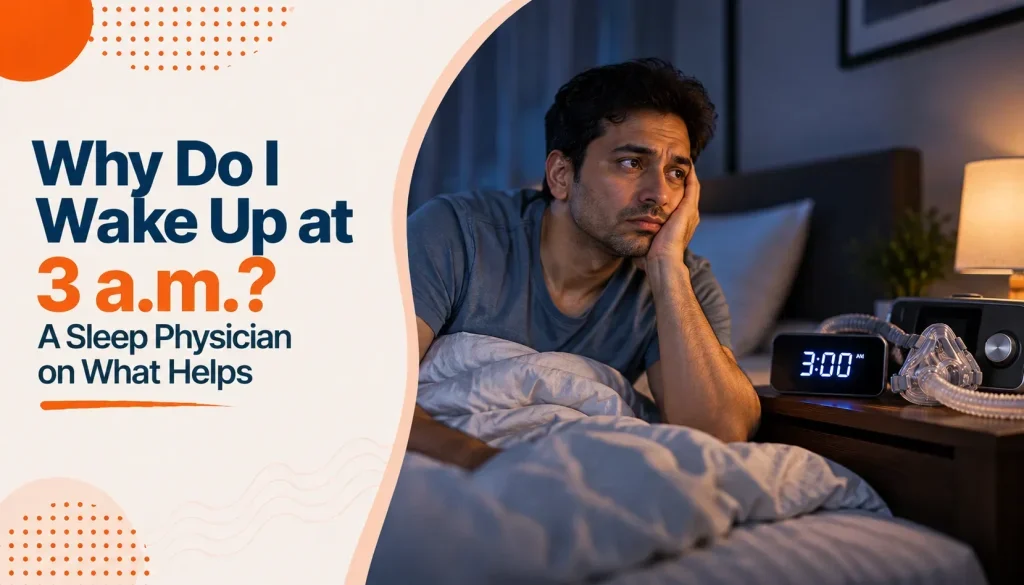
Why Do I Wake Up at 3 a.m.? A Sleep Physician on What Helps
By Yatin J. Patel, MD · Pulmonary and Sleep Physician
I was the only pulmonologist at Goshen Hospital for 25 years, almost all of my career. In those days, it was a 120-bed hospital in northern Indiana with a 10-bed ICU. Some nights I had a patient on a ventilator. The patient was stable. The nurse had not called. And still, at 3 a.m., I would be wide awake.
I knew why. Some part of me was still on duty. On those nights, I stayed in bed and practiced Yoga Nidra and cognitive behavioral therapy for insomnia (CBT-I). Sometimes sleep came back, sometimes it didn’t. But I always got the rest. My brain and my body always got the rest.
That was stress, and I could name it. Most people who type this question into a search bar have already decided their answer is stress too. Sometimes it is. But in 30 years of sleep medicine, I have learned that the clock on your nightstand cannot tell you why you woke up. The pattern around it can. Stress, insomnia, a full bladder, pain, a late glass of wine, and sleep apnea can all leave you staring at the ceiling in the small hours, and each one leaves different fingerprints.
This article walks through those fingerprints, so you can bring a clearer story to your doctor and get to the right answer sooner.
Why Do I Keep Waking Up at 3 a.m.?
Most people wake briefly several times a night. Those short arousals between sleep cycles are normal, and most of us do not remember them. The problem starts when you come all the way up and stay there.
The early-morning hours are a vulnerable stretch for two reasons. First, deep sleep is concentrated in the first half of the night. By 2 or 3 a.m., most of it is behind you, and what remains is lighter sleep with longer periods of REM, the dreaming stage. Lighter sleep breaks more easily. Second, your body is already getting ready for morning. Cortisol, the hormone that helps you wake up, begins its normal daily rise in the second half of the night and peaks around the time you get up. For most people, that rise is ordinary physiology, not a hormone problem. Put the two together and whatever is disturbing you has an easier time getting through at 3 a.m. than at midnight.
Common reasons people wake in the middle of the night include:
- Stress and a busy mind. You surface, a thought about work or family catches, and your brain starts running.
- Insomnia. Sleep doctors call it insomnia disorder when trouble falling or staying asleep happens at least three nights a week for three months and affects how you feel or function during the day.
- Low mood. Waking early and being unable to get back to sleep can go along with depression, which is worth mentioning to your doctor.
- Alcohol. A drink may help you fall asleep, but as your body clears it in the early-morning hours, sleep tends to fragment.
- Caffeine later in the day, which can stay in your system far longer than most people expect.
- An early body clock. If you also get sleepy very early in the evening, especially as you get older, a 3 or 4 a.m. wake-up may simply mean your clock has shifted earlier.
- Bathroom trips, pain, acid reflux, hot flashes, or the side effects of certain medications.
- The room itself: heat, light, noise, a restless partner, a pet, or a phone that lights up.
- Sleep apnea. This one is easy to miss, because the person it is happening to rarely sees it.
Could Sleep Apnea Be Waking You Up?
In obstructive sleep apnea, the muscles of the throat relax during sleep, the airway narrows, and sometimes it closes completely. Breathing stops or becomes very shallow. Oxygen drops. Your brain senses the trouble and pulls you out of sleep just far enough to reopen the airway, and then you drift off again. Most of these arousals are so brief you usually do not remember them. Some nights, one of them brings you all the way up, heart pounding, catching your breath.
There is a reason this so often happens in the early morning. REM is the stage of sleep with the most vivid dreams, and Mother Nature doesn’t want us to act out our dreams. So during REM, she leaves most of our muscles temporarily paralyzed. The diaphragm keeps breathing for us, but the muscles that hold the throat open go slack along with the rest. Breathing pauses during REM tend to last longer and pull oxygen lower. Because REM clusters in the later part of the night, many people with sleep apnea find that the hours around 3 a.m. are when they wake up gasping, or simply wake up and cannot settle.
Signs that point toward a breathing problem:
- Loud, regular snoring
- Waking up gasping, choking, or with a racing heart
- A partner who has watched you stop breathing
- Daytime sleepiness, especially dozing when you sit still
- Morning headaches or a very dry mouth
- Getting up more than once a night to urinate
- Waking unrefreshed even after a full night in bed
This is far from rare. The American Heart Association estimates that about one in three middle-aged men and about one in six middle-aged women meet the diagnostic criteria for obstructive sleep apnea, and that it often goes unrecognized [1].
It also does not always look like the textbook picture. In my clinic, I treated slim runners, fit retirees, and many women who never thought of themselves as snorers. A good number of those women came to me describing fatigue, poor sleep, and waking in the night after years of being told it was stress or menopause.
“Sleep apnea doesn’t care what your scale says.” — Yatin J. Patel, MD, CPAP Is Sexy
If this section sounds familiar, I wrote a book about what life can look like once sleep apnea is treated: more energy, clearer mornings, and sharing a bed with your partner again. Download Chapter 1 free at dryatinjpatel.com/chapter1.
How Can You Tell If It Might Be More Than Stress?
No single symptom can tell stress and sleep apnea apart, and the two often show up together. Poor sleep makes stress harder to handle, and stress makes sleep lighter. Insomnia and sleep apnea also overlap more than most people realize. In a sleep lab study of more than 1,300 people with insomnia, about one in seven turned out to have moderate-to-severe sleep apnea [2]. Still, the overall pattern usually leans one way.
| What you notice | More typical of stress or insomnia | More typical of a breathing problem |
|---|---|---|
| How you wake | Mind already racing with a worry | Gasping, choking, or heart pounding |
| What your partner hears | Tossing and turning | Snoring, then silence, then a snort |
| How mornings feel | Tired but wired | Heavy, foggy, sometimes a headache or dry mouth |
| Daytime | Tired, yet hard to nap | Dozing off in meetings, the recliner, or the car |
| Nights after a drink | Fall asleep faster, wake later | Louder snoring and more broken sleep |
Alcohol deserves a closer look. A review of 14 studies found that drinking before bed increased breathing events and lowered oxygen during sleep, and the effect was largest in people already diagnosed with sleep apnea [3].
None of these clues confirms a diagnosis on its own. Their value is in pointing you toward the right conversation with your doctor.
What Should You Do If You Keep Waking Up at Night?
Start by gathering the story. For two weeks, jot down a few lines each morning:
- What time you woke and how: drifting up, startled, or gasping
- What was on your mind when you woke
- When you had your last caffeine and your last drink
- Whether you got up to use the bathroom
- How you felt by mid-afternoon
Then ask the person who sleeps beside you. Partners often know things about our nights that we never will. I have had many spouses walk into my exam room and play a recording from their phone, and it told me more in 30 seconds than a long interview could. If your smartwatch has flagged possible sleep apnea, bring that along too. A flag is a reason to get checked, and it is not a diagnosis.
For nights driven mainly by a racing mind, sleep specialists usually start with habits rather than pills: keep the same wake time every day, turn the clock away from the bed, and let rest be enough. If you find yourself frustrated or fighting for sleep, get up, keep the lights low, and sit somewhere comfortable until you feel drowsy again. When insomnia persists, the American College of Physicians recommends CBT-I as the first treatment for adults [4].
If you are reading this at 3 a.m., I recorded a guided session for exactly this moment. It combines the CBT-I approach with Yoga Nidra, and your only job is to rest: Awake at 3 AM? Yoga Nidra & CBT-I with a Sleep Physician.
It makes sense to talk with a healthcare professional if:
- You are waking most nights for several weeks
- You wake gasping or choking, or someone has seen you stop breathing
- You feel sleepy during the day, especially behind the wheel
- Your blood pressure is hard to control, or you have atrial fibrillation that keeps returning
That last point matters. The American Heart Association recommends screening for sleep apnea in people with resistant or poorly controlled high blood pressure and in those whose atrial fibrillation recurs after treatment [1].
How Is Sleep Apnea Diagnosed?
It begins with a conversation: your sleep, your daytime energy, what your partner has noticed, and your medical history. If sleep apnea looks possible, the next step is a sleep study.
Many people can do this at home. You sleep in your own bed wearing a small device with a belt around your chest, a sensor on your finger for oxygen and heart rate, and a soft tube at the nose to measure airflow. Others are better served by an overnight study in a sleep lab, which records brain waves and sleep stages as well.
The main result is the apnea-hypopnea index, the average number of times per hour your breathing stops or becomes very shallow. Your doctor uses it, along with your oxygen levels and symptoms, to judge whether sleep apnea is present and how severe it is.
One practical point: if a home test comes back normal but you still feel unwell, say so. A home test can underestimate sleep apnea on a night when you sleep poorly or rarely lie on your back. I once had a patient whose home test was normal and whose in-lab study a few weeks later showed severe sleep apnea. She trusted her instinct, and so did I.
What If You Already Use CPAP?
Waking at 3 a.m. can happen on CPAP too, especially in the first few weeks. Some patients find the mask on the floor with no memory of taking it off.
“If you wake up at 3 a.m. and find the mask on the floor, just put it back on. Don’t get angry with yourself.” — Yatin J. Patel, MD, CPAP Is Sexy
Many people need a couple of weeks to get used to the mask. If the awakenings continue beyond that, the cause is often something that can be addressed:
- A leaking mask. Overtightening the straps tends to make leaks worse by distorting the seal.
- Dry mouth or a stuffy nose, which a humidifier adjustment or nasal care may help.
- Pressure that feels hard to breathe against. Many machines have an exhale-relief setting your clinic can turn on.
- The type of mask. A review of 13 studies found that, on average, full-face masks needed higher pressure, left more breathing events untreated, and were worn about 48 fewer minutes a night than nasal masks [5]. Some people truly need a full-face mask, so this is a question worth asking, not a rule.
Your machine records data every night, including leak and remaining events. Share it with your treating clinician or equipment provider, and let them make any pressure changes rather than adjusting settings yourself.
Download Chapter 1 of CPAP Is Sexy free at dryatinjpatel.com/chapter1.
Frequently Asked Questions
-
Why do I wake up at 3 a.m. every night?
By the early morning, most of your deep sleep is done, the sleep that remains is lighter, and your body’s cortisol is beginning its normal climb toward morning. That makes it easier for stress, alcohol, a full bladder, pain, or a breathing problem to wake you. Keeping a two-week log of how and when you wake is a good way to find the pattern.
-
Can sleep apnea cause nighttime awakenings?
-
Is waking up gasping for air a sign of sleep apnea?
-
Can stress cause repeated nighttime awakenings?
-
When should I seek medical advice for sleep disruptions?
-
What should I do if I keep waking up while using CPAP?
Conclusion
Waking at 3 a.m. is common, and the time itself tells you very little. What happens around it tells you much more: how you wake, what your partner hears, and how you feel the next afternoon. Stress is a frequent cause. A breathing problem is a frequent one too, and it is highly treatable once someone looks for it.
If your nights have been broken for a while, gather the story and take it to someone who can help you read it. Many of my patients told me they had no idea how tired they were until they finally slept through the night.
Read Chapter 1 of CPAP Is Sexy free at dryatinjpatel.com/chapter1.
References
- Yeghiazarians Y, et al. Obstructive Sleep Apnea and Cardiovascular Disease: A Scientific Statement From the American Heart Association. Circulation. 2021;144(3):e56–e67. https://
doi.org/10.1161/CIR. 0000000000000988 - Hein M, et al. Prevalence and risk factors of moderate to severe obstructive sleep apnea syndrome in insomnia sufferers: a study on 1311 subjects. Respir Res. 2017;18(1):135. https://doi.
org/10.1186/s12931-017-0616-8 - Kolla BP, et al. The impact of alcohol on breathing parameters during sleep: A systematic review and meta-analysis. Sleep Med Rev. 2018;42:59–67. https://doi.
org/10.1016/j.smrv.2018.05.007 - Qaseem A, et al. Management of Chronic Insomnia Disorder in Adults: A Clinical Practice Guideline From the American College of Physicians. Ann Intern Med. 2016;165(2):125–133. https://
doi.org/10.7326/M15-2175 - Andrade RGS, et al. Nasal vs Oronasal CPAP for OSA Treatment: A Meta-Analysis. Chest. 2018;153(3):665–674. https://
doi.org/10.1016/j.chest.2017. 10.044
This article is for general education and is not a substitute for personal medical advice. Please talk with your own healthcare professional about your symptoms.