Stay Awake.
Drive Safe.
A drowsy driving campaign I started in November 2000. It is still running.
Press and podcast inquiries:
The trucker who kept a pin in his cab
Big Jim had driven trucks for twenty-two years. When I asked him how he stayed awake on long hauls, he hesitated before he told me.
He kept a sharp pin in the cab. When his eyelids got heavy and the road started to blur, he stabbed himself through his jeans to jolt awake.
That was not his only method. On straight stretches he told himself it was safe to close his eyes for a few seconds. The road was not curving. Nothing could go wrong.
He also closed one eye at a time. A few minutes for the left, then a few for the right. He believed he was giving each eye the rest it needed while he kept driving.
Seventy thousand pounds, moving at highway speed, with a driver stabbing himself to stay conscious.
He had no idea he had sleep apnea. He thought he was just tired. He thought everyone felt this way.
You feel it. You just underrate it.
Here is what most people get wrong about this, including a lot of doctors.
You usually do know you are sleepy. The research is fairly clear on that. What fails is not the first judgment. It is the second one: how impaired am I right now, and can I finish this drive.
The AAA Foundation for Traffic Safety put drivers in a simulator in 2023 and tracked them on long drives. Among drivers who rated their own drowsiness as low, three out of four were actually moderately or severely drowsy. Even among drivers whose eyes were closed for fifteen seconds or longer within a single minute, one in four still believed they were fine.
Fifteen seconds of closed eyes at highway speed is nearly four football fields of road you did not see.
That is a simulator study, not crash data. What it measures is not how often people crash. It measures how badly we grade our own alertness once we are already tired. The body keeps driving long after the brain has clocked out.
Sleepiness does not hide from you. It edits your judgment about itself.
We also do not know how often this kills people, and that is its own problem. There is no breathalyzer for sleepiness. Police have to infer it from a scene: no skid marks, a clean drift out of the lane. The official federal figure attributes about two and a half percent of fatal crashes to drowsy driving. Studies that correct for how much of the data is simply marked unknown put the real figure somewhere between fifteen and thirty-three percent.
Roughly one in twenty-five adults says they have fallen asleep at the wheel in the past month. That one we can count, because we can just ask.
Why I started this
In the late 1990s, while I was practicing in Goshen, a truck driver fell asleep at the wheel and hit a police car stopped on the shoulder of a northern Indiana highway. A young officer serving his community was killed. A family was left without him. A community was shaken.
What stayed with me was that it did not have to happen.
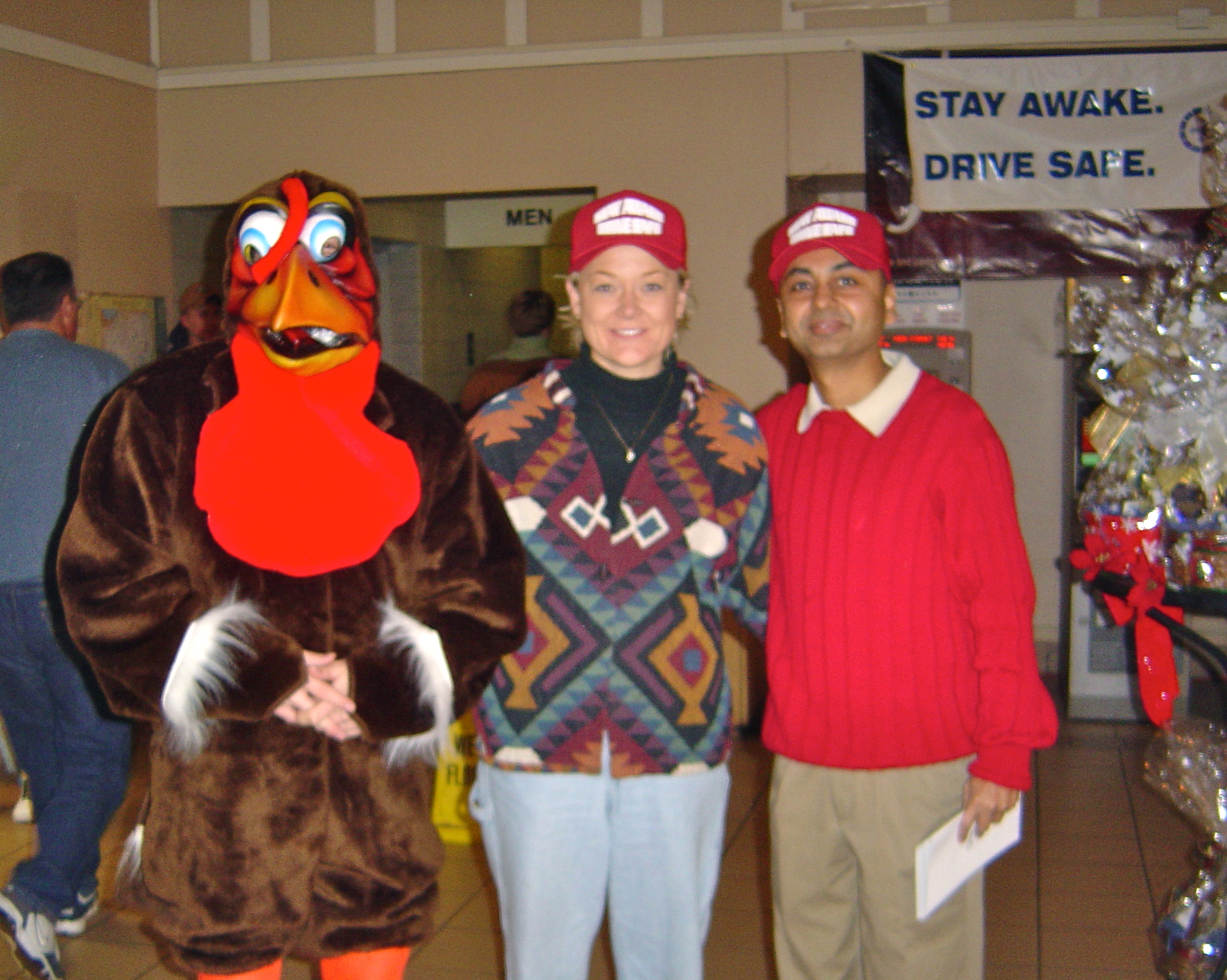
Diagnosing sleep apnea one patient at a time, inside my clinic walls, was no longer enough. So in November 2000, with my sleep center team and a handful of patients who cared as much as I did, we started Stay Awake, Drive Safe. We started small. By 2002 we had grown enough to put volunteers in front of holiday travelers before every major driving weekend.
Twenty-five years later we are still sending warnings before the holidays, still working with schools and employers, still on the radio and television and now social media, still trying to reach drivers before they get behind the wheel.
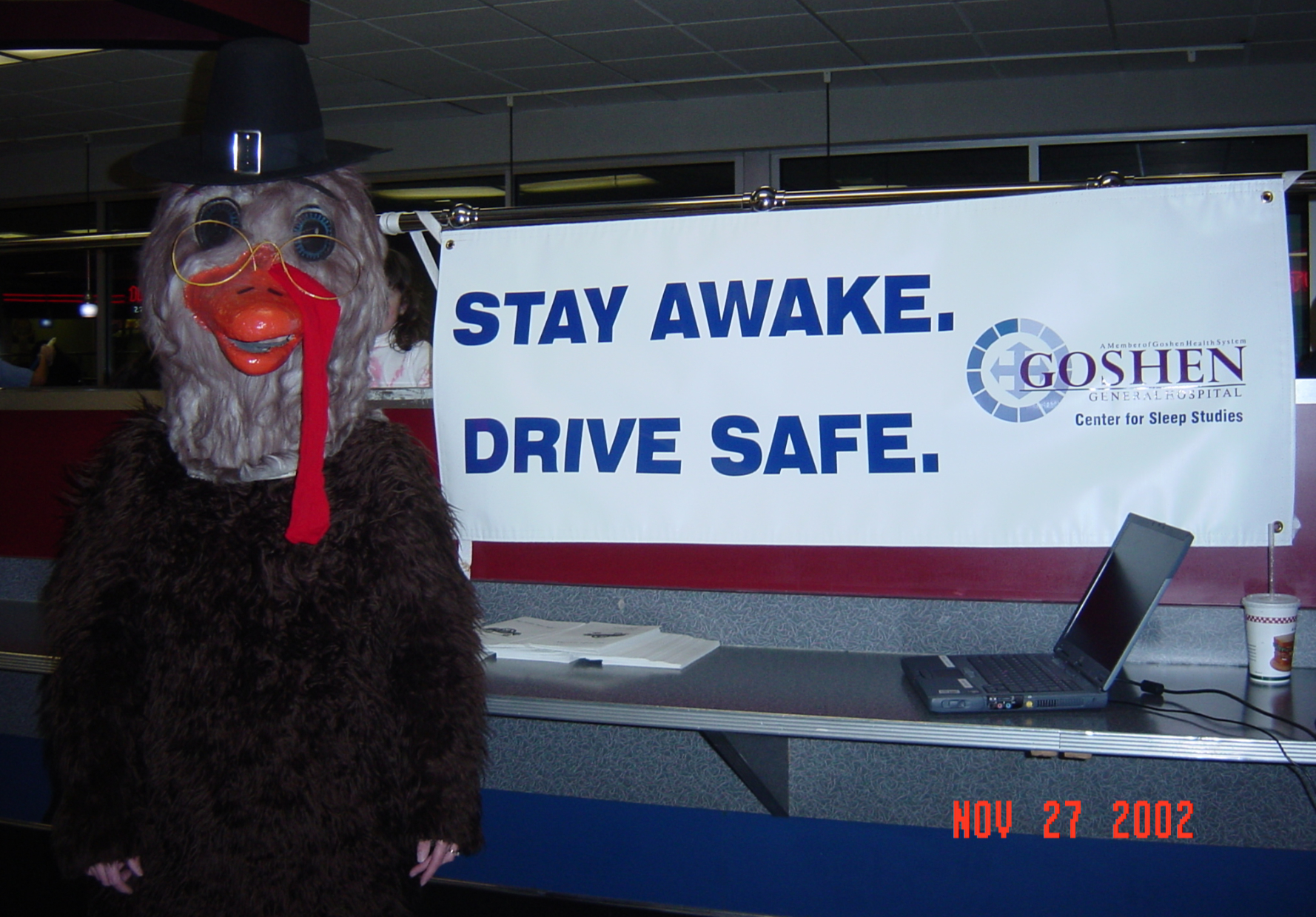
Thanksgiving, in the early years of the campaign. Laura Graber, our Director of Cardiopulmonary Services, and I traded off the turkey suit that night. Neither of us can say for certain who is in it here.
Ten Years. 170,000 Miles. Two Words on the Glass.
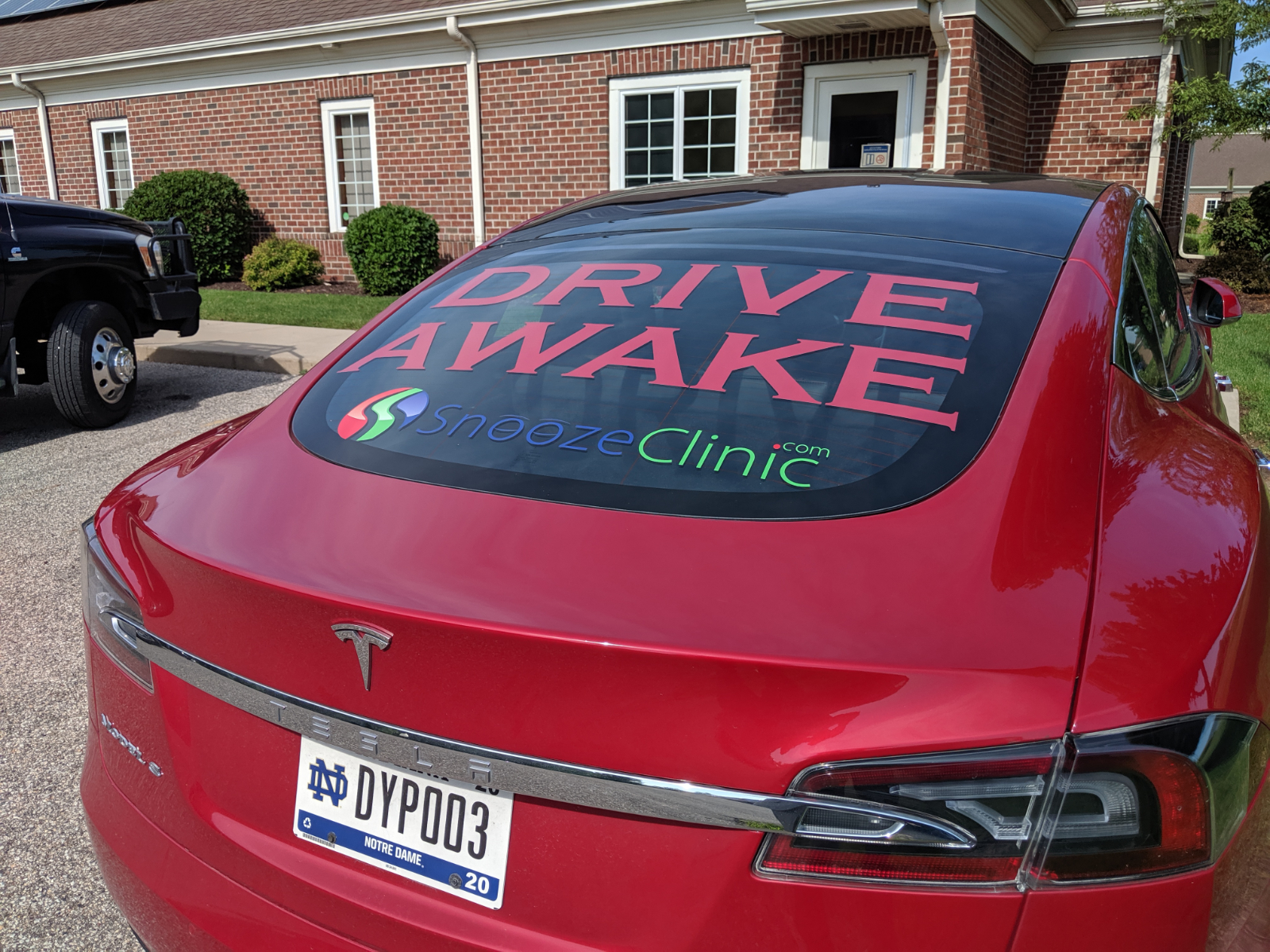
Ten years. 170,000 miles. The same two words on the back glass.
Ten years ago I had two words put on the back window of my car. DRIVE AWAKE. They are still there, through about 170,000 miles. Most of those miles were on Indiana roads. These days the car is on the Beltway, on I-95, on the roads around Maryland, Washington, and Virginia, saying the same thing to a different set of drivers.
People ask why. It is a fair question. I am a sleep physician. I could have put the clinic name up there and left it at that.
Here is the reason. For thirty years, patients sat down across from me and told me about the drive home. The stretch of road they do not remember. The rumble strip that brought them back. The exit they passed because they were gone for a few seconds and didn’t know it. These were not reckless people. They were tired people. Most of them had no idea their sleep was the problem.
You cannot hand a pamphlet to everyone on the highway. You can drive in front of them.
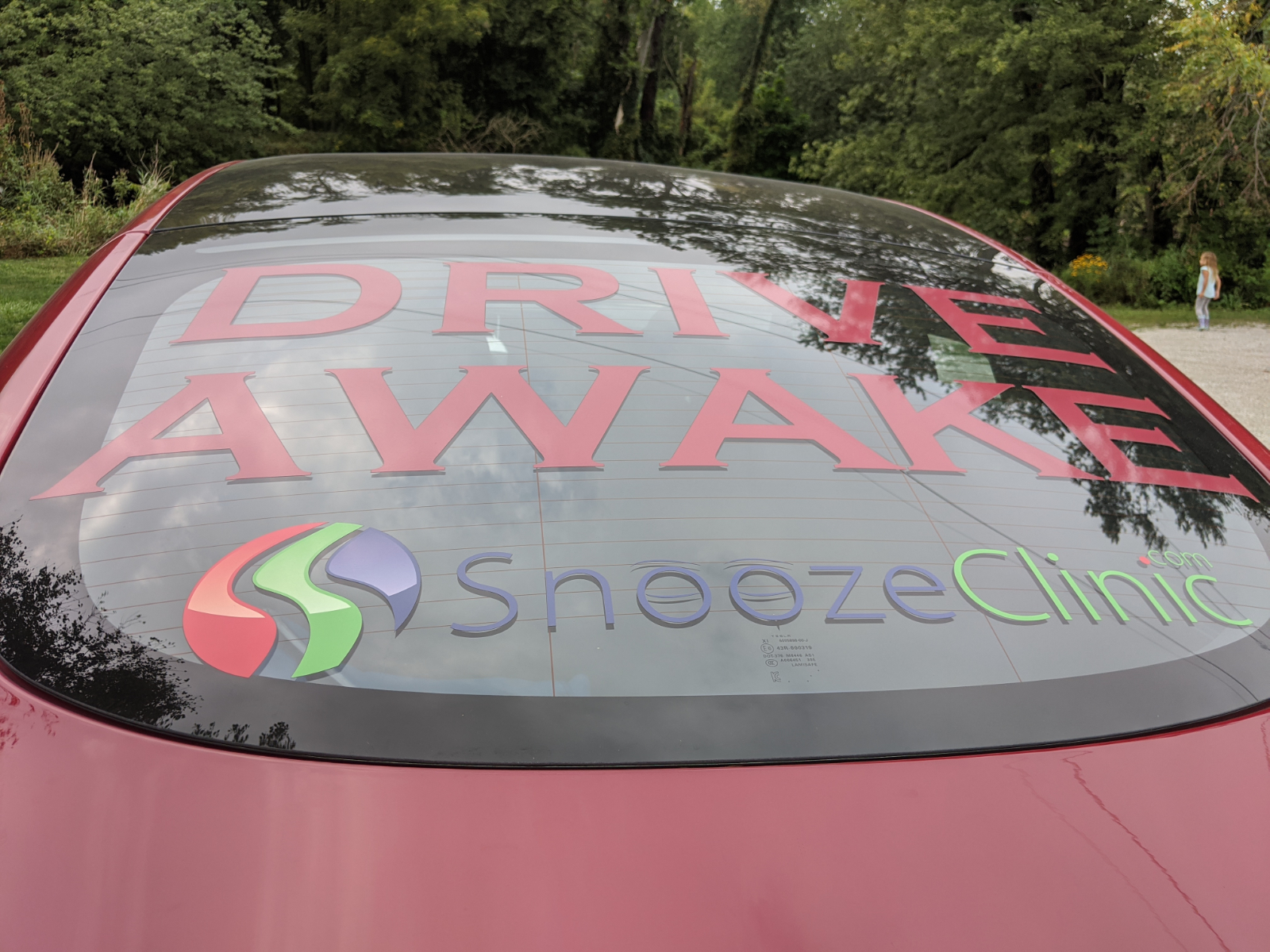
The message, up close. Every car behind me at the light reads it.
That is the whole idea, and it has not changed. Sleep well at night so you are awake for your life during the day. Awake at the wheel. Awake at dinner. Awake for the people who need you present. When something is getting in the way of your sleep, it is highly treatable, and the difference shows up in your daytime, not your night.
Two words. Ten years. Still on the glass.
We wrote that list a long time ago, before smartphones, before most people had heard the phrase drowsy driving. I went back and checked it against the research for this page. It still holds. Sleep deprivation. Night shift work. Untreated sleep apnea. Young drivers. The mid-afternoon dip and the stretch between midnight and six. Driving alone.
The original warning, still accurate
You run a higher risk of falling asleep while driving if you:
- Are sleep deprived
- Are a night shift worker
- Have untreated sleep apnea
- Are a young driver
- Are driving between midnight and 6 a.m.
- Are driving alone
The American Thoracic Society names most of that same list as its high-risk groups: short sleepers, shift workers, occupational drivers, adolescents. Nothing on our poster has been overturned. Several items have only gotten more evidence behind them.
Some of the hardest rooms I spoke to were inside the hospital. Nurses coming off a twelve, driving home at seven in the morning. Techs rotating between days and nights every few weeks. Health care runs on people whose schedules fight their own biology, and the drive home is where that bill comes due. Most of that room checked more than one box on the poster behind me.
The work is not finished.
Free Preview
Get Chapter 1 Free
It is the chapter Big Jim is in.
"*" indicates required fields
Privacy Note: We’ll never share your email. Unsubscribe anytime.
What actually helps, and for how long
Coffee helps. In one study, drivers who had caffeine within two hours of driving had about half the crash risk. Pulling into a rest stop helped by about the same amount. Both are real, and I want to be honest that they work, because telling people otherwise gets you ignored.
Here is the part nobody mentions. The benefit is brief. After a break, performance climbs back to where it was before the break within about forty minutes.
So use them for what they are. Coffee and a rest stop are how you get somewhere safe. They are not how you finish the trip.
The only thing that resets sleepiness is sleep. Twenty minutes parked in a legal, safe spot does more than four hours of willpower.
And if you are planning a long drive, most of the work happens the night before, not on the road.
When it is not about last night
Some people do everything right and still cannot stay alert.
Seven hours in bed. No alcohol. No night shift. And they still fight their eyelids at two in the afternoon, still lose the last twenty minutes of the drive home, still get told by their spouse that they were snoring in the passenger seat.
That is not a discipline problem. That is a medical one.
Obstructive sleep apnea interrupts breathing dozens of times an hour, all night, every night. Each interruption pulls the brain out of deep sleep to reopen the airway. You do not remember any of it. You wake up believing you slept fine, and you spend the day paying for a night you have no memory of.
It is common. It is missed constantly. And it is highly treatable.
It also shows up in the crash data. In a long-running cohort study, people with severe sleep apnea had more than double the risk of a motor vehicle crash. People sleeping six hours or less had about a third more risk. Those are associations from an observational study rather than proof of cause, but they point the same direction as everything else.
The American Thoracic Society makes a strong recommendation for CPAP treatment in confirmed sleep apnea specifically to reduce driving risk. Not for your blood pressure. Not for your heart. For the drive.
If you snore. If you wake up tired. If your partner says you stop breathing. If you are falling asleep when you should not be.
Get tested. Do not disqualify yourself because you do not look like the cartoon.
The drive you get back
When Big Jim came in for his follow-up after starting treatment, he did not talk about his blood pressure or his oxygen levels, though both had changed.
He said: “Doc, I don’t need the pin anymore.”
That is what this campaign has always been about. Not the crash that was avoided, because you never get to see that one. The ordinary drive home that stops being something you have to survive.
The commute you remember all of. The road trip where you are the one who offers to drive. The Thanksgiving night when everyone gets there.
That is on the other side of a diagnosis most people never get.
Free Preview
Get Chapter 1 Free
It is the chapter Big Jim is in.
"*" indicates required fields
Privacy Note: We’ll never share your email. Unsubscribe anytime.
If you cover this, I want to hear from you
I have been working on drowsy driving since 2000, and the single most useful thing I can do now is help other people tell the story. If you are a reporter, a producer, a podcast host, or an editor, write to me. I will make time.
An American Board of Internal Medicine diplomate for thirty years, board certified in pulmonary disease and sleep medicine. Thirty years in practice. Founded the Stay Awake, Drive Safe campaign in 2000 and have run it every holiday season since.
Things I can speak to on short notice:
- Why federal drowsy driving crash counts are almost certainly too low, and what the corrected estimates show
- The holiday travel window, and why Thanksgiving and Christmas week are different from the rest of the year
- What in-car drowsiness detection can and cannot do, and what to make of the accuracy numbers
- Sleep apnea and driving risk, including what the American Thoracic Society actually recommends
- Why hospitals and health systems have a drowsy driving problem in their own parking lots
- Teen drivers, night shift workers, and long-haul truckers
- The daytime cost of a bad night: alertness, mood, memory, and presence
Remote-ready by Zoom or Riverside from the Washington, DC area. Available in studio in the DC market, and in northern Indiana with notice.
Twenty-five years of campaign photography is available to newsrooms on request, including dated material from the early 2000s.
References
- Cai AWT, Manousakis JE, Lo TYT, et al. I think I’m sleepy, therefore I am: awareness of sleepiness while driving. A systematic review. Sleep Medicine Reviews. 2021;60:101533. doi:10.1016/j.smrv.2021.101533
- Gaspar JG, Carney C. Drowsiness and Decision Making During Long Drives: A Driving Simulation Study. AAA Foundation for Traffic Safety; March 2023.
- Dawson D, Reynolds AC, Van Dongen HPA, Thomas MJW. Determining the likelihood that fatigue was present in a road accident: a theoretical review and suggested accident taxonomy. Sleep Medicine Reviews. 2018;42:202-210. doi:10.1016/j.smrv.2018.08.006
- Mukherjee S, Patel SR, Kales SN, et al. An official American Thoracic Society statement: the importance of healthy sleep. American Journal of Respiratory and Critical Care Medicine. 2015;191(12):1450-1458. doi:10.1164/rccm.201504-0767ST
- Tefft BC. Prevalence of motor vehicle crashes involving drowsy drivers, United States, 1999-2008. Accident Analysis and Prevention. 2012;45:180-186. doi:10.1016/j.aap.2011.05.028
- Wheaton AG, Shults RA, Chapman DP, Ford ES, Croft JB. Drowsy driving and risk behaviors: 10 states and Puerto Rico, 2011-2012. MMWR Morbidity and Mortality Weekly Report. 2014;63(26):557-562.
- Cummings P, Koepsell TD, Moffat JM, Rivara FP. Drowsiness, counter-measures to drowsiness, and the risk of a motor vehicle crash. Injury Prevention. 2001;7(3):194-199. doi:10.1136/ip.7.3.194
- Gaspar J, Tefft B, Carney C, Horrey WJ. The impact of self-initiated breaks during drowsy driving. Sleep. 2025;zsaf150. doi:10.1093/sleep/zsaf150
- Gottlieb DJ, Punjabi NM. Diagnosis and management of obstructive sleep apnea: a review. JAMA. 2020;323(14):1389-1400. doi:10.1001/jama.2020.3514
- Gottlieb DJ, Ellenbogen JM, Bianchi MT, Czeisler CA. Sleep deficiency and motor vehicle crash risk in the general population: a prospective cohort study. BMC Medicine. 2018;16(1):44. doi:10.1186/s12916-018-1025
- Strohl KP, Brown DB, Collop N, et al. An official American Thoracic Society clinical practice guideline: sleep apnea, sleepiness, and driving risk in noncommercial drivers. American Journal of Respiratory and Critical Care Medicine. 2013;187(11):1259-1266. doi:10.1164/rccm.201304-0726ST
Written and reviewed by Yatin J. Patel, MD, board-certified in pulmonary medicine and sleep medicine.
Nothing on this page is medical advice, and reading it does not create a physician and patient relationship between you and the author. Talk to your own doctor about your own sleep.
Yatin J. Patel, MD
Sleep Physician. Creator of the AEI∞ Framework.
Founder, Stay Awake, Drive Safe, since 2000.