Obstructive Sleep Apnea in Adults: What You Need to Know
You slept eight hours. You woke up tired anyway.
Or you did not, and you are only reading this because someone who sleeps next to you asked you to.
Most of the patients I saw in thirty years of practice did not make their own appointment. Their wife made it. They sat down, folded their arms, and told me some version of the same three sentences: I do not have a problem. I do not even snore. I am tired, but I work a lot.
Here is the thing. They were usually telling me the truth about what they could observe. You are unconscious for the entire event. There is no pain, no alarm, no moment you can point to. The most common symptom of sleep apnea in adults is no symptom at all.
So the diagnosis rarely starts with a symptom. It starts with somebody else noticing, or with a number on a test.
Here is what sleep apnea in adults actually looks like, why it hides so well, how it gets found, and what comes back when it is treated.
What Is Sleep Apnea in Adults?
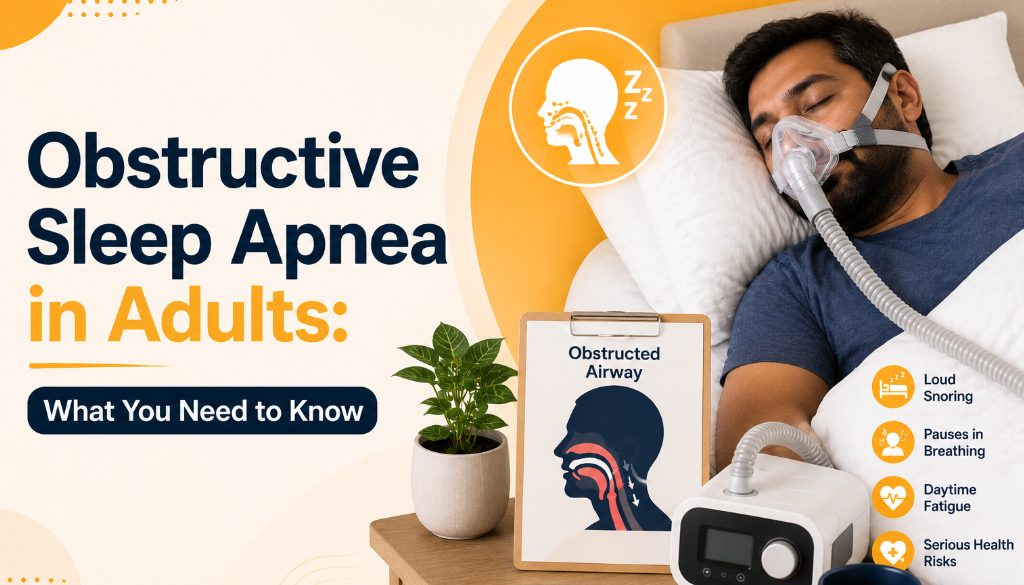
Obstructive sleep apnea is a breathing disorder of sleep. The muscles that hold your throat open relax when you fall asleep, the airway narrows or collapses, and airflow stops or drops for ten seconds or longer. Oxygen falls. The brain notices, sends a jolt of adrenaline, opens the airway, and you take a gasping breath. You rarely remember it.
Then it happens again. In moderate disease, it happens fifteen to thirty times an hour. In severe disease, thirty times an hour or more. All night, every night, for years.
That is the part people miss. Sleep apnea is not really about snoring -though understanding the distinct clinical difference between sleep apnea and snoring is key to determining if you are experiencing genuine airway closure. It is about a night that never gets to do its job. You spend eight hours in bed and get very little actual rest, because rest requires stretches of uninterrupted sleep that the airway keeps taking away.
This is common. A 2025 systematic review put the number of American adults with obstructive sleep apnea near eighty-four million, roughly one in three adults, with about forty million in the moderate-to-severe range where the consequences for the heart and brain are clearest. About half of the total is mild.
Common Symptoms of Sleep Apnea in Adults
Before the list, the honest caveat that belongs in front of it.
Plenty of people with obstructive sleep apnea report no symptoms whatsoever. Among people identified through general population screening, a large share do not report excessive sleepiness at all, and people with existing cardiovascular disease frequently report none of the classic picture. That is not denial. It is the nature of a condition you sleep through.
Three reasons the symptom check fails:
- You are asleep for the event. Nobody has a memory of not breathing.
- Tiredness always has a better explanation available. Work. Age. Kids. A long week. Every one of those is true, which is what makes it so easy to stop there.
- The decline is slow. Nobody wakes up one morning with half their energy gone. It leaves over years, and you recalibrate as it goes, so there is no before-and-after to compare against.
Snoring is not the entry requirement, either. Habitual snoring is present in most people who have sleep apnea, but plenty of people snore without it, and some people have significant disease without much noise at all. “I do not snore” is worth knowing. It is not a negative test.
The two symptoms everyone knows are snoring and daytime sleepiness. The most commonly reported symptom is actually simpler than either: sleep that does not refresh you.
Nighttime signs:
- Loud, habitual snoring, often with pauses
- Gasping or choking on waking, which is the single most reliable clue on history
- Witnessed pauses in breathing, though a partner reports these in only a minority of cases
- Waking to urinate more than once
- Nighttime reflux
- Frequent awakenings with no obvious cause
Daytime signs:
- Excessive sleepiness, or fatigue without frank sleepiness
- Morning headache, a bilateral pressure that fades within a few hours of waking
- Difficulty concentrating, word-finding trouble, a short fuse
- Low mood or anxiety that does not respond well to treatment
- Falling asleep in front of the television, in meetings, at red lights
Sleep Apnea Symptoms in Men and Women Are Not the Same
To learn why clinical bias has historically underdiagnosed female patients, read our complete guide on why sleep apnea looks different in women and how unique symptoms like insomnia get misdiagnosed for years. This matters more than almost anything else on this page.
| More typical presentation | |
|---|---|
| Men | Loud snoring, witnessed apneas, classic daytime sleepiness, an elbow in the ribs from a partner |
| Women | Fatigue rather than sleepiness, insomnia, morning headache, anxiety, low mood, nonrestorative sleep |
Women often arrive describing insomnia and exhaustion, not snoring. The textbook picture in most clinicians’ heads is the heavyset man who stops breathing, so the woman gets worked up for something else. In the Wisconsin Sleep Cohort analysis, men were referred for sleep studies roughly eight times more often than women with comparable symptoms. That gap has narrowed to about five to one, but it has not closed. The symptoms were never fundamentally different. The recognition was.
Two more numbers are worth knowing on this side. Among more than a thousand patients being treated for chronic insomnia at a sleep clinic, close to eighty percent turned out to have undiagnosed obstructive sleep apnea. Their problem was not that they could not sleep. It was that they could not breathe. And in a large Swiss population study using full home sleep testing, moderate-to-severe sleep apnea was found in about one in twelve premenopausal women and closer to one in three after menopause.
Why Sleep Apnea Often Goes Undiagnosed in Adults
In population surveys, somewhere between eighty and ninety-five percent of people with clinically significant obstructive sleep apnea arrive at screening with no diagnosis on record. The undiagnosed skew toward women, toward minority patients, and toward people without steady primary care.
Five reasons this happens:
- You are asleep for the symptom. There is nothing to report.
- Fatigue does not feel like a medical complaint. It feels like life, so it does not come up in a fifteen-minute visit.
- Every symptom has a competing explanation you already believe. Long hours. Fifty. Allergies. A bad mattress.
- There is no physical exam finding that makes the diagnosis. A completely normal throat exam does not rule it out.
- There is no routine screening program. The U.S. Preventive Services Task Force has said the evidence is insufficient to recommend screening adults with no symptoms, so it falls to the patient or the clinician to raise it.
Nobody is at fault here. It is a quiet condition in a hurried system.
But it does change who gets to raise it. If the person who sleeps three feet away from you has been telling you that something is wrong at night, that is not nagging. It is the only direct observation of your sleep that exists. You cannot make it yourself.
What Causes Sleep Apnea in Adults?
Sleep apnea comes down to anatomy and muscle tone. Anything that makes the throat smaller at rest, or makes it more collapsible when the muscles relax, moves you toward it.
The main contributors:
- Fat deposition in the tongue and the walls of the throat, which narrows the airway from the inside
- A long soft palate, large tonsils, or a small or set-back lower jaw
- Nasal obstruction, which increases the suction pressure needed to move air
- Loss of muscle tone in the airway with age
- Loss of progesterone after menopause, which had been helping keep upper airway muscles active
Alcohol, benzodiazepines, and opioids make existing apnea worse by deepening muscle relaxation. They do not cause the condition on their own. If you drink in the evening, the effect is measurable: pooled trial data show that evening alcohol adds roughly seven breathing events an hour in people who already have sleep apnea, about a one-third increase in a single night.
Sleep Apnea Risk Factors in Adults
- Excess weight, the most important modifiable risk factor. Weight gain narrows the airway; weight loss widens it.
- Male sex, which carries a substantially higher prevalence than in women.
- Age forty to seventy.
- Postmenopausal status.
- Neck circumference above seventeen inches in men or sixteen in women, which predicts risk even after accounting for overall body weight.
- Craniofacial structure, including a recessed jaw or narrow throat. This is why roughly one in five people with sleep apnea are not overweight at all, and why severe disease is common in Asian populations at normal body weight.
- Family history, which roughly doubles risk in first-degree relatives, raising the crucial question of whether your airway structure and genetics are setting your risk baseline.
- Smoking and chronic nasal congestion.
- Black, Hispanic, and Native American race and ethnicity.
- Hypothyroidism and acromegaly.
You will notice that several of these are things you cannot change. That is fine. The treatment does not require you to change them.
How Sleep Apnea Affects Daily Life
Start with the day, because that is where you live.
Untreated sleep apnea is associated with a two- to three-fold higher risk of cardiovascular and metabolic disease, including hypertension, atrial fibrillation, heart failure, coronary disease, type 2 diabetes, and stroke. Among people with resistant hypertension, atrial fibrillation, or type 2 diabetes, the majority have sleep-disordered breathing. Untreated sleep apnea roughly doubles stroke risk overall, and in men with the severe form, it comes close to quadrupling it. It is linked to about a twenty-six percent higher risk of cognitive impairment and dementia. In severe, untreated disease, all-cause mortality runs about sixty percent higher. Mild disease does not carry that signal.
Those numbers set the stakes. They are not the point.
The point is the ordinary stuff. Driving is a good example. In an AAA Foundation simulator study, three out of four drivers who rated themselves barely tired were in fact moderately or severely drowsy, and one in four had their eyes closed for fifteen seconds or more in a single minute while still believing they were fine. Your body keeps driving long after your brain has clocked out, and you are the last person qualified to judge it.
Then there is intimacy, which almost nobody brings up, and almost everybody is thinking about. Up to seven in ten men with moderate-to-severe sleep apnea report sexual problems. In a UK Biobank cohort of more than 155,000 men followed for about twelve years, it was not the snoring that predicted erectile dysfunction. It was the daytime sleepiness, which is precisely the thing treatment fixes. Women with sleep apnea are about two and a half times more likely to report sexual difficulty, most often low desire and trouble with arousal.
And mood. In a sleep-clinic cohort in Western Australia, three months of faithful CPAP use dropped average depression scores from clinically depressed to barely a trace, while antidepressant prescriptions stayed unchanged. Only the breathing changed.
That is the frame I want you to hold. This is not a list of things being taken from you. It is a list of recoverable things.
If you want the longer version of that argument, I put it in the first chapter of my book. You can read it free at dryatinjpatel.com/chapter1.
How Sleep Apnea Is Diagnosed in Adults
The diagnosis rests on a sleep study, which produces a number called the apnea-hypopnea index, or AHI: the average number of breathing events per hour of sleep.
Diagnostic criteria:
- AHI of 5 or more per hour with symptoms such as sleepiness, fatigue, or unrefreshing sleep
- AHI of 15 or more per hour regardless of symptoms
Severity bands: mild is 5 to 14, moderate is 15 to 29, and severe is 30 or more.
There are two ways to get that number.
| In-lab polysomnography | Home sleep apnea test | |
|---|---|---|
| Setting | Sleep laboratory, overnight, technologist present | Your own bed, portable recorder |
| What it measures | Brain waves, eye movement, muscle activity, airflow, effort, oxygen, heart rhythm, leg movement | Airflow, respiratory effort, oxygen, heart rate |
| Best for | Complex or unclear cases | Suspected moderate-to-severe apnea, otherwise healthy |
| Limits | Cost, wait time, sleeping in an unfamiliar place | Sensitivity around eighty percent; can confirm but cannot rule out |
| Not appropriate when | Rarely inappropriate | Heart failure, stroke, neuromuscular disease, chronic opioid use, significant lung disease |
The American College of Physicians recommends a sleep study for adults with unexplained daytime sleepiness once other causes, such as thyroid disease, reflux, and other respiratory conditions, have been considered, with polysomnography as the standard and a home test as a reasonable alternative when polysomnography is not available, and there are no serious comorbidities.
Before the study, many clinicians use the STOP-BANG questionnaire, which is the most sensitive screening tool available. It is eight quick yes-or-no questions about snoring, tiredness, observed apneas, blood pressure, body mass index, age, neck size, and sex. It is a screen, not a diagnosis. A high score means test, not treat.
If a home test comes back negative and your symptoms are still unexplained, push for the in-lab study. A negative home test is not a clean bill of health.
Treatment Options for Adults With Sleep Apnea
Sleep apnea is highly treatable. Treatment is recommended for everyone with an AHI of 15 or higher, and for people in the 5 to 14 range who have symptoms or relevant conditions such as hypertension, ischemic heart disease, or prior stroke.
| Option | How it works | Best suited for | What to know |
|---|---|---|---|
| Positive airway pressure (CPAP) | Gentle air pressure holds the airway open | Any severity, first-line for moderate and severe | Most effective at reducing AHI. Modern machines are quiet, small, and far easier than the ones people remember. Fit and follow-up drive success. |
| Mandibular advancement device | Custom dental appliance holds the lower jaw forward | Mild to moderate disease, or CPAP intolerance | Less reduction in AHI than PAP, but easier for some to use consistently. Needs a qualified dentist. |
| Hypoglossal nerve stimulation | Implanted device that activates the tongue muscle with each breath | Selected patients within a body mass index range who cannot tolerate PAP | Surgical implant; careful patient selection required |
| Upper airway surgery | Removes or repositions obstructing tissue or bone | Specific anatomy, or patients who decline other options | Results vary with anatomy. Worth a specialist evaluation rather than a first move. |
| Weight loss, positional therapy, alcohol timing | Reduces airway loading and collapsibility | Real effect, slower arrival. Not a substitute for treating moderate or severe disease now. | |
Two honest notes.
First, adherence is where treatment succeeds or fails. Roughly three in four patients use PAP consistently, and the ones who use it most gain the most. In one multicenter study of 123 men, three months on CPAP dropped reported arousal problems from nearly half to almost none, and low desire from about seven in ten to roughly one in three, with the largest gains in the men who wore it longest each night.
Second, randomized trials have not yet demonstrated a mortality benefit for any sleep apnea treatment. What they do show, consistently, is better daytime sleepiness, better blood pressure, and better quality of life. I tell patients the truth: I cannot promise you extra years. I can tell you what usually comes back in the ones you have.
When Should Adults See a Sleep Specialist?
Bring it up if you have any of the following:
- Unexplained sleepiness, fatigue, or sleep that never refreshes you
- Snoring with pauses, or gasping awake
- Waking more than once a night to urinate, or nighttime reflux
- Morning headaches
- Insomnia that has not responded to the usual approaches, particularly if you are a woman
- Blood pressure that will not come down on multiple medications
- Atrial fibrillation, especially recurrent after treatment
- A job that involves driving
- Ongoing symptoms despite being on CPAP already, which is a reason for a full in-lab evaluation rather than a reason to quit
You do not need to be certain. You need to ask the question out loud in a room with someone who can order the test.
Frequently Asked Questions
-
Can you have sleep apnea if you are not overweight?
Yes. Roughly one in five people with obstructive sleep apnea are not obese. Jaw position, tongue size, and throat shape can produce significant disease at a normal weight.
-
Does snoring always mean sleep apnea?
-
Can sleep apnea be cured?
-
Does treating sleep apnea lower heart risk?
-
How long until I feel better?
-
Are the machines still loud and awkward?
Conclusion
Sleep apnea in adults is common, frequently missed, and highly treatable. That combination is unusual in medicine, which is why we created a comprehensive sleep apnea symptoms, causes, and treatment guide to help you navigate every step of your health journey – making this well worth ten minutes of your attention.
You do not have to accept that this is just what fifty feels like. There is a version of you that your family has not seen in a while. He is not gone. She is not gone. They are just not sleeping.
Start with the first chapter. It is free at dryatinjpatel.com/chapter1, and it will tell you whether the rest of the book is for you.
Yatin J. Patel, MD, Sleep Physician. Creator of the AEI∞ Framework.
References
- Veasey SC, Rosen IM. Obstructive sleep apnea in adults. N Engl J Med. 2019;380(15):1442-1449.
- American Psychiatric Association. Diagnostic and Statistical Manual of Mental Disorders. 5th ed, text revision. American Psychiatric Association Publishing; 2022.
- Sönmez I, et al. Unmasking obstructive sleep apnea: estimated prevalence and impact in the United States. Respir Med. 2025;248:108348.
- Gottlieb DJ, Punjabi NM. Diagnosis and management of obstructive sleep apnea: a review. JAMA. 2020;323(14):1389-1400.
- Terry DP, Grashow R, Creager C, et al. Sleep apnea screening and neuropsychiatric symptoms in former professional American-style football players. Neurology. 2026;106(9):e214922.
- Wisconsin Sleep Cohort analysis of sex differences in sleep study referral.
- Krakow B, et al. Sleep and Human Health Institute. Undiagnosed obstructive sleep apnea in chronic insomnia patients.
- Heinzer R, et al. HypnoLaus population study, Lausanne. Prevalence of sleep-disordered breathing by menopausal status.
- Yeghiazarians Y, Jneid H, Tietjens JR, et al. Obstructive sleep apnea and cardiovascular disease: a scientific statement from the American Heart Association. Circulation. 2021;144(3):e56-e67.
- US Preventive Services Task Force, Mangione CM, Barry MJ, et al. Screening for obstructive sleep apnea in adults: US Preventive Services Task Force recommendation statement. JAMA. 2022;328(19):1945-1950.
- Yeghiazarians Y, Jneid H, Tietjens JR, et al. Circulation. 2021;144(3):e56-e67.
- Cowie MR, Linz D, Redline S, Somers VK, Simonds AK. Sleep disordered breathing and cardiovascular disease: JACC state-of-the-art review. J Am Coll Cardiol. 2021;78(6):608-624.
- Kolla BP, Foroughi M, Saeidifard F, Chakravorty S, Wang Z, Mansukhani MP. The impact of alcohol on breathing parameters during sleep: a systematic review and meta-analysis. Sleep Med Rev. 2018;42:59-67.
- Yaggi HK, Concato J, Kernan WN, Lichtman JH, Brass LM, Mohsenin V. Obstructive sleep apnea as a risk factor for stroke and death. N Engl J Med. 2005;353(19):2034-2041.
- Lal C, Ayappa I, Ayas N, et al. The link between obstructive sleep apnea and neurocognitive impairment: an official American Thoracic Society workshop report. Ann Am Thorac Soc. 2022;19(8):1245-1256.
- Wang X, Ouyang Y, Wang Z, Zhao G, Liu L, Bi Y. Obstructive sleep apnea and risk of cardiovascular disease and all-cause mortality: a meta-analysis of prospective cohort studies. Respirology. 2016;21(6):1038-1044.
- Cher J, Gaspar J, Carney C. Drowsiness and Decision Making During Long Drives. AAA Foundation for Traffic Safety; 2023.
- Liu L, Kang R, Zhao S, et al. Sexual dysfunction in patients with obstructive sleep apnea: a systematic review and meta-analysis. J Sex Med. 2015;12(10):1992-2003.
- Liang J, et al. Daytime sleepiness, sleep-disordered breathing, and incident erectile dysfunction in the UK Biobank cohort. Sci Rep. 2026.
- Cai T, et al. Association between obstructive sleep apnea and female sexual dysfunction: a systematic review and meta-analysis. Arch Gynecol Obstet. 2025.
- Western Australia sleep clinic cohort. Depression scores before and after three months of CPAP therapy (n=426).
- Gawrys B, Silva TW, Herness J. Obstructive sleep apnea in adults: common questions and answers. Am Fam Physician. 2024;110(1):27-36.
- Qaseem A, Dallas P, Owens DK, et al. Diagnosis of obstructive sleep apnea in adults: a clinical practice guideline from the American College of Physicians. Ann Intern Med. 2014;161(3):210-220.
- Reishtein J, et al. Sexual function before and after three months of CPAP therapy in men with obstructive sleep apnea. Drexel University / University of Pennsylvania.
- Holder S, Narula NS. Common sleep disorders in adults: diagnosis and management. Am Fam Physician. 2022;105(4):397-405.