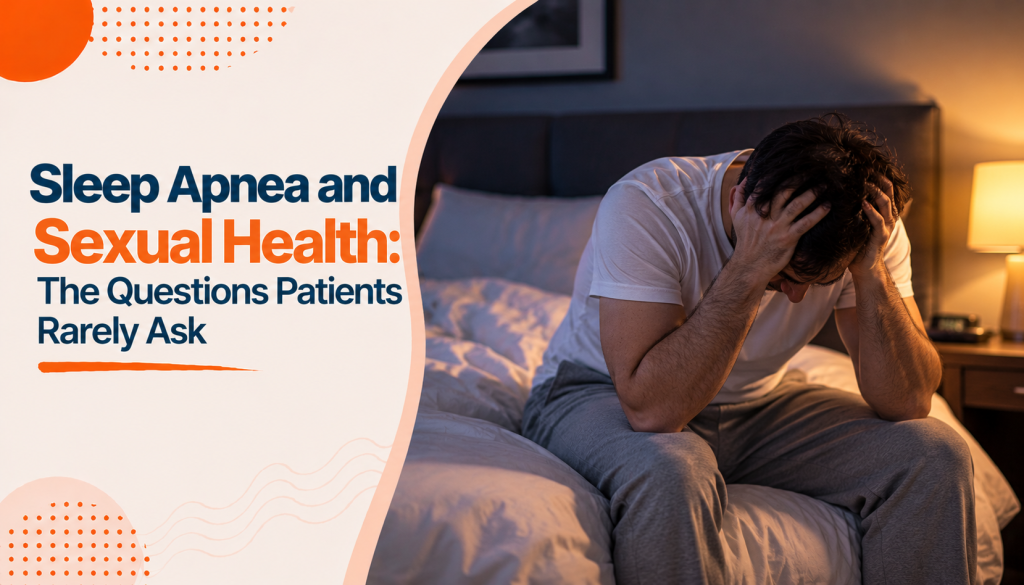
Sleep Apnea and Sexual Health: The Questions Patients Rarely Ask
By Yatin J. Patel, MD. Sleep Physician. Creator of the AEI∞ Framework.
A young man came to see me looking bewildered.
“My testosterone isn’t low,” he told me. “It’s zero. Three endocrinologists can’t explain it.”
He had been through test after test. Nobody had asked how he slept.
I told him that sleep apnea can be associated with lower testosterone in some men, particularly when the sleep apnea is severe. Sleep was a piece of the puzzle that had not yet been explored. He started treatment that week.
Can Sleep Apnea Affect Sexual Health?
Yes. Sleep apnea is associated with sexual health problems in both men and women, including erectile dysfunction, lower sexual desire, and difficulty with arousal [1][ 2]. The relationship is not always straightforward because sexual health can be affected by many factors, including age, medications, hormones, cardiovascular health, stress, and relationship factors. But sleep is one piece of the picture that is sometimes overlooked.
Why Sleep Apnea Can Affect Sexual Health
When breathing stops and starts all night, the body stays under strain for hours. In plain language, here is how that can reach the bedroom.
| What can happen with sleep apnea | How it may affect you |
|---|---|
| Repeated disruptions in breathing | May affect cardiovascular health and sexual function |
| Broken or poor-quality sleep | May contribute to daytime sleepiness and lower desire |
| Changes associated with severe sleep apnea | May be associated with lower testosterone in some men |
| Exhaustion and irritability | May affect mood, closeness, and relationships |
Sleepiness may matter more than snoring. In a study of more than 155,000 men, daytime sleepiness predicted erectile dysfunction, while snoring alone did not once other risk factors were accounted for [3].
Severity matters too. Pooled data from 18 studies of more than 1,800 men found that testosterone tended to fall hardest in severe sleep apnea, independent of age and weight [4]. Another study found that severe, but not mild, sleep apnea was associated with erectile dysfunction [5].
“Your body is telling you something.” Yatin J. Patel, MD
Want to see how the book begins? Read Chapter 1 free at dryatinjpatel.com/chapter1.
What It Can Look Like at Home
Most couples don’t connect any of this to sleep. They blame age or stress, and sometimes they blame each other.
“For many couples, the bedroom has gone cold, and neither partner fully understands why.” Yatin J. Patel, MD
From the outside, it can look like a loss of interest. From the inside, it often feels like exhaustion. Many of the people I treated still loved their partners deeply. They were simply too tired to show it.
For Women
Sleep apnea in women is often missed, and so are its effects on sexual health. A 2025 review pooling 11 studies and more than a million women found that women with sleep apnea were about two and a half times more likely to report sexual problems, most often low desire and difficulty with arousal [2].
Many women I’ve met had been told for years that it was hormones, stress, or just a busy life. Sometimes those things are part of it. Sometimes the missing piece is how they breathe at night.
Why This Conversation Is Hard
Few patients bring this up on their own. Many feel embarrassed, and many doctors don’t think to ask about sleep when the concern is sexual, or about sexual health when the concern is sleep.
Over the years, I learned that raising it myself could change the whole conversation. Some patients who were unmoved by talk of blood pressure and heart risk sat up when I mentioned intimacy. It mattered to them, and they deserved a straight answer.
If you’ve noticed changes in desire or function, it is worth telling your doctor and asking whether sleep could be part of the picture. Only a proper evaluation can sort out the causes.
Is It Reversible?
That’s the hopeful part. Research suggests that treating sleep apnea may improve sexual health for some people, although the results vary and sexual problems can have many causes. I’ve seen patients notice meaningful changes after addressing their sleep, but I never want to suggest that one treatment is a guaranteed answer. If you’re experiencing sexual health changes, a proper medical evaluation matters.
Frequently Asked Questions
-
Can sleep apnea cause erectile dysfunction?
Sleep apnea is associated with erectile dysfunction, especially when it is severe [5]. Erectile dysfunction has many possible causes, so it is worth a full evaluation with your doctor.
-
Does sleep apnea lower testosterone?
-
Can sleep apnea affect a woman's sex drive?
-
Is it the snoring or the tiredness that matters?
-
Should I tell my doctor about sexual problems if I think I have sleep apnea?
-
Can CPAP improve sexual health?
Start With Chapter 1
If any of this sounds familiar, for you or for someone you love, start with the first chapter. It’s free.
Read Chapter 1 at dryatinjpatel.com/chapter1.
References
- Liu L, et al. Sexual dysfunction in patients with obstructive sleep apnea: a systematic review and meta-analysis. Journal of Sexual Medicine. 2015;12(10):1992-2003. https://doi.org/10.1111/jsm.12983
- Qin H, et al. Association between obstructive sleep apnea and female sexual dysfunction: a systematic review and meta-analysis. Archives of Gynecology and Obstetrics. 2025;312:1871-1881. https://doi.org/10.1007/s00404-025-08196-z
- Zhou H, et al. Association between obstructive sleep apnea and male sexual dysfunction: a prospective cohort study based on 155,688 participants from the UK Biobank. Scientific Reports. 2026;16(1):13948. https://doi.org/10.1038/s41598-026-36847-x
- Su L, et al. Association between obstructive sleep apnea and male serum testosterone: a systematic review and meta-analysis. Andrology. 2022;10(2):223-231. https://doi.org/10.1111/andr.13111
- Margel D, et al. Severe, but not mild, obstructive sleep apnea syndrome is associated with erectile dysfunction. Urology. 2004;63(3):545-549. https://doi.org/10.1016/j.urology.2003.10.016
This article shares a physician’s perspective for general education. It is not medical advice and does not replace care from your own physician.