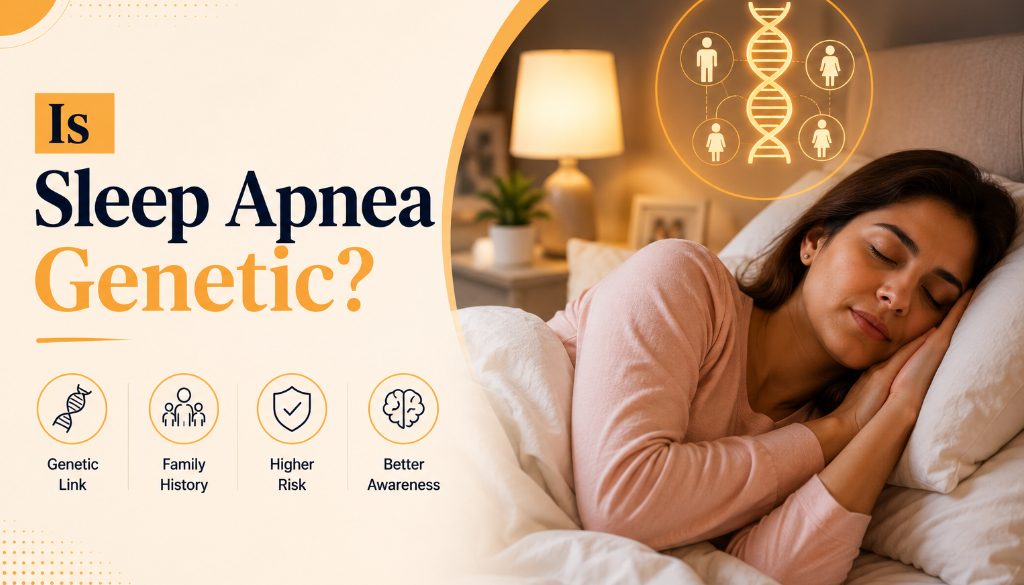
Is Sleep Apnea Genetic?
Years ago, I treated a man for sleep apnea. Later, his grown son became my patient too – same diagnosis. Sleep apnea, twice in one family.
I was seeing the son for a follow-up when I mentioned I’d run into his dad recently, and that he looked terrific. The son laughed. “Too good,” he said.
He told me that when he visited his father, the man would doze off mid-conversation. Talk about the grandkids’ soccer games – not interested. Talk about the business – not interested. So the son had mostly stopped going.
“Ever since you put him on the CPAP,” he said, “he’s got so much energy he’s at every soccer game, and he’s back at the family business driving everybody nuts. I’m about ready to throw the machine in the trash.”
We both laughed. But sit with what that story holds. Two generations, one diagnosis – and on the other side of a small machine, a father who came all the way back.
That’s what brings people to the question: is sleep apnea genetic? If your father had it, are you next?
Short answer: yes, sleep apnea runs in families, and the genetic component is real. But “genetic” doesn’t mean “fated.” A family history of sleep apnea is information – a head start on catching something that’s highly treatable – and you can explore our complete sleep apnea symptoms, causes, and treatment guide to learn exactly how this cycle operates. Let me walk you through what’s actually inherited, what isn’t, and what you can do with either.
Can Sleep Apnea Run in Families?
It can, and it does. If a parent or sibling has obstructive sleep apnea, your odds are roughly double those of someone with no family history. Researchers see this pattern again and again: the disorder clusters in families the way height or a particular jawline does.
Twin studies – the cleanest way to separate genes from environment – put a large share of the risk down to heredity. Depending on how it’s measured, estimates of the inherited portion run from around 40 percent to as high as 80 percent, and much of that holds even after accounting for body weight. So when people ask whether sleep apnea is hereditary, the honest answer is that a meaningful part of it is inherited.
Genetic Risk Factors
You don’t inherit “sleep apnea” as a single switch. You inherit a set of traits that, stacked together, narrow the airway or destabilize breathing at night. That’s why the genetics are described as polygenic – many small contributions rather than one broken gene.
The main inherited pieces:
- Craniofacial structure. The shape and size of your jaw, the position of your tongue, the width of your airway – bone and soft tissue you were born with.
- Fat distribution. Some people are simply more prone to carrying weight around the neck and throat, and gene variants linked to obesity (the well-studied FTO gene among them) recur in sleep apnea research.
- Ventilatory control. How steadily your brain regulates breathing during sleep also has a heritable component.
Large genome-wide studies scanning hundreds of thousands of people have pinned down several genetic locations linked to sleep apnea, and many of them point straight back to body weight. The strongest genetic thread connecting the two suggests that a genetic tendency toward higher weight actively drives sleep apnea risk up – not just travels alongside it.
A handful of inherited conditions raise the risk more directly by changing airway anatomy from birth. But for most people, genetic risk means this quieter stack of ordinary traits, not a named syndrome.

Want the fuller picture?
The first chapter of CPAP Is Sexy lays out what sleep apnea is doing beneath the surface – and the energy that comes back when you treat it. Read it free at dryatinjpatel.com/chapter1.
Lifestyle vs Genetics
Here’s the part I want you to hold onto. Genes load the situation; they don’t pull the trigger by themselves. The single most important driver of obstructive sleep apnea is one you can influence: body weight.
The numbers are striking. A 10 percent weight gain has been linked to roughly a 30 percent increase in the severity of nighttime breathing events. It runs the other way too – meaningful weight loss can substantially calm those same events. Exercise helps on its own: people who train hard through the week show markedly lower odds of moderate-to-severe apnea, even when the scale barely moves.
Read that right-hand column again. Even if the left one is stacked against you, the right one is where the outcome actually gets decided.
Who Is Most at Risk?
The best-established risk factors for sleep apnea:
- Male sex – men are diagnosed two to four times as often as women. Women are also underdiagnosed, because their symptoms often look like fatigue, insomnia, or anxiety rather than loud snoring – a gap worth its own conversation.
- A family history of sleep apnea.
- Excess weight, especially a larger neck size.
- Craniofacial features like a small or set-back jaw.
- Older age, and for women, the years after menopause.
- Certain hormone-related conditions, including an underactive thyroid.
Notice these overlap. Someone with a strong family history, a rising waistline, and a set-back jaw isn’t at three separate small risks – those add up.
Can You Prevent Sleep Apnea?
You can’t rewrite your jaw or your family tree. But you can reduce the risk, and if apnea is already present, you can treat it effectively.
The levers that matter most:
- Keep weight in a healthy range – the highest-yield move for prevention and for improvement.
- Move your body regularly; the benefit holds even without weight loss.
- Go easy on alcohol in the hours before bed, since it relaxes the airway.
- Try sleeping on your side rather than flat on your back.
- Protect your sleep hours – short, ragged sleep makes everything worse.
None of this erases inherited risk. What it does is give you room to work – and it makes any treatment that follows more effective.
When to Get Tested
Family history is exactly the kind of thing that should lower your threshold for getting checked. You don’t need to wait until a partner is counting the pauses in your breathing.
Worth a conversation with a clinician if you notice:
- Loud, habitual snoring, or gasping and choking sounds at night (knowing the clinical difference between sleep apnea and snoring is essential to realizing when your throat is actually collapsing).
- Waking unrefreshed no matter how long you were in bed.
- Daytime sleepiness, morning headaches, trouble focusing.
- High blood pressure, atrial fibrillation, or type 2 diabetes – all of which are major risk factors in the circular loop between sleep apnea and heart disease – are closely associated with untreated breathing events.
A short screening questionnaire (often called STOP-BANG) captures most cases, and testing has never been easier – many people can now be tested at home rather than in a lab. If you have a family history plus any of the signs above, that’s reason enough to ask.
Frequently Asked Questions
-
Is sleep apnea hereditary or lifestyle-related?
Both. A substantial share of the risk is inherited, but weight and daily habits strongly shape whether that risk leads to a diagnosis – and how severe it becomes.
-
If my parent has sleep apnea, will I get it?
-
Can you have genetic sleep apnea and still fix it?
-
Does losing weight cure inherited sleep apnea?
Conclusion
So – is sleep apnea genetic? Partly, yes. You may have inherited a narrower airway, a tendency to carry weight where it matters, a breathing pattern that wobbles at night. But heredity sets the starting line, not the finish. Weight, habits, and – when it’s needed – treatment decide how you actually sleep.
A billion years of evolution built you to sleep soundly and wake up ready. If that’s not happening, your genes aren’t the last word. The next move is yours: know your family history, watch for the signs, and get tested if they’re there.
Think back to that father and son. Same diagnosis, one family – and a dad who came back with so much energy his son pretended to complain about it. That’s what’s on the other side.
Read the first chapter of CPAP Is Sexy free – it’s about the energy, focus, and presence that return when sleep is restored, not about fear. Download it at dryatinjpatel.com/chapter1.
Bibliography:
-
Cowie MR, Linz D, Redline S, Somers VK, Simonds AK. Sleep Disordered Breathing and Cardiovascular Disease: JACC State-of-the-Art Review. Journal of the American College of Cardiology. 2021;78(6):608-624. doi:10.1016/j.jacc.2021.05.048.
-
Szily M, Tarnoki AD, Tarnoki DL, et al. Genetic Influences on the Onset of Obstructive Sleep Apnoea and Daytime Sleepiness: A Twin Study. Respiratory Research. 2019;20(1):125. doi:10.1186/s12931-019-1095-x.
-
Strausz S, Ruotsalainen S, Ollila HM, et al. Genetic Analysis of Obstructive Sleep Apnoea Discovers a Strong Association With Cardiometabolic Health. European Respiratory Journal. 2021;57(5):2003091. doi:10.1183/13993003.03091-2020.
-
American Psychiatric Association. Diagnostic and Statistical Manual of Mental Disorders, Fifth Edition, Text Revision (DSM-5-TR). Washington, DC: American Psychiatric Association; 2022.
-
Veasey SC, Rosen IM. Obstructive Sleep Apnea in Adults. New England Journal of Medicine. 2019;380(15):1442-1449. doi:10.1056/NEJMcp1816152.
-
Yeghiazarians Y, Jneid H, Tietjens JR, et al. Obstructive Sleep Apnea and Cardiovascular Disease: A Scientific Statement From the American Heart Association. Circulation. 2021;144(3):e56-e67. doi:10.1161/CIR.0000000000000988.
-
Gottlieb DJ, Punjabi NM. Diagnosis and Management of Obstructive Sleep Apnea: A Review. JAMA. 2020;323(14):1389-1400. doi:10.1001/jama.2020.3514.
-
Pivetta B, Chen L, Nagappa M, et al. Use and Performance of the STOP-Bang Questionnaire for Obstructive Sleep Apnea Screening Across Geographic Regions: A Systematic Review and Meta-Analysis. JAMA Network Open. 2021;4(3):e211009. doi:10.1001/jamanetworkopen.2021.1009.
-
Robbins R, Quan SF. Sleep Disorders. NEJM Evidence. 2024;3(10):EVIDra2400096. doi:10.1056/EVIDra2400096.