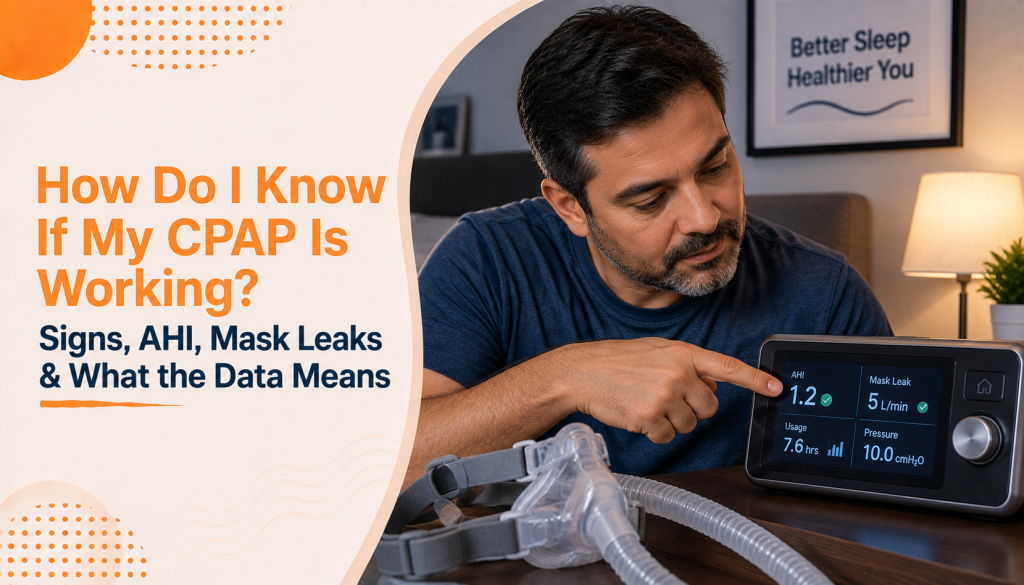
How Do I Know If My CPAP Is Working? Signs, AHI, Mask Leaks & What the Data Means
By Yatin J. Patel, MD · Sleep Physician
“I use my CPAP every night. How do I know it’s actually working?”
That’s the question I want every patient to ask.
The short answer: your CPAP is working when three things line up. You feel better. Your machine’s data looks good. And you use it consistently, with someone reviewing it.
One of the three is not enough. I’ve seen patients who felt fine while their mask leaked all night. I’ve seen perfect numbers from someone wearing the mask three hours a night. Together, these three give you a clearer picture of whether your treatment is working.
Here is how to read each one.
How Do You Know If Your CPAP Is Working?
Start with how you feel. When CPAP is doing its job, patients usually tell me some version of this:
- More alert during the day, with less dozing
- Sleep that feels deeper, with fewer wake-ups
- Fewer morning headaches
- Less snoring, or none (your bed partner is the best reporter)
- Sharper focus and more patience in the afternoon
Some notice a difference the first week. Others take a month or more. Both are normal.
But feelings have limits. Some people feel better while their breathing is still only partly controlled. Others have clean data and stay tired for reasons that have nothing to do with the machine. Symptoms point the way. They don’t confirm it. If you’re still tired, read Why Am I Still Tired After Using CPAP? 8 Possible Reasons.
What Does Your CPAP Data Tell You?
Most modern machines record every night and send it to an app, your equipment supplier, and your sleep team. You’ll usually see four things:
- AHI: breathing events per hour while you wear the mask
- Leak: how much air escapes around or through the mask
- Usage: hours per night and nights per week
- Pressure: what the machine delivered, especially on auto-adjusting machines
The American Thoracic Society found that machines track usage reliably, while AHI and leak are harder to interpret and are defined differently by each manufacturer. Very high or very low values, though, are clinically meaningful [1]. Usage is one of the most reliable numbers your machine tracks, but it tells you how consistently you are using CPAP – not by itself whether your sleep apnea is fully controlled. AHI and leak are good guides, especially at the extremes.
Read trends, not single nights. A week or a month tells a story. One odd night after a head cold or a late dinner is noise.
What Is AHI on CPAP?
AHI stands for apnea-hypopnea index: the number of times per hour your breathing stops or turns shallow.
Your sleep study gave you your starting AHI, the number without treatment. The AHI on your machine is different. It’s your residual AHI: the events that still get through with CPAP on. That’s the number that tells you how well the pressure is holding your airway open.
One caution. The machine estimates events from airflow. It is not a sleep study. Treat it as a reliable guide, not a lab result.
What Is a Good AHI on CPAP?
Most sleep physicians, me included, like to see residual AHI under 5. Under 10 is generally considered acceptable. Those targets trace back to how the American Academy of Sleep Medicine grades a CPAP titration study: an optimal pressure brings breathing events below 5 an hour, and a good one brings them to 10 or fewer [2].
But a number is not the whole story. An AHI of 3 in someone who still dozes off every afternoon needs a closer look. An AHI of 7 may or may not be concerning depending on your usual readings, symptoms and overall clinical situation. I read the number next to the person.
What Does CPAP Leak Rate Mean?
Some leak is built in. Every mask has small vents that let your exhaled air escape. That’s normal, and the machine accounts for it.
The leak that matters is unintentional: air escaping around the cushion or out an open mouth. A big leak can hiss, dry your eyes and mouth, wake you or your partner, and lower the pressure that actually reaches your airway. It also makes your AHI harder to trust [1].
There is no single universal leak number, because each manufacturer measures leak its own way [1]. Your app will flag leak as high by its own standard. If you see that flag night after night, it’s worth fixing. The usual causes are a mask that’s the wrong size or style, a worn cushion, straps pulled too tight, or mouth breathing. Mask style matters: in the American Academy of Sleep Medicine’s review, nasal masks were linked to better use than full-face masks [3]. For fixes, see 10 Common CPAP Problems and Solutions.
When the numbers and the mornings line up, people get their afternoons back. My book, CPAP Is Sexy, is about that life on the other side of the mask. Read the first chapter free at dryatinjpatel.com/chapter1.
How Many Hours Should You Use CPAP?
The simple answer: every time you sleep, all night.
You may have heard of the four-hour rule. For Medicare coverage, adherence is generally defined as at least four hours per night on 70% of nights during a consecutive 30-day period within the first three months. Private insurance requirements may vary[4]. That is a coverage rule. It decides whether insurance keeps paying for your machine. It is not a ceiling on how good you can feel.
The research points higher. In a multicenter study of patients with severe sleep apnea, about four hours a night was the threshold for normal self-rated sleepiness, about six hours for objective alertness testing, and about seven and a half hours for everyday functioning. The more hours, the more people returned to normal [5].
The last hours of the night count too. Dream sleep, where apnea is often at its worst, clusters toward morning. If the mask comes off at 3 AM, you miss some of the best sleep of the night. If the first weeks feel hard, read Why CPAP Feels So Hard at First—and How to Stick With It.
What If Your CPAP Numbers Look Good but You Still Feel Tired?
This happens, and it’s frustrating. Good data means the machine is holding your airway open. It doesn’t mean everything else about your sleep is fine.
In a French study of 502 patients using CPAP for a year, about 12 percent were still excessively sleepy. After ruling out depression, restless legs, and narcolepsy, about 6 percent remained sleepy with no other explanation [6].
In my clinic, the usual reasons are simpler than people expect: too few hours in bed, shift work, another sleep disorder, sedating medications, or another health condition such as low thyroid or depression. The machine fixed the breathing. Now we look at the rest. For more, read Why Am I Still Tired After Using CPAP? 8 Possible Reasons.
What If Your CPAP Data Doesn’t Look Right?
Watch for patterns that hold for a week or more:
- AHI staying above 10, or well above your usual range
- Leak flagged high most nights
- Usage slipping, or the mask coming off in the middle of the night
- On an auto-adjusting machine, pressure repeatedly reaching the upper limit may be a reason for your sleep team to review the data
- Symptoms that aren’t improving, or new ones such as snoring, morning headaches, or waking up gasping
A rising AHI can have many causes: weight change, new medications, alcohol, a mask problem, or a different kind of breathing pattern that needs a different approach. Your sleep team can tell which.
Please don’t change your pressure or other settings yourself, even when an online forum shows you how. Your pressure was chosen for your airway, and changing it without the full picture can create problems your app won’t show. Bring the pattern to your sleep team.
When Should You Talk to Your Sleep Physician?
Ask for a review if:
- You still feel tired after several weeks of regular use
- Your data stays off for a week or more
- Treatment doesn’t seem to work despite regular use
- Your weight, health, or medications change significantly
- You’re finding it hard to keep using CPAP
A sleep physician reads your numbers alongside your history, your original sleep study, and how you feel. Data plus the person. Many of the problems I see on a download are solved in a single visit.
Medical disclaimer: This article is for general educational purposes and is not a substitute for personalized medical advice, diagnosis, or treatment. If you have concerns about your CPAP therapy, symptoms, or treatment data, speak with your sleep physician or healthcare provider.
FAQs About CPAP Effectiveness
-
What is a normal AHI while using CPAP?
An AHI below 5 is commonly used as a treatment goal, but your sleep physician should interpret the number alongside your symptoms, usual readings and overall treatment response. Your sleep physician reads it alongside how you feel.
-
Can you still have sleep apnea while using CPAP?
-
Does feeling better mean my CPAP is working?
-
What does a high CPAP leak rate mean?
-
Should I worry about one night of high AHI?
-
When should I ask my doctor to review my CPAP data?
References
- Schwab RJ, Badr SM, Epstein LJ, et al. An official American Thoracic Society statement: continuous positive airway pressure adherence tracking systems. The optimal monitoring strategies and outcome measures in adults. Am J Respir Crit Care Med. 2013;188(5):613-620. doi:10.1164/rccm.201307-1282ST
- Kushida CA, Chediak A, Berry RB, et al. Clinical guidelines for the manual titration of positive airway pressure in patients with obstructive sleep apnea. J Clin Sleep Med. 2008;4(2):157-171. PMCID: PMC2335396
- Patil SP, Ayappa IA, Caples SM, Kimoff RJ, Patel SR, Harrod CG. Treatment of adult obstructive sleep apnea with positive airway pressure: an American Academy of Sleep Medicine systematic review, meta-analysis, and GRADE assessment. J Clin Sleep Med. 2019;15(2):301-334. doi:10.5664/jcsm.7638
- Patel SR, Bakker JP, Stitt CJ, Aloia MS, Nouraie SM. Age and sex disparities in adherence to CPAP. Chest. 2021;159(1):382-389. doi:10.1016/j.chest.2020.07.017
- Weaver TE, Maislin G, Dinges DF, et al. Relationship between hours of CPAP use and achieving normal levels of sleepiness and daily functioning. Sleep. 2007;30(6):711-719. doi:10.1093/sleep/30.6.711
- Pépin JL, Viot-Blanc V, Escourrou P, et al. Prevalence of residual excessive sleepiness in CPAP-treated sleep apnoea patients: the French multicentre study. Eur Respir J. 2009;33(5):1062-1067. doi:10.1183/09031936.00016808