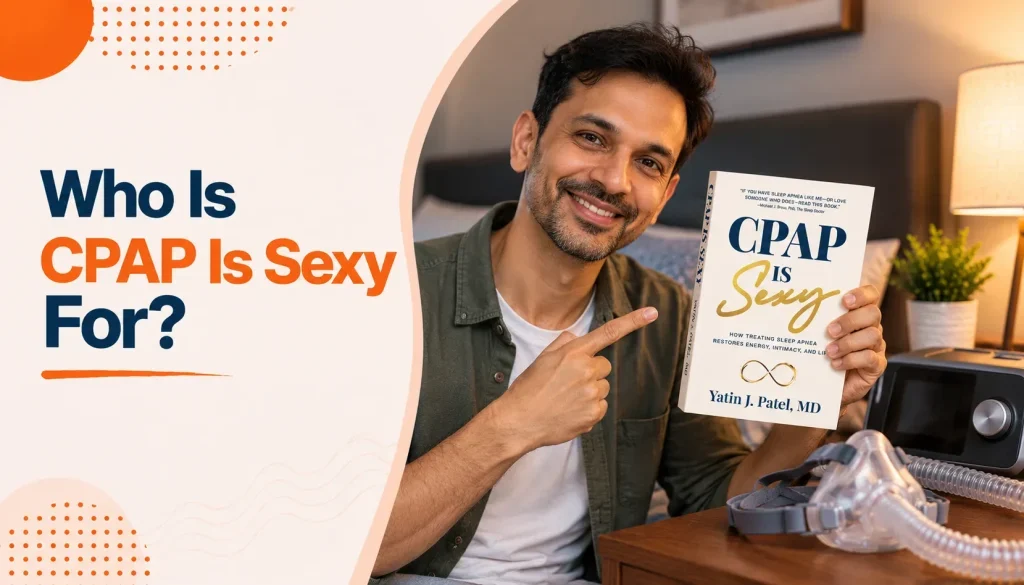
Who Is CPAP Is Sexy For?
By Yatin J. Patel, MD. Sleep Physician. Creator of the AEI∞ Framework.
For months, a woman I knew from the hospital would stop me in the hallway whenever she saw me.
“Dr. Patel, my husband snores so loudly I can’t sleep. He stops breathing. He walks around in a fog all day.”
I’d tell her I would be happy to see him, and she’d promise to talk to him that night. A few weeks later we would have the same conversation in the same hallway. “He refuses,” she told me once. “Says there’s nothing wrong with him.”
Then one afternoon she walked into my exam room with her phone in her hand and her husband behind her, arms crossed. What she played for us that day is in the book.
Her husband is the reader I most hope this book reaches.
CPAP Is Sexy is for people living with sleep apnea and the people who love them. Most of all, it is for people who may have sleep apnea and don’t know it yet. Most people with significant sleep apnea have no diagnosis on record [1]
When I picture my readers, I think of people who are tired and wondering if they have sleep apnea, people who snore and wonder if the treatment would be worse than the disease, and people who need some encouragement to make the phone call, make the appointment, and get the sleep study. I hope this book reaches them, because they are the majority.
| If this sounds like you | What you may find in the book |
|---|---|
| You're tired and wondering if it's sleep apnea | A plain-language look at what may be happening at night |
| You snore and dread the idea of CPAP | What today's treatment is like, and stories from people who dreaded it too |
| You've been meaning to make the call | What a sleep study involves, so the first step feels smaller |
| You sleep beside someone who snores or stops breathing | What partners in my practice lived through, and why your instincts matter |
| You were diagnosed but CPAP hasn't worked for you yet | Practical help for getting started, getting through the first weeks, and tolerating the mask |
| You use CPAP but still feel tired | Common reasons the benefit stalls, from mask fit to daily habits |
| You simply want more energy and focus | The habits and the bigger framework behind sound sleep |
If You’re Tired and Wondering
Maybe you snore. Maybe someone has told you that you stop breathing at night. Or maybe you just wake up unrefreshed, fight to stay awake in the afternoon, and can’t remember the last time you felt sharp.
Those symptoms can have many possible causes. A qualified healthcare professional can help determine whether a sleep evaluation is appropriate. The book can help you understand what may be going on and give you better questions to bring to your appointment.
If You Snore and Worry That the Treatment Is Worse
I understand this one. For years I knew people called the machine CRAP, and many still picture a big, bulky device strapped to the face.
Today’s machines are far smaller and quieter than the ones many people imagine. In the book, I describe what treatment actually looks like now, through the eyes of patients who expected the worst.
If You Need a Nudge to Make the Call
Many of my patients waited years before picking up the phone. Some were busy, some were scared, and some simply didn’t believe anything could change.
A sleep study is often less of an ordeal than people expect, and in some cases it can be done at home. The book walks through what to expect so the first step feels smaller. Your own doctor can tell you which kind of evaluation fits you.
“People who are tired and wondering if they have sleep apnea, people who snore and wonder if the treatment would be worse than the disease, people who need some encouragement to make the phone call. My hope is that this book will reach them.” Yatin J. Patel, MD
Want to see how the book begins? Read Chapter 1 free at dryatinjpatel.com/chapter1.
If You Love Someone Who Snores: You May Be the Bridge
In my clinic, I asked to see both the patient and the spouse at the first visits. The partner’s account often provided valuable information because they were the one awake and observing what happened during the night.
Many people with undiagnosed sleep apnea never notice the pauses in their own breathing. Their partners do, and that is why partners so often make the first call.
“Sleep apnea is not a solo disease. When one person stops breathing dozens or hundreds of times a night, two people suffer.” Yatin J. Patel, MD
The book has a chapter written for you. Before it, there is a short note to patients that ends: “Read it. Then hand them the book.” With the holidays ahead, a book may be a gentler way to start a conversation that has been hard to have.
If You’re a Woman and Your Symptoms Don’t Fit
For many women, sleep apnea shows up as fatigue, insomnia, morning headaches, or a low mood rather than loud snoring. Women develop sleep apnea at roughly half the rate of men, yet sleep clinics have historically seen as many as eight men for every woman [2]. Much of that gap comes down to recognition.
If You’ve Been Diagnosed and CPAP Hasn’t Worked Yet
This group is bigger than most people realize. Only about half of diagnosed patients meet even the minimum insurance standard of four hours a night on 70 percent of nights [3]. A good share of the book was written for them, and the struggles usually look like one of these.
The machine never really got started
Maybe it’s still in the box. Maybe the mask felt impossible on the first night, and you never tried again. That is more common than people admit, and it is a reasonable place to start over.
You started, then stopped
One of my patients threw her machine across the room, twice. She couldn’t even touch the box. We worked through it gradually, one small step at a time, and six months later she was the one referring other patients to me. The book walks through the approach I used with patients like her.
You use it, but you still feel tired
Sometimes the machine is doing its job, and something else is getting in the way: a mask that leaks, a setting that needs another look, or habits that blunt the benefit. The book covers the common reasons and how to raise them with your care team.
“From ‘I’m not sure I can do this’ to ‘I can’t imagine sleeping without it.'” Yatin J. Patel, MD
Whichever group you’re in, your sleep team is the right partner for any change. They can review your data with you and adjust what isn’t working.
And If You Simply Want to Live More Awake
CPAP opens the airway. What you do with your days is the other half of the equation. The book looks at the everyday habits that shape how rested you feel, and many of them apply whether or not you have sleep apnea.
It also introduces the bigger idea behind my work, the AEI∞ Framework. Sound sleep supports five forces that feed one another at the same time: Alertness, Emotional Intelligence, Information Intelligence, Selfless Service, and Spirituality. I’ll say more about it in time. For now, it’s enough to know the book is about more than a machine.
What the Book Won’t Do
It is not a medical textbook, and it can’t diagnose anyone. Your own diagnosis and treatment plan belong in a conversation with your physician.
Frequently Asked Questions
-
Who should read CPAP Is Sexy?
People who are tired or snore and wonder whether they have sleep apnea, people who have been diagnosed or struggled with CPAP, the partners and families of anyone living with sleep apnea, and anyone interested in living with more energy.
-
Do I need a sleep apnea diagnosis to read it?
-
How common is undiagnosed sleep apnea?
-
How do I know if I should be tested for sleep apnea?
-
Is the book helpful if I've already given up on CPAP?
-
What is the AEI∞ Framework?
-
Is CPAP Is Sexy a good gift for someone with sleep apnea?
-
Is the book a substitute for medical advice?
-
What does sleep apnea do to a relationship?
Start With Chapter 1
If you see yourself, or someone you love, somewhere on this page, start with the first chapter. It’s free.
Read Chapter 1 at dryatinjpatel.com/chapter1.
References
- Yeghiazarians Y, et al. Obstructive sleep apnea and cardiovascular disease: a scientific statement from the American Heart Association. Circulation. 2021;144(3):e56-e67. https://doi.org/10.1161/CIR.0000000000000988
- Young T, et al. Menopausal status and sleep-disordered breathing in the Wisconsin Sleep Cohort Study. American Journal of Respiratory and Critical Care Medicine. 2003;167(9):1181-1185. https://doi.org/10.1164/rccm.200209-1055OC
- Patil SP, et al. Optimal NIV Medicare Access Promotion: patients with OSA. Chest. 2021;160(5):e409-e417. https://doi.org/10.1016/j.chest.2021.06.084
This article shares a physician’s perspective for general education. It is not medical advice and does not replace care from your own physician.