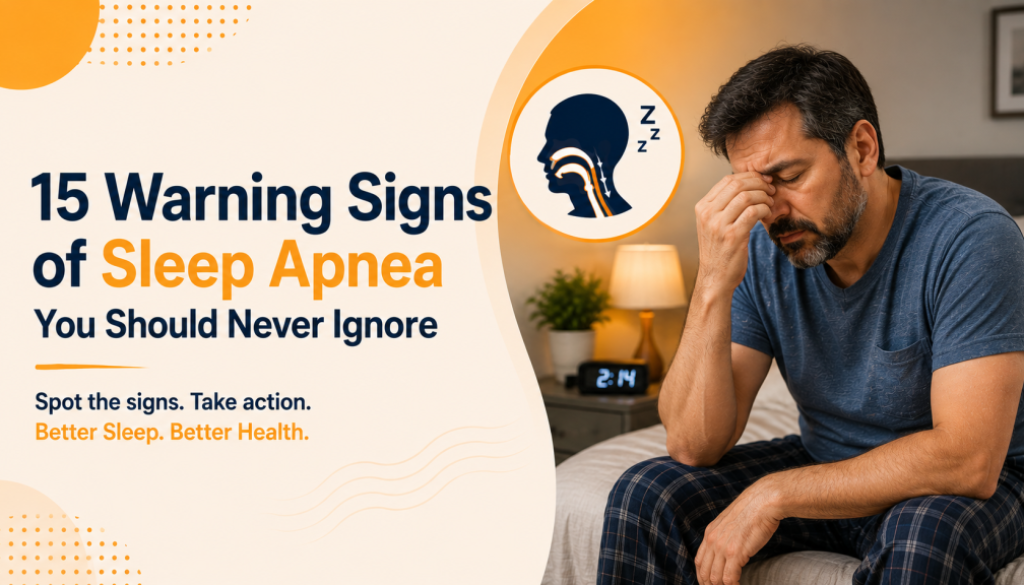
15 Warning Signs of Sleep Apnea You Should Never Ignore
Most people don’t come to see me on their own. They come because a spouse pushed them into it. And the first thing they say, sitting across the desk, is some version of “I don’t have any problem.” That’s the commonest scenario in my clinic. They aren’t being stubborn. They walked in exhausted, tired of being tired, and they still can’t feel what the person beside them has watched for years. The snoring. The long silence. Then the gasp.
Sleep apnea does its damage while you’re asleep, which makes you the last one to know. So it helps to know what to look for. Here are the 15 signs I watch for. A few carry far more weight than the rest, and I’ll tell you which. Almost all of them point to something we can fix.
What Is Sleep Apnea?
Sleep apnea is a breathing problem that happens at night. In the common form, obstructive sleep apnea, the muscles around your throat go slack as you fall asleep and the airway narrows or closes. Air stops moving. Oxygen drops. Your brain hauls you up from deep sleep just long enough to draw a breath, often with a snort or a gasp. Then you sink back down, and it happens again. In a severe case,e it repeats dozens of times an hour, all night, and you remember none of it.
You spend the whole night working to breathe instead of resting. That’s why you can log eight hours and wake up with nothing in the tank.
Why Symptoms Often Go Unnoticed
The commonest sign of sleep apnea is no sign at all. More than ninety percent of the people who have it go undiagnosed. It is the perfect disease for staying in denial. Deep-sleep deprivation blunts the very part of the brain you would use to judge how you’re doing. So the tired man doesn’t know he’s tired.
That’s why it hides. The loud signs happen while you’re unconscious. The snoring, the pauses, the gasping belong to whoever is lying next to you. In most of my exam rooms, the spouse is the one who finally says it out loud: “You stop breathing at night. It scares me.” If you’re reading this for someone else, believe what you’ve been seeing.
The quiet signs get explained away. We blame the tiredness on age, on work, on stress, on the kids. And there is one more blind spot. The textbook patient is a heavyset man who snores like a freight train, so anyone who doesn’t match that photo gets missed. For years, men were sent for sleep studies far more often than women with the same complaints, roughly eight to one at the widest, now closer to five to one. In women, it tends to look like fatigue, broken sleep, a morning headache, a flat mood: same disease, different face.
15 Warning Signs of Sleep Apnea
Nighttime signs
- Loud or frequent snoring. The most common sign, and the one partners notice first. By itself, it proves nothing. Plenty of people snore without having apnea. Paired with the signs below, it counts.
- Witnessed pauses in breathing. Someone watches you stop, then start again. This is one of the two signs that matter most. If your partner has seen it, don’t wave it off.
- Gasping or choking awake. You come up with a sharp gasp, a snort, or the feeling you were choking. Along with witnessed pauses, this is the sign that points most reliably to apnea.
- Waking again and again. Surfacing over and over through the night, usually with no idea why. Those are the small arousals that reopen the airway. You feel them as restlessness.
- Getting up to urinate two or more times. The pressure swings in your chest during apnea signal the body to produce more urine overnight. People blame their age. Sometimes it’s the breathing.
- Nighttime heartburn or reflux. The same struggle to breathe drags stomach acid upward, so reflux and apnea travel together more often than you’d think.
Daytime signs
- Excessive daytime sleepiness. Nodding off at your desk, in a meeting, at a red light, in front of the TV before you meant to. This is what brings most people in.
- Unrefreshing sleep. A full night in bed, and you wake as if you never slept.
- Fatigue and low energy. Not always sleepiness. Sometimes just a flat, bone-deep tiredness with no drive behind it. This is often how it shows up in women.
- Morning headaches. A dull, pressing headache at waking that fades over an hour or two, tied to the drop in oxygen overnight.
- Dry mouth after sleep. Waking with a parched mouth or a raw throat, usually from breathing through your mouth all night.
- Trouble concentrating or remembering and losing the thread, reaching for words, forgetting why you walked into the room. Broken sleep goes straight for focus and memory.
- Mood changes – a short fuse, irritability, anxiety, a low mood no one can place. Apnea can wear the mask of depression, and it belongs in that conversation.
Physical signs
- Weight gain, especially around the middle. Extra tissue around the neck and belly makes the airway more prone to collapse, and poor sleep makes weight loss harder. The two feed each other.
- A bigger neck and a crowded throat. A thick neck, a small or set-back jaw, a throat with little room to spare. Each one makes the airway close more quickly during sleep.
The same disease gets recognized in one picture and missed in the other:
If you saw yourself or the person next to you in more than a couple of these signs of sleep apnea in adults, do something about it.
Want the whole picture in plain English? The first chapter of CPAP Is Sexy is free to read. It lays out what these signs mean and what life looks like once you sleep through the night again. Read Chapter 1 here.
Why Early Diagnosis Matters
Here is the good news, and I mean it: sleep apnea is highly treatable. The sooner you catch it, the sooner you get back what it’s been quietly draining. Leave it alone for years, and it will drive up blood pressure and strain the heart and brain. That’s the reason not to sit on it. But the part I want you to hold onto is the other side. The energy comes back. The patience comes back. The interest in the people around you comes back. That is what treatment is for.
When Should You See a Doctor?
If you have unexplained daytime sleepiness, fatigue, or unrefreshing sleep, with or without nighttime symptoms, get evaluated. The case is stronger still if someone has watched you stop breathing or gasp, or if you already carry high blood pressure, heart failure, or atrial fibrillation. You don’t need all fifteen signs. A drive where you fought to stay awake, a worried partner, a headache that keeps turning up at breakfast. Any one of those is reason enough to ask.
Whenever in doubt, see your sleep doctor. Whenever in doubt, get a sleep study. Still in doubt? Get another sleep study. But do not ignore sleep apnea.
And if you’re the partner who’s been watching this happen, you’re allowed to be the one to start it. “I’ve noticed you stop breathing at night, and I want us to get it checked” is one of the most loving things a person can say.
How Sleep Apnea Is Diagnosed
It’s simpler than most people fear. It usually starts with a short questionnaire in the office. The one I reach for is STOP-BANG: eight fast questions covering snoring, daytime tiredness, observed pauses, blood pressure, and a few physical factors like age and neck size, or checking if sleep apnea is genetic. It’s the most sensitive of the common screens and takes about a minute. A high score sends you on to a sleep study.
That study comes in two forms. A home sleep test lets you sleep in your own bed while wearing a small device that tracks your breathing and oxygen levels. For many people, that’s enough to make the call. An in-lab study, polysomnography, measures more, including your sleep stages and every pause in detail, and it’s the better choice for complicated cases. Your doctor will steer you to the right one. Either way, you walk out with an answer instead of a guess.
Treatment Options
Read this part twice, because apnea responds well to treatment.
- CPAP. A quiet stream of air through a mask that holds the airway open all night. It’s first-line for a reason: it works. The machines and masks today are a fraction of the size and noise people remember. For most patients, this is how sound sleep comes back.
- Oral appliances. A custom mouthpiece that eases the lower jaw forward, keeping the airway open. A good fit for milder cases, or for people who can’t get comfortable on CPAP.
- Positional therapy. When the apnea shows up mainly on the back, simple ways to stay off your back can help.
- Weight and lifestyle. Losing weight, clearing nasal congestion, and moving your last drink earlier in the evening all bring the numbers down. They work best alongside one of the treatments above, not in place of it.
- Surgery and newer options. For selected patients, a procedure or an implanted therapy addresses specific anatomy. Your sleep physician can tell you whether you’re a candidate.
A billion years of evolution built us to be repaired by sleep. Apnea gets in the way of that. The right treatment clears the way.
Frequently Asked Questions
-
What are the early signs of sleep apnea?
Usually loud snoring, waking unrefreshed, and daytime tiredness. The one that carries the most weight is someone noticing you pause or gasp in your sleep. In women, the early signs tend to include fatigue, insomnia, morning headaches, and low mood.
-
Is loud snoring always sleep apnea?
-
What does gasping during sleep mean?
-
Can women have sleep apnea without snoring?
-
How is sleep apnea diagnosed?
Conclusion
Fifteen signs, and you don’t need all of them. You need to see the pattern: the pauses your partner notices, the fog you’ve been explaining away for years. Treat it as information, not a sentence. Sleep apnea is common, it’s easy to miss, and it’s highly treatable. On the far side of it is a version of you that’s been hard to reach lately, with more energy and a clearer head.
That version isn’t gone. It’s usually one good night’s sleep away.
Start here: Download the first chapter of CPAP Is Sexy, free. It’s the clearest picture I can give you of what these signs mean and the life waiting once you sleep through the night again.
References:
- Gottlieb DJ, Punjabi NM. Diagnosis and management of obstructive sleep apnea: a review. JAMA. 2020;323(14):1389-1400
- Veasey SC, Rosen IM. Obstructive sleep apnea in adults. New England Journal of Medicine. 2019;380(15):1442-1449
- Yeghiazarians Y, Jneid H, Tietjens JR, et al. Obstructive sleep apnea and cardiovascular disease: a scientific statement from the American Heart Association. Circulation. 2021;144(3):e56-e67.
- US Preventive Services Task Force. Screening for Obstructive Sleep Apnea in Adults: Recommendation Statement. JAMA. 2022;328(19):1945-1950.
- Gawrys B, Silva TW, Herness J. Obstructive Sleep Apnea in Adults: Common Questions and Answers. American Family Physician. 2024;110(1):27-36.