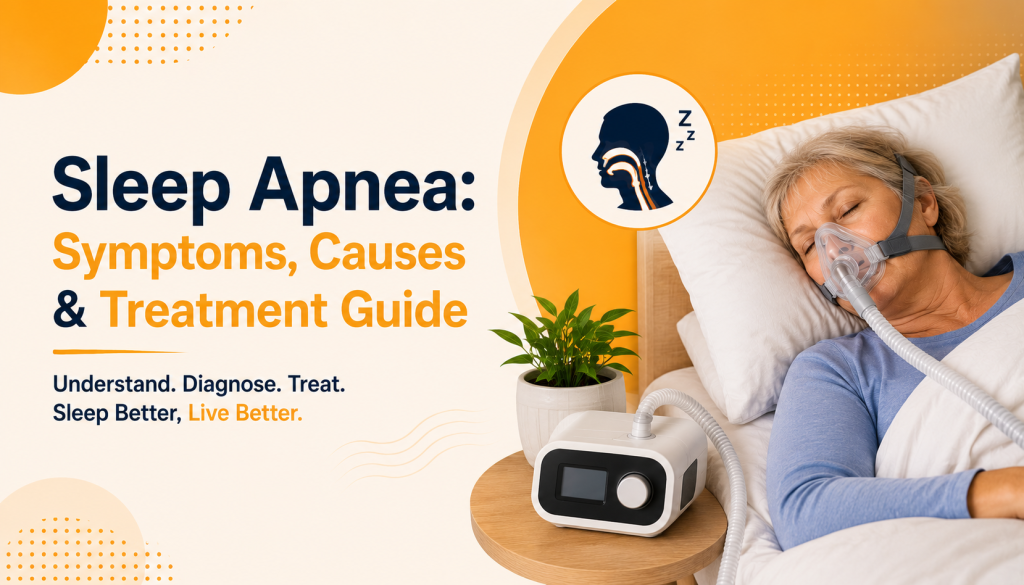
Sleep Apnea: Symptoms, Causes & Treatment Guide
There is a version of the person you love that you have not seen in a while. The one with energy at the end of the day. The one who laughed easily, who reached for you, who did not fall asleep on the couch by eight o’clock. He is not gone. She is not gone. They are just not sleeping.
That is usually what brings a family into my office. Not a chart. Not a number. Somebody noticed that the person beside them had slowly gone quiet, and they wanted them back.
If we have not met, I am a sleep physician from Amish country in northern Indiana. I have spent thirty years helping people regain their energy, focus, and relationships through the one thing we all take for granted until it breaks down – sound sleep. And more often than not, the thing standing in the way is sleep apnea.
Here is what surprised the people who counted. More than eighty million American adults have sleep apnea. That is about one in three of us. Most of them have no idea. They think they are just tired, just getting older, just not the person they used to be.
They are wrong about that. They are not breathing right at night. And that is one of the most fixable problems in all of medicine.
This is a plain guide to sleep apnea. What it is, how to spot it, what causes it, what it does if you leave it alone, and every way we treat it today. No scare tactics. Just the truth, the way I would tell it to you across the desk.
What Is Sleep Apnea?
Sleep apnea means your breathing keeps stopping while you sleep. Not for a moment here and there. Dozens of times an hour, all night long, without you knowing it.
Each time it happens, your throat closes, or your brain skips a breath – your oxygen drops. Your body panics, just a little, and yanks you out of deep sleep to get you breathing again. You do not fully wake up, so you never remember it. But you never get the deep, restoring sleep your body is trying to reach either. You spend the whole night climbing toward rest, only to be pulled back down.
That is why people with sleep apnea can spend nine hours in bed and wake up feeling like they never slept. Because in the way that counts, they didn’t.
The worst of it hits in the early-morning hours, around three or four, when your sleep is deepest, and your guard is all the way down. I tell my patients that is exactly the hour a thief picks to break into a house, because everyone inside is out cold. Sleep apnea is that thief. What it comes to steal is your energy, your intimacy, and your life. And a thief you can name is a thief you can stop.
Types of Sleep Apnea
There are three kinds, and it helps to know which one we are talking about.
Obstructive sleep apnea :
This is the common one, the one behind the great majority of cases. The airway at the back of your throat collapses or narrows while you sleep. The signal to breathe is fine. The pipe is just blocked. Think of a straw that pinches shut when you inhale hard.
Central sleep apnea :
Less common, and different. Here the airway is open, but the brain briefly stops sending the signal to breathe. It shows up most in people with heart failure and in certain other conditions. It calls for a different treatment approach, which is one reason getting a proper diagnosis matters.
Complex sleep apnea :
A mix of the two. Sometimes when we start treating the obstructive kind, a bit of the central kind shows up. It occurs in a small proportion of patients and is manageable. Your sleep team watches for it and adjusts.
Most of what follows is about the obstructive kind, because that is what most people have.
Common Symptoms of Sleep Apnea
The tricky part is that the most severe symptoms occur while you are asleep, so the person who has them is often the last to know. Here is what to watch for, in yourself or in someone you share a bed with.
- Loud snoring. The classic sign, though not everyone with apnea snores, and plenty of people who snore do not have apnea. More on that below.
- Gasping or choking at night. If you have watched someone go quiet, then startle awake with a gasp, that is one of the most telling signs there is.
- Waking up tired. You slept all night and feel like you didn’t. This is often the very first thing people notice.
- Daytime sleepiness. Nodding off at your desk, in meetings, at red lights. Among people sent to a sleep clinic, this is reported by up to 9 in 10.
- Morning headaches. A dull, both-sided pressure that fades an hour or two after you get up. It is about twice as common in people with apnea.
- Dry mouth in the morning, from breathing through an open mouth all night.
- Trouble concentrating, foggy thinking, or a memory that is not what it used to be.
- Mood changes – irritability, low mood, anxiety that does not have an obvious cause.
- Getting up to use the bathroom more than once or twice a night.
One more thing worth saying plainly. Sleep apnea symptoms in women often do not look like the textbook picture. Instead of loud snoring and a partner’s elbow in the ribs, it shows up as fatigue, trouble sleeping, morning headaches, and a low mood. For years, that meant women got sent for a sleep study far less often than men with the very same complaints. If you are a woman reading your own symptoms in that list, you are not imagining it, and you are not alone. Want a complete checklist of symptoms? Read our guide on 15 warning signs of sleep apnea you should never ignore.
What Causes Sleep Apnea?
Sleep apnea is not one thing gone wrong. It is usually a few things stacking up until the airway can no longer stay open on its own.
Extra weight. This is the single biggest driver. Fat around the neck and tongue crowds the airway, and the airway gives way. The link is strong enough that putting on about ten percent of your body weight raises your risk of developing apnea roughly sixfold. The good news hiding inside that fact is that it runs both ways, which we will get to.
Muscles that relax too much. During sleep, the muscles that hold your throat open naturally loosen. In some people, they loosen enough for the airway to collapse.
The shape you were born with. A smaller jaw, a set-back chin, large tonsils, a big tongue, a narrow airway. Anatomy matters, and it is why thin people get sleep apnea too.
Family history. Sleep apnea can run in families, as both the shape of your airway and the way your brain controls breathing can be inherited.
Smoking, which inflames and narrows the airway.
Alcohol and sedatives, which relax the throat muscles even further. A nightcap makes a mild problem worse for that night.
Nasal congestion, which forces mouth breathing and adds to the collapse.
Age. Risk climbs through your forties, fifties, and sixties.
The menopause shift. Before menopause, about one in twelve women has significant sleep apnea. After menopause, it is closer to one in three. The hormones that helped protect the airway step back, and the airway becomes far more vulnerable. This is one of the most missed transitions in all of women’s health.
Risk Factors for Sleep Apnea
Causes and risk factors overlap, but here is the short list of who is most likely to have it:
- Carrying extra weight, especially around the neck and middle
- Being male, since men have it about twice as often as women, though the gap narrows sharply after menopause.
- Age in the forties through seventies
- A family history of sleep apnea or snoring
- A larger neck size, which usually means more tissue around the airway
- High blood pressure, particularly the kind that is hard to control with medication.
- Type 2 diabetes
- An irregular heart rhythm, such as atrial fibrillation
- Being past menopause
- Smoking and regular alcohol use
If several of those describe you, it does not mean you have sleep apnea. It means you are exactly the person who should get checked.
What Happens If Sleep Apnea Goes Untreated?
I am going to give this to you straight, because you deserve to know. Then I am going to tell you the good news, which is bigger.
When you stop breathing over and over all night, your body treats each pause like a small emergency. Blood pressure spikes. Adrenaline surges. Your heart works overtime through the hours that are supposed to be its rest. Do that every night for years, and it adds up.
Here is where it adds up:
- Blood pressure. Sleep apnea drives it up, and among people whose blood pressure will not come down no matter how many pills they take, the large majority have undiagnosed sleep apnea underneath it. Learn more about how sleep apnea can cause high blood pressure.
- The heart. It is linked to heart disease, heart failure, and irregular heart rhythms like atrial fibrillation. Learn more about the connection between sleep apnea and heart disease.
- Stroke. Untreated apnea roughly doubles the risk overall. In men with the severe form, it runs about four times higher.
- Blood sugar. It is linked to type 2 diabetes, on top of and separate from weight.
- The brain. Focus and memory suffer. Over years, untreated apnea is linked to faster mental aging. An untreated case, severe enough, can slow your thinking speed by about five years.
- Mood. Anxiety and low mood are common companions, and they often lift once the breathing is fixed.
- The road. If left untreated, you are about three times more likely to be in a car crash. The dangerous part is that tired drivers are terrible judges of how tired they are.
In the most severe, untreated cases, the risks extend to lifespan. Mild apnea does not carry that same weight, which is part of why finding it and treating it early matters so much.
Now the good news, and it is the whole point. Almost none of this is a fixed sentence. It is a to-do list. Sleep apnea is one of the few serious conditions where the treatment works fast, and you can actually feel it. Treat the breathing, and the body starts putting itself back together. The blood pressure eases. The fog lifts. The energy comes back. The person your family has been missing comes back too. Survey the partners of people who start treatment, and more than nine in ten are glad they did, with relationship satisfaction climbing from about half of them to seven in ten.
That is the part nobody tells you. This is not a story about decline. It is a story about getting your life back.
A lot of people use these two words like they mean the same thing. They are related but not the same; the difference is the whole ballgame.
A couple of honest details behind that table. Only about half to six in ten people with sleep apnea are loud snorers, so quiet sleep does not rule it out. And plenty of people snore like a freight train with no apnea at all. The more reliable warning sign is not the snore. It is the gasp, the choke, the pause where the breathing stops. If someone has watched you do that, take it seriously.
If you are reading this and quietly recognizing yourself, or someone on the other side of your bed, you do not have to figure it out alone. I wrote the first chapter of my book to walk you through exactly what to do next, in the same plain language you are reading right now. You can read it for free: dryatinjpatel.com/chapter1
How Sleep Apnea Is Diagnosed
Getting an answer is easier than most people fear. It usually goes in three steps.
The conversation. Your doctor asks about snoring, about pauses in your breathing at night, about how tired you are during the day. There are simple questionnaires, like the STOP-Bang, that turn those questions into a quick score to help you decide whether you should be tested.
The exam. A look at your airway, your jaw, your throat. This helps, though a normal exam does not rule apnea out, which is why the next step exists.
The sleep study. This is the real answer. It measures your breathing, oxygen levels, heart rate, and sleep throughout the night, and it counts how many times per hour your breathing drops or stops. That count is called the AHI, and it sorts apnea by severity:
You have two ways to do the study. The traditional way is an overnight in a sleep lab. The newer way is a home sleep test, where you sleep in your own bed with a small kit that tracks your breathing and oxygen. The home test is a fraction of the cost and works well for straightforward cases. If it comes back clean but your symptoms are loud, the lab study is the tiebreaker. Either way, the mystery ends, and you finally know what you are dealing with.
My rule for patients is simple. When in doubt, get a sleep study. If the study comes back inconclusive and you still feel that something is wrong, do not let it drop. Repeat it. Get the answer. The one thing you do not want to do is spend another year wondering.
Treatment Options for Sleep Apnea
This is where the story turns, because sleep apnea is highly treatable. Here are your real options, from the mainstay to the alternatives.
CPAP Therapy
CPAP is the main treatment, and for good reason. It is a small machine that sends a gentle, steady stream of air through a mask, and that air holds your airway open all night: no collapse, no pauses, no oxygen drops. You breathe. You sleep. Your body finally reaches the deep rest it has been chasing.
Here is what that does. For most people, CPAP reduces breathing events from dozens per hour to a handful or fewer. Daytime sleepiness eases within weeks. Blood pressure comes down, modestly for most people and more for those whose pressure has been hard to control. And the everyday changes, the energy and the clear head and the being present again, tend to arrive faster than people expect.
I will be straight about the catch. CPAP only works on the nights you wear it, and the first couple of weeks take some getting used to. Here is what has changed, and I tell my patients this all the time. The machines are better, smaller, quieter, and, honestly, nicer to look at. The masks and nasal cannulas are better, smaller and softer, barely touching your face. The doctors are better, far more aware of sleep apnea than they were a generation ago. And the patients are better too, walking in already knowing what they are dealing with. The machines now connect to an app, so you and your doctor can fine-tune the fit until you forget you have it on. The people who push through the first couple of weeks are almost always glad they did.
This is the heart of it. A billion years of evolution built a body that runs on sound sleep. CPAP is simply how you get that sleep back.
Lifestyle Changes
These are not a replacement for treating moderate or severe apnea, but they help; in mild cases, they sometimes do the whole job.
- Weight loss. The most powerful lever you have. Losing more than about twenty pounds can resolve mild sleep apnea in more than half of people who carry extra weight.
- Sleeping on your side instead of your back, which we will come back to in a moment.
- Skipping the evening drink, or at least moving it earlier, so your airway isn’t overly relaxed at bedtime.
- Regular exercise, which lowers apnea severity even when the scale does not move much .
- A steady sleep routine, because a rested body handles everything better.
Oral Appliances
If CPAP is not for you, a custom oral appliance is the next stop. It looks like a mouthguard and works by holding your lower jaw slightly forward, which keeps the airway open. I joke with my patients that it sets the jaw forward like Marlon Brando in The Godfather, and at bedtime that is not a bad look if it lets you breathe. It suits mild to moderate apnea best. On average, it reduces breathing events by about a dozen per hour. CPAP does more, but a device you will actually wear every night beats a machine that sits in the closet. A dentist trained in sleep makes it to fit you.
Surgery
Surgery is not the first move, and for most people it is never needed. It is reserved for specific situations, such as a clear anatomical blockage or a person who cannot tolerate the other options. There are modern choices worth knowing about, including a small implanted device that gently stimulates the airway muscles during sleep, jaw-advancement surgery for the right candidates, and weight surgery for people whose weight is driving everything. If you ever reach this point, a sleep surgeon walks you through what fits.
Best Sleeping Positions for Sleep Apnea
For a lot of people, position alone makes a real difference.
Side sleeping is best. When you lie on your back, gravity pulls your tongue and soft tissue down into the airway, and the collapsing gets worse. Roll onto your side, and the airway often stays open. In some people, nearly all their apnea happens only when they are on their back.
Avoid sleeping flat on your back.Old tricks like a tennis ball sewn into the back of a shirt worked because they made back-sleeping uncomfortable enough to keep you on your side. Today, there are small wearable devices that gently buzz to nudge you over without waking you.
Try raising the head of the bed a few inches, or using a wedge pillow. Sleeping on a slight incline takes some of the gravity out of it.
Position is a helper, not usually a cure on its own for moderate or severe apnea. But paired with the right treatment, it earns its keep.
When Should You See a Doctor?
You do not need every sign on this list. One or two that keep showing up is reason enough to get checked. See a doctor if you notice:
- Loud, habitual snoring
- Anyone witnessing you gasp, choke, or stop breathing in your sleep
- Daytime sleepiness or deep fatigue even after a full night in bed
- Waking up unrefreshed, day after day
- Morning headaches
- Trouble with focus or memory
- Mood changes you cannot explain
- Getting up to use the bathroom several times a night
Bring it up with your regular doctor and ask, directly, whether a sleep study makes sense for you. It is a short conversation that has changed the direction of many lives, and it starts with you saying it out loud.
Frequently Asked Questions
-
Can sleep apnea go away on its own?
Usually not. It tends to stay or get worse over time. The exception is mild apnea driven by weight. Lose enough weight, and mild cases can resolve, sometimes completely.
-
Is sleep apnea dangerous?
-
Can thin people get sleep apnea?
-
Is snoring always sleep apnea?
-
Does CPAP cure sleep apnea?
-
Can sleep apnea affect memory?
-
How common is sleep apnea?
The Bottom Line
Sleep apnea is common, serious when ignored, and one of the most treatable conditions I see. Most of the people carrying it have no idea, and they have quietly written off their own exhaustion as just the way things are now.
It is not the way things have to be. A billion years of evolution built you to run on deep, unbroken sleep. Sleep apnea takes that away a few seconds at a time. Treatment gives it back. And what comes back with it is not a number on a chart. It is your energy, your focus, and the version of you the people around you have been waiting to see again.
If any of this sounded like you, or like someone you love, take the next step today, not someday.
Read the first chapter of my book free at dryatinjpatel.com/chapter1. It is the same conversation I have with every new patient, written down for you to keep.
About the author
Yatin J. Patel, MD, is a board-certified sleep physician with thirty years in practice and the creator of the AEI∞ Framework. He writes and speaks about restoring energy, intimacy, and life through sound sleep.
References:
- Gottlieb DJ, Punjabi NM. Diagnosis and management of obstructive sleep apnea: a review. JAMA. 2020;323(14):1389-1400
- Feltner C, Wallace IF, Aymes S, et al. Screening for obstructive sleep apnea in adults: updated evidence report and systematic review for the US Preventive Services Task Force. JAMA. 2022;328(19):1951-1971
- Veasey SC, Rosen IM. Obstructive sleep apnea in adults. New England Journal of Medicine. 2019;380(15):1442-1449
- Morgenthaler TI, Malhotra A, Berry RB, Johnson KG, Raphaelson M. Optimal NIV Medicare access promotion: patients with central sleep apnea. Chest. 2021;160(5):e419-e425.
- Roberts EG, Raphelson JR, Orr JE, LaBuzetta JN, Malhotra A. The pathogenesis of central and complex sleep apnea. Current Neurology and Neuroscience Reports. 2022;22(7):405-412.
- Gawrys B, Silva TW, Herness J. Obstructive sleep apnea in adults: common questions and answers. American Family Physician. 2024;110(1):27-36.
- Apovian CM, Aronne L, Barenbaum SR. Clinical management of obesity. 3rd ed. The Obesity Society; 2025.
- Yeghiazarians Y, Jneid H, Tietjens JR, et al. Obstructive sleep apnea and cardiovascular disease: a scientific statement from the American Heart Association. Circulation. 2021;144(3):e56-e67.
- Mehra R, Chung MK, Olshansky B, et al. Sleep-disordered breathing and cardiac arrhythmias in adults: mechanistic insights and clinical implications. Circulation. 2022;146(9):e119-e136.
- Wang Y, Luo L, Huang P, Jiang S, Pan X. Effects of obstructive sleep apnea on cognition. CNS Neuroscience & Therapeutics. 2025;31(8):e70553.
- Cistulli PA, Sutherland K. Phenotyping obstructive sleep apnoea: bringing precision to oral appliance therapy. Journal of Oral Rehabilitation. 2019;46(12):1185-1191.
- Lastra AC, Neborak JM, Mokhlesi B. Diagnosis and treatment of obstructive sleep apnea. JAMA Internal Medicine. 2025.
- Srijithesh PR, Aghoram R, Goel A, Dhanya J. Positional therapy for obstructive sleep apnoea. Cochrane Database of Systematic Reviews. 2019;5:CD010990.