Why Sleep Apnea Looks Different in Women — and Why It Gets Missed
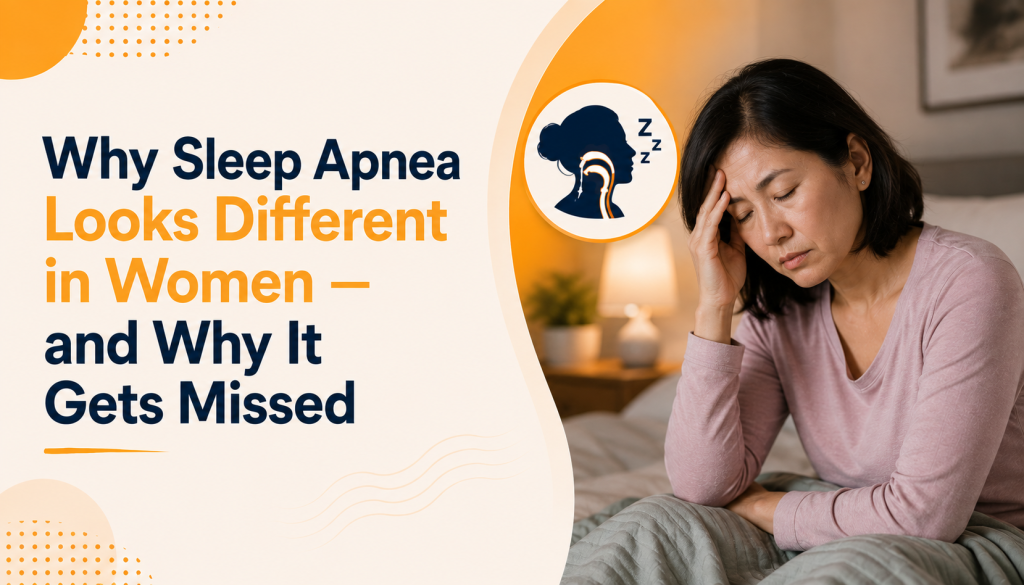
Maureen was fifty-four, a retired nurse from Nappanee who’d spent thirty years taking care of everyone but herself. By the time she sat down in my exam room, she’d seen three doctors. They told her it was menopause. They told her it was depression. She left with sleeping pills, antidepressants, and a referral to a psychiatrist. None of it touched how she felt.
She didn’t look like the sleep apnea most people picture. She wasn’t overweight. She didn’t snore like a freight train – which highlights how the clinical difference between sleep apnea and snoring can keep quieter, atypical cases hidden for decades. Her husband had never once seen her gasp for air in the night.
But she used a word that stayed with me. She said she felt “switched off.”
Her sleep study came back: severe obstructive sleep apnea. Her oxygen had been dropping into the seventies every night, and her brain had been jolting awake dozens of times an hour to start her breathing again – then forgetting it by morning. Three months on CPAP, the woman who came back to my office was barely the same person. The exhaustion was gone. The fog had thinned. The anxiety had quieted.
Her question was the one I hear most: “Why didn’t anyone catch this sooner?”
This is the answer.
Sleep apnea was studied in men, so the symptoms were defined by men
For decades, sleep apnea was treated as a man’s disease. The research focused on men. The screening questionnaires still used in clinics today were built around male symptoms. Women were close to invisible before the conversation even started.
The numbers tell the story. In the general population, women develop sleep apnea at roughly half the rate of men. But in sleep clinics — the place the diagnosis actually gets made — men have historically outnumbered women by as much as eight to one. Follow-up studies show that gap has narrowed to roughly five to one, but it has never closed. And here’s the part that matters: that gap isn’t biology. It’s recognition. Women weren’t being missed because their symptoms were strange. They were being missed because no one was looking for the disease in them, a critical clinical gap we address fully in our comprehensive sleep apnea symptoms, causes, and treatment guide.
It adds up. An estimated 80 to 95 percent of moderate-to-severe sleep apnea cases go undiagnosed — and women, normal-weight people, and anyone who sleeps alone wait the longest.
The good news underneath all of this: sleep apnea is one of the most treatable conditions in medicine. The hard part has always been finding it.
How it actually shows up — men versus women
| The textbook (male) picture | How it often looks in women | |
|---|---|---|
| Snoring | Loud, freight-train | Light, or none at all |
| Breathing pauses | Witnessed gasping | Often unwitnessed, especially if sleeping alone |
| Daytime sign | Falling asleep at the wheel | Fatigue that no amount of rest fixes |
| Mood | Irritability | Anxiety, low mood, feeling “switched off” |
| Night | - | Waking repeatedly, multiple bathroom trips |
| Morning | - | Headaches, unrested, brain fog |
Here’s how easy it is to miss: up to 40 percent of women with moderate-to-severe sleep apnea report none of the classic symptoms at all — no snoring they’re aware of, no witnessed pauses, no daytime sleepiness. They’re far more likely to report fatigue, insomnia, morning headaches, anxiety, and trouble concentrating. So the symptoms get filed under something else: just menopause, just stress, just aging, just depression. And the prescriptions follow — sleeping pills and antidepressants, when what they actually needed was a sleep study.
Want the full opening chapter, free? Read Chapter 1 of CPAP Is Sexy at dryatinjpatel.com/chapter1.
Menopause changes the math
Before menopause, women have a built-in shield. Estrogen and progesterone help keep the muscles of the upper airway firm during sleep, so the throat is less likely to collapse. That protection is a big reason men are two to three times more likely than women to have sleep apnea during the reproductive years.
After menopause, those hormone levels fall — and so does the protection. In the largest population-based sleep study ever conducted, moderate-to-severe sleep apnea was present in about 8.6 percent of premenopausal women. After menopause, that figure jumped to 29.4 percent — close to one in three. The long-standing gap between men and women narrowed by more than half.
The timing of menopause matters too. Women who go through surgical menopause — a hysterectomy with the ovaries removed — have roughly a 27 percent higher risk of developing sleep apnea than women who reach menopause naturally, because the hormonal protection doesn’t taper off gradually. It disappears overnight.
This is exactly why sleep apnea in women so often shows up, or gets worse, right around menopause – and why it gets waved off as “just menopause symptoms,” delaying vital intervention for cardiovascular complications like sleep apnea and heart disease.
The cost of getting missed
Being overlooked isn’t harmless. At the same disease severity, women with sleep apnea report more depression, more anxiety, more daytime fatigue, and meaningfully lower quality of life than men. They aren’t sicker — they’re carrying more of the disease’s weight while being told nothing is wrong.
There’s also a part of this that almost never gets discussed. A 2025 review pooling data from more than 1.3 million women found that women with sleep apnea were about 2.5 times more likely to experience sexual dysfunction — with the biggest hit to desire and arousal. And treatment moves the needle: in one University of Washington study, women’s sexual quality of life improved significantly on CPAP, while men’s barely changed.
So if you’re a woman who has watched her energy, her mood, or her intimacy fade and chalked it up to age or hormones — it’s worth considering that what changed may not have been you. It may have been your sleep.
A quick self-check
Ask yourself:
- Do you wake up tired even after a full night in bed?
- Do you wake often during the night, or get up several times to use the bathroom?
- Do you get morning headaches?
- Have you been told your fatigue is “just menopause” or “just depression”?
- Has your mood, memory, or concentration slipped?
- Has anyone noticed you snore — even lightly — or pause your breathing?
If you said yes to several of these, it’s worth asking your doctor about a sleep study. You may not fit the stereotype. You may not sound like a freight train. But you may still be struggling to breathe in your sleep.
If this sounds like you — or someone you love
Maureen spent years being treated for everything except the thing that was actually wrong. The exhaustion she’d accepted as her new normal turned out to be a treatable disease. Three months later she had her life back.
If you’ve been dismissed for years, advocate for yourself and ask for the study. And if you’re reading this for a woman you love — a wife, a mother, a sister, a friend — send it to her. The conversation you start could be the one that gives her back the version of herself she thought was gone.
Start with the opening chapter of CPAP Is Sexy, free: dryatinjpatel.com/chapter1. Read the stories, meet the patients, and see what’s waiting on the other side of a good night’s sleep.