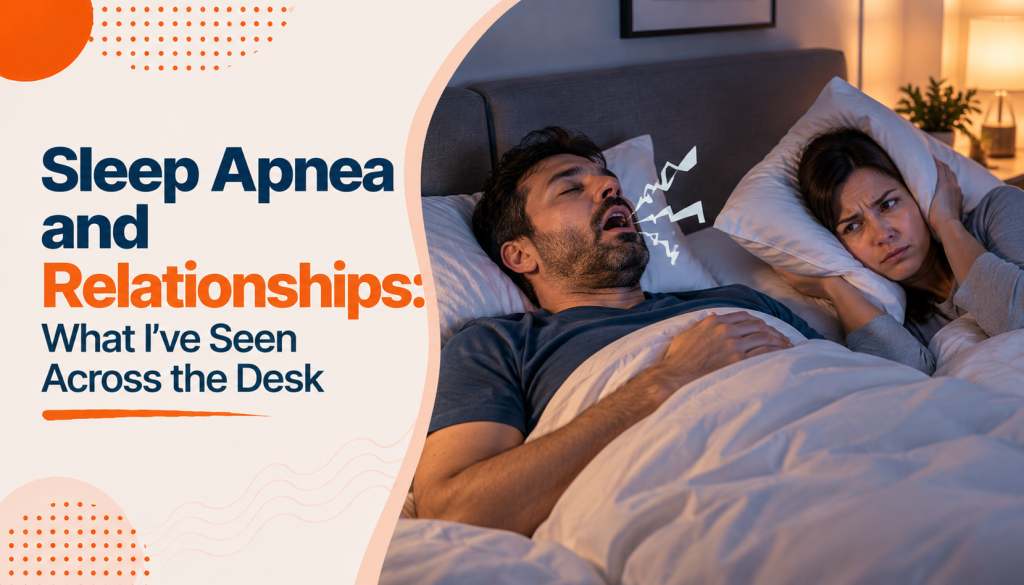
Sleep Apnea and Relationships: What I’ve Seen Across the Desk
By Yatin J. Patel, MD. Sleep Physician. Creator of the AEI∞ Framework.
John and Maria, as I call them in the book, had slept in separate bedrooms for over a decade.
His snoring drove her to the guest room first. Later, his gasping kept her awake even through the wall. Eventually, they stopped trying. They ate dinner at different times and stopped talking about their days.
When John finally got tested and started CPAP, Maria was skeptical.
I’ll come back to them. First, how couples end up there.
Sleep apnea can affect two people, not one. Partners lose sleep, many move to another room, and the fatigue that follows can wear on patience, conversation, and intimacy. For many couples, treatment can help them find their way back to each other, though every couple’s path is different.
How Separate Bedrooms Begin
It usually starts as a temporary fix. “I’ll sleep in the guest room tonight so you can rest. I have an early meeting.”
Then one night becomes most nights. Over time, the distance that started at bedtime can creep into the day.
I didn’t take this seriously at first. Then I saw the pattern repeat, dozens of times and then hundreds, and I came to believe that separate beds can lead to separate lives. Not always, but more often than anyone wants to admit.
Quiet shame often comes with it. Many couples don’t tell friends, family, or even their own doctor that they sleep apart.
To be fair, not every couple who sleeps apart is struggling. Some simply sleep better that way and are happy with it. The trouble comes when neither person chose the separation.
What Partners Carry at Night
The partner of someone with untreated sleep apnea often sleeps in fragments. One woman told me she would lie with her hand resting on her husband’s chest, feeling it rise and fall, and nudge him when a pause went on too long. A husband told me he kept a lamp on every night so he could see his wife breathing.
Then comes the daytime. The person they love may be irritable, distant, and too tired for conversation or closeness. Partners often take it personally, even when they know it isn’t about them.
“Your instincts were right. Your persistence matters.” Yatin J. Patel, MD
What Can Change After Treatment
The research here is encouraging. In a German study, more than nine in ten bed partners supported their spouse’s CPAP therapy, and partners’ relationship satisfaction rose from about half to about seven in ten after treatment [1]. A later survey of more than 1,500 partners across ten European countries found that about nine in ten viewed CPAP positively, and about four in ten said their relationship satisfaction had improved [2]. These were partner-reported results, but they match much of what I saw in my own clinic.
Back to John and Maria. Once he started CPAP, his snoring and gasping eased. Maria came back to their bedroom, tentatively at first. A few months later, she told me, “We actually talk before we fall asleep.”
Want to see how the book begins? Read Chapter 1 free at dryatinjpatel.com/chapter1.
What Partners Tell Me About the Machine
Many patients worry their partner will find the mask unattractive. When I talk with partners, I tend to hear the opposite.
“The soft hum is so much better than the terrifying silence.”
“We’re in the same bed for the first time in years. Do you know what that means to me?”
For many partners, the machine on the nightstand is a sign that the person they love is taking care of themselves, for both of them.
If You’re the One Lying Awake
Your sleep counts too. Your exhaustion is real, even if your partner insists they sleep fine.
“The sleep study measures what happens inside your body. It doesn’t measure what happens to the person beside you.” Yatin J. Patel, MD
If you suspect sleep apnea, consider going to the first appointment together. A doctor can learn a great deal from the person who has been listening every night.
And if conversations about it keep ending in “I’m fine,” you are not alone. Many of the partners I met had been asking for years before anything changed. I wrote the book partly for you.
Forty-One Years
Years after Maria came back to their bedroom, she and John sent me a card on their 41st anniversary. The front said, “We slept on it.” Inside were three words: “For forty-one years.”
Frequently Asked Questions
-
Can sleep apnea affect a relationship?
It can. Sleep apnea disrupts the partner’s sleep as well as the patient’s, and the daytime fatigue, irritability, and low energy that can follow can strain relationships. Many couples also end up sleeping apart.
-
Is it common to sleep in separate bedrooms because of snoring?
-
Can CPAP help a relationship?
-
Should a partner come to the sleep appointment?
-
What if my partner snores but doesn't have sleep apnea?
-
Does sleep apnea affect intimacy?
Start With Chapter 1
If you’ve been lying awake beside someone you miss, start with the first chapter. It’s free, and you may recognize more of your own story than you expect.
Read Chapter 1 at dryatinjpatel.com/chapter1.
References
- Fietze I, et al. Nocturnal positive pressure ventilation improves relationship satisfaction of patients with OSA and their partners. Sleep Medicine. 2023;111:191-198. https://doi.org/10.1016/j.sleep.2023.08.023
- Laharnar N, et al. Bed partner perception of CPAP therapy on relationship satisfaction and intimacy: a European perspective from the ESADA network. Journal of Sleep Research. 2024;33(4):e14125. https://doi.org/10.1111/jsr.14125
This article shares a physician’s perspective for general education. It is not medical advice and does not replace care from your own physician.