Sleep Apnea vs Snoring: What’s the Difference?
A woman who worked the front desk at the cancer center in Goshen cornered me in the hallway for months about her husband’s snoring. Freight train one night, she said. Grizzly bear the next. I told her to bring him to the clinic. He refused. Then one morning she showed up with her phone, hit play, and held it out.
It was not the noise that got my attention. It was the gap in the middle of it. Twenty seconds of nothing. Then a gasp.
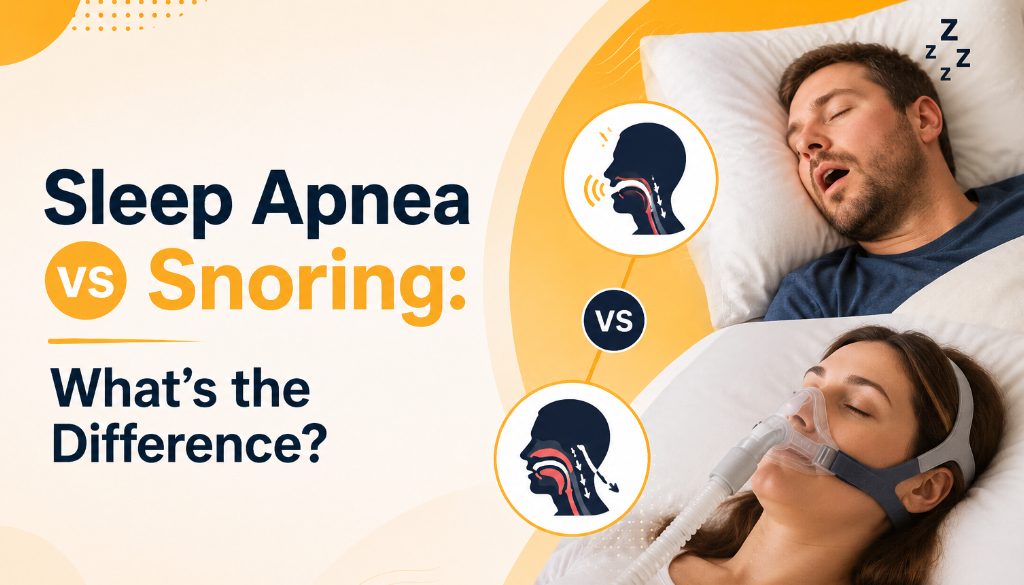
That gap is the difference between snoring and sleep apnea. Snoring is a sound. Sleep apnea is a breathing disorder. They travel together often enough that people use the words interchangeably, and that habit costs years; to understand how they interact, our comprehensive sleep apnea symptoms, causes, and treatment guide breaks down the complete spectrum so you can separate them properly.
What Is Snoring?
Snoring is the sound of tissue vibrating in your upper airway while you breathe during sleep. When you fall asleep, the muscles of your throat, soft palate, and tongue relax. The airway narrows. Air moving through that narrowed space sets the soft tissue flapping, and you get the sound.
Snoring without breathing pauses and without drops in blood oxygen is called primary snoring. On its own, it is not dangerous to the snorer. It is, however, one of the more reliable ways to end up sleeping in separate bedrooms.
What makes people snore:
- Carrying extra weight, especially around the neck
- Sleeping on your back
- Alcohol in the evening, which relaxes the airway further
- Nasal congestion or a deviated septum
- Age, because throat muscles relax more as the years go on
- Anatomy you were born with: a large tongue, big tonsils, a long soft palate
What Is Sleep Apnea?
Sleep apnea is a condition in which your breathing repeatedly stops or becomes too shallow while you sleep. The common form is obstructive sleep apnea, where the airway does not just narrow; it closes. Air stops moving. Oxygen falls. Your brain registers the emergency and pulls you toward wakefulness just far enough to reopen the throat, usually without waking you enough to remember it.
A full pause is an apnea. A partial one is a hypopnea. Each lasts at least ten seconds, sometimes up to a minute or longer. They can repeat dozens or hundreds of times a night. I have had patients who stopped breathing over a hundred times each hour. You are not sleeping through those events. You are surviving them.
More than eighty million American adults have sleep apnea, roughly one in three. Most of them do not know it. In population studies, somewhere between eighty and ninety-five percent of people with clinically significant sleep apnea arrive at screening with no diagnosis on record.
That is the part worth sitting with. This is not a rare condition being over-tested. It is a common one being missed.
Sleep Apnea vs Snoring: Key Differences
The formal dividing line is the apnea-hypopnea index, or AHI, which is the average number of breathing events per hour of sleep measured during a sleep study.
| Primary snoring | Obstructive sleep apnea | |
|---|---|---|
| What it is | Sound from vibrating airway tissue | Repeated closure of the airway |
| Breathing pauses | None of significance | Ten seconds or longer, repeatedly |
| Blood oxygen | Stable | Drops with events |
| Sleep quality | Largely intact for the snorer | Fragmented, often without memory of waking |
| Daytime effect | Usually none | Fatigue, fog, low mood, sleepiness |
| AHI | Fewer than 5 events per hour | 5 or more per hour |
| Severity bands | Not applicable | Mild 5 to 15, moderate 15 to 30, severe above 30 |
| Main risk | Relationship and quality of life | Cardiovascular, metabolic, cognitive, safety |
You cannot tell which side of that table you are on by how loud you are. Volume is not the measurement. Oxygen is.
Is Snoring a Sign of Sleep Apnea?
It can be. Snoring is one of the most common symptoms people with obstructive sleep apnea report, and loud habitual snoring is a reasonable prompt to get evaluated.
But snoring by itself does not diagnose anything. Plenty of people snore for decades with a normal AHI and normal oxygen all night. The sound tells you the airway is narrowing. It does not tell you whether it is closing.
There is also good reason not to assume tonight’s snoring is next year’s snoring. Airways change as weight, age, muscle tone, and nasal anatomy change. Snoring that was harmless at forty is worth rechecking at fifty-five, particularly if your partner starts describing pauses that were not there before.
Signs Your Snoring May Be Sleep Apnea
Bring these to your doctor:
- Witnessed pauses in breathing, meaning someone has watched you stop
- Gasping, choking, or snorting yourself awake
- Waking unrefreshed after a full night in bed
- Daytime sleepiness, or fatigue heavy enough to reshape your afternoons
- Trouble concentrating, or memory that has quietly gotten worse
- Morning headaches that fade within a couple of hours
- Waking to urinate twice or more a night
- Nighttime heartburn
- Irritability, low mood, a shorter fuse than you used to have
The single most telling one is gasping or choking at night. If someone has watched you stop breathing, that is not a snoring conversation anymore. That is a sleep study conversation.
If you recognize yourself in that list, the first chapter of my book walks through exactly what happens next, in plain language, before you ever call a clinic. You can read it free at dryatinjpatel.com/chapter1.
Can You Have Sleep Apnea Without Snoring?
Yes, and this is where the diagnosis gets missed most often.
Snoring is common in sleep apnea. It is not universal. There are quiet apneics, and they are disproportionately women. For years, men were referred for sleep studies about eight times more often than women who reported the same symptoms. That gap has narrowed to roughly five to one, but it has not closed.
Women were not missed because their apnea was exotic. They were missed because the picture in everyone’s head was a heavyset man sawing logs, and a tired forty-five-year-old woman with a morning headache does not match that picture. She gets told it is stress, or hormones, or anxiety, or that it is simply what this decade feels like – which is why understanding why sleep apnea looks different in women is key to stopping the cycle of misdiagnosis.
Two things worth knowing:
Before menopause, roughly one in twelve women has moderate to severe sleep apnea. After menopause, it is closer to one in three. The airway loses a hormonal protection it had for thirty years.
And among patients carrying a chronic insomnia diagnosis in one large sleep-clinic series, about eight in ten turned out to have undiagnosed sleep apnea. Their trouble was not that they could not sleep. It was that they could not breathe, and the body kept interrupting sleep to fix it.
If you have the daytime symptoms and none of the noise, you still deserve the test.
Why Sleep Apnea Is More Serious Than Snoring
Primary snoring costs you a peaceful bedroom. Untreated sleep apnea costs you more, because every event spikes blood pressure and drops oxygen, and the body absorbs that hundreds of times a night for years.
Untreated sleep apnea is associated with roughly double the risk of stroke, and in men with the severe form the risk climbs to nearly four times. It is linked to about a quarter higher risk of cognitive impairment and dementia. Moderate to severe disease carries substantially higher odds of atrial fibrillation – underscoring the dangerous, circular relationship between sleep apnea and heart disease – though whether treating the apnea prevents that rhythm problem specifically is not settled. In severe, untreated cases, all-cause mortality runs about sixty percent higher; mild apnea does not carry that signal.
There is a daytime cost too. Put drowsy drivers in a simulator and three out of four who rated themselves barely tired were moderately or severely impaired. One in four kept driving with their eyes closed and still believed they were fine.
Now the part I care about more, because it is the part patients actually feel.
This is a highly treatable condition, and the return is fast. In one clinic cohort, three months of consistent treatment took the average depression score from clinically depressed down to barely a trace, with no change in anyone’s antidepressant. Only the breathing changed. Survey the bed partners, and more than nine in ten support the therapy, with relationship satisfaction climbing from about half to seven in ten after treatment.
That is what the sleep study is actually for. Not a diagnosis to carry around. A door.
How Sleep Apnea Is Diagnosed
Your doctor may start with a screening questionnaire such as STOP-BANG, which scores snoring, tiredness, observed apneas, blood pressure, body mass index, age, neck circumference, and sex. It is a screening tool, not a diagnosis.
The diagnosis itself requires a sleep study.
In-lab polysomnography remains the gold standard. You spend a night in a sleep lab while brain waves, eye movement, heart rhythm, airflow, breathing effort, oxygen, and limb movement are all recorded. It catches sleep apnea and everything else that might be going on.
A home sleep apnea test measures a narrower set of signals, usually airflow, effort, heart rate, and oxygen. It is cheaper, more comfortable, and appropriate when moderate to severe obstructive sleep apnea is suspected in an otherwise healthy adult. It can underestimate milder disease, and a negative home test in a symptomatic patient should be followed by a lab study rather than accepted as the end of the conversation.
Treatment Options for Sleep Apnea and Snoring
For primary snoring:
- Weight loss where excess weight is a factor
- Positional therapy, which usually means staying off your back
- Moving alcohol earlier in the evening or cutting it
- Treating nasal obstruction with rinses, steroid sprays, or dilator strips
- A mandibular advancement device, a custom-fitted oral appliance that holds the lower jaw forward, recommended as first line for snoring
- Exercises that strengthen the tongue, throat, and palate muscles
- Palate or nasal surgery in selected cases
For obstructive sleep apnea:
- Positive airway pressure therapy, the first-line treatment. A machine delivers a steady stream of air through a mask to hold the airway open. Continuous, bilevel, and auto-adjusting versions exist. It improves daytime sleepiness, blood pressure, and quality of life.
- Weight loss, through lifestyle change, medication, or bariatric surgery, which can put mild disease into remission
- Oral appliances, a reasonable alternative in mild to moderate disease or for people who cannot tolerate a mask
- Hypoglossal nerve stimulation, an implanted device that keeps the tongue forward during sleep, for patients who cannot use PAP
- Positional therapy for people whose events are concentrated on their back
- Surgery when other approaches have not worked
One note on the mask, because it is the objection I heard most in thirty years of practice. The machines are not the machines you remember. They are quiet, small, and the masks come in shapes that would not have existed a decade ago. Most people who quit CPAP quit over a fixable problem in the first three weeks.
When Should You See a Doctor?
Make the appointment if you have loud, persistent snoring with witnessed pauses, gasping or choking at night, daytime sleepiness that interferes with work or driving, morning headaches, memory or concentration trouble, or repeated nighttime waking. Make it too if you have the daytime symptoms without any snoring at all, especially if you are a woman who has been handed three other explanations already. This is a deceptive disease that is vastly underdiagnosed because the symptoms can be very subtle. I always tell my patients – Whenever in doubt, get tested. Still in doubt, get retested.
A sleep specialist is the right stop when the picture is unclear, when a home test came back negative but symptoms persist, or when treatment has already been tried and abandoned.
Frequently Asked Questions
-
Is snoring always a sign of sleep apnea?
No. Many people snore with a completely normal AHI. Loud habitual snoring with witnessed pauses, gasping, or daytime sleepiness is what should get evaluated.
-
Can children have sleep apnea?
-
Will losing weight cure my snoring or sleep apnea?
-
Is CPAP the only treatment?
-
Can sleep apnea go away on its own?
-
How long does a sleep study take?
Conclusion
Snoring is a sound. Sleep apnea is a breathing disorder that happens to make one. The difference is not volume; it is oxygen, and the only way to know which one you have is to measure it.
The woman with the recording on her phone got her husband tested that month. He was severe. He has been on treatment for years now, and what she reports is not that the house is quieter, though it is. What she reports is that she got her husband back.
That is the thing worth testing for. Not the sound. The person on the other side of it.
Read the first chapter of CPAP Is Sexy free at dryatinjpatel.com/chapter1.
Yatin J. Patel, MD, is a board-certified sleep physician and the founder of the Sneeze and Snooze Clinic in Goshen, Indiana. He is the creator of the AEI∞ Framework and the author of CPAP Is Sexy: How Treating Sleep Apnea Restores Energy, Intimacy, and Life.
References
- Sönmez I, et al. Unmasking obstructive sleep apnea: estimated prevalence and impact in the United States. Respiratory Medicine. 2025;248:108348.
- Yeghiazarians Y, et al. Obstructive sleep apnea and cardiovascular disease: AHA scientific statement. Circulation. 2021;144(3):e56-e67.
- Gottlieb DJ, Punjabi NM. Diagnosis and management of obstructive sleep apnea. JAMA. 2020;323(14):1389-1400.
- Wisconsin Sleep Cohort analysis, referral gap between women and men.
- HypnoLaus population study, Lausanne.
- Krakow B, et al. Sleep and Human Health Institute, chronic insomnia cohort.
- Yaggi HK, et al. Obstructive sleep apnea as a risk factor for stroke and death. N Engl J Med. 2005;353(19):2034-2041.
- Lal C, et al. Ann Am Thorac Soc. 2022;19(8):1245-1256.
- American Heart Association scientific statement on sleep-disordered breathing and cardiac rhythm.
- Wang X, et al. Respirology. 2016;21(6):1038-1044; Young T, et al. Sleep. 2008;31(8):1071-1078.
- Cher J, Gaspar J, Carney C. Drowsiness and Decision Making During Long Drives. AAA Foundation for Traffic Safety; 2023.
- Western Australia sleep-clinic cohort, n=426.
- German bed-partner study, 508 partners; European replication.
- Ramar K, et al. Clinical practice guideline for the treatment of obstructive sleep apnea and snoring with oral appliance therapy: an update for 2015. J Clin Sleep Med. 2015;11(7):773-827.