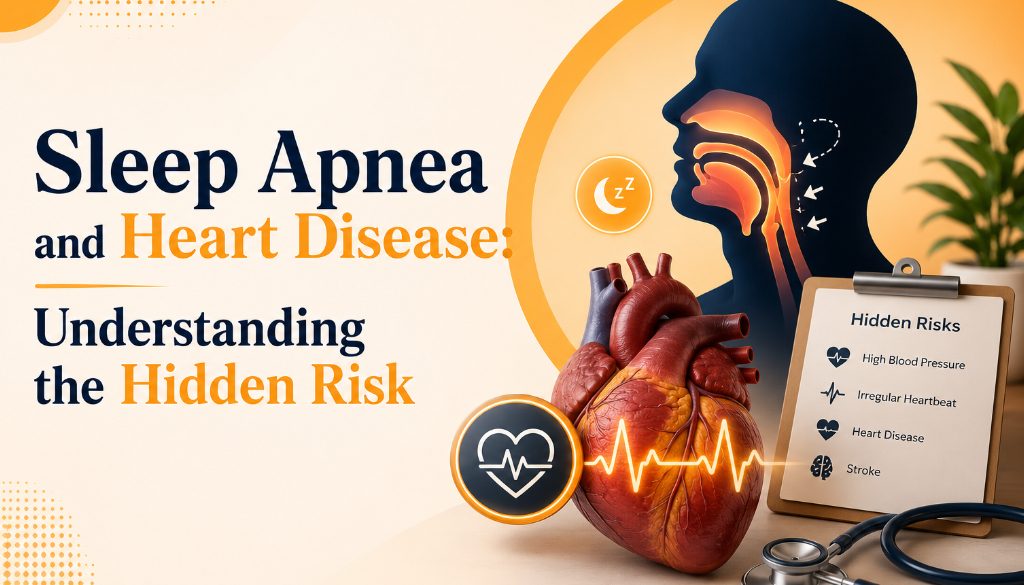
Sleep Apnea and Heart Disease: Understanding the Hidden Risk
For thirty years, the single busiest referral pipeline into my sleep clinic came from one place – and it wasn’t another sleep specialist. It was the Center for Cardiovascular Diseases. Heart doctors are sending me their patients by far the most of anyone else. That never surprised me, because the cardiologists had already worked out what most people are never told: the heart trouble you worry about and the breathing you do at night are far more connected than they seem. And here is the part that matters more than the risk itself – this is one of the most treatable links in all of medicine. Once you understand how sleep apnea reaches the heart, you also understand exactly how to take that pressure back off it.
Sleep apnea is common. It affects roughly 34 percent of middle-aged men and 17 percent of middle-aged women. Yet an estimated 80 percent or more of the people who have it have never been diagnosed. That gap is the whole story here – because untreated sleep apnea does not just cost you a good night. Night after night, it puts real, measurable strain on the heart and blood vessels, and it is closely associated with high blood pressure, heart attack, stroke, heart failure, and irregular heart rhythms.
The good news runs alongside every one of those facts: when the breathing is treated, much of that strain comes off. Let me walk you through how the connection works, and what the evidence says you can get back.
How Sleep Apnea Affects the Heart
Obstructive sleep apnea occurs when the muscles at the back of the throat relax during sleep, narrowing or collapsing the upper airway. Breathing pauses – sometimes dozens or hundreds of times a night – and each pause lasts ten seconds or longer.
Your body treats every one of those pauses as an emergency. Blood pressure spikes, the heart rate swings, stress hormones surge, and oxygen drops. Repeat that cycle for years, and the cardiovascular system pays a cumulative bill: more inflammation, damage to the lining of the blood vessels, faster buildup of plaque in the arteries, and a heart working harder than it should.
This is why the American Heart Association recognizes obstructive sleep apnea as a condition associated with hypertension, atrial fibrillation, heart failure, coronary artery disease, stroke, pulmonary hypertension, and cardiovascular death. The relationship runs both ways. Among people who already have one of those cardiovascular conditions, sleep apnea occurs in an estimated 40 to 80 percent of cases – a loop in which apnea worsens the heart disease and the heart disease worsens the apnea. The reassuring flip side is that treating the apnea is one of the few moves that can interrupt that loop from the sleep side.
Oxygen Deprivation During Sleep, Explained
The signature of obstructive sleep apnea is intermittent hypoxemia – repeated dips in blood oxygen through the night. This is different from the steady thin air of high altitude. Sleep apnea delivers rapid cycles of oxygen falling and then rushing back. That pattern is what makes it harmful: it mimics the ischemia-reperfusion injury seen in heart attacks and strokes, where tissue is starved and then abruptly reoxygenated.
Each cycle triggers the sympathetic nervous system – the fight-or-flight response – releasing adrenaline and noradrenaline that tighten blood vessels and raise blood pressure. At the same time, straining to breathe against a closed airway creates large pressure swings in the chest that increase the heart’s workload in both directions at once. The repeated oxygen drops also generate reactive oxygen species – unstable molecules that damage cells and fuel inflammation – which, over time, contribute to endothelial dysfunction and accelerated arterial hardening.
The High Blood Pressure Connection
If sleep apnea has a signature cardiovascular consequence, it is high blood pressure. Roughly half of people with obstructive sleep apnea have hypertension, and about 30 percent of people with hypertension have sleep apnea. The overlap is most striking in resistant hypertension – blood pressure that stays high despite three or more medications – where 60 to 95 percent of patients have moderate-to-severe sleep apnea.
Part of what makes this connection so consequential is timing. The pressure surges from sleep apnea happen during sleep, exactly when blood pressure should be at its lowest. That “non-dipping” pattern – pressure that fails to fall overnight – carries its own cardiovascular risk, over and above whatever your daytime readings show. Recent ACC/AHA hypertension guidance now recognizes obstructive sleep apnea as a secondary, treatable cause of high blood pressure, and a particularly important one to look for in resistant cases. That word – treatable – is the reason it belongs on the checklist.
Stroke and Heart Failure Risks
The effects of untreated sleep apnea extend well beyond blood pressure.
Stroke. Untreated sleep apnea is associated with roughly double the risk of stroke, and in men with more severe apnea the association climbs closer to fourfold. It is also common on the other side of a stroke – a large share of stroke patients are found to have obstructive sleep apnea – and untreated apnea is independently linked to poorer recovery and higher risk of a second event. Which is precisely why finding and treating it after a stroke is worth the effort.
Heart failure. Sleep-disordered breathing shows up in 40 to 60 percent of patients with symptomatic heart failure. Sustained high pressure, the strain of those intrathoracic pressure swings, and chronic sympathetic activation all push the heart muscle toward remodeling. People with sleep apnea who do not yet have heart failure carry a higher risk of developing it down the road.
Coronary artery disease. Untreated sleep apnea is associated with about a twofold increase in cardiovascular events or death. And the timing is telling: in people with sleep apnea, heart attacks are more likely to strike during nighttime sleeping hours – the reverse of the general population’s morning peak.
Atrial fibrillation. Sleep-disordered breathing is common among people with atrial fibrillation, reported in 21 to 74 percent depending on the group studied. Untreated apnea is also associated with a meaningfully higher chance that atrial fibrillation returns after an ablation procedure.
These are the stakes. They are real, and they are also why treating breathing is one of the highest-leverage things you can do for your heart. That is where the story turns.

Read the first chapter free. If you want the plain-English version of how sound sleep restores the heart, the energy, and the life around it, download Chapter 1 of CPAP Is Sexy at dryatinjpatel.com/chapter1.
Sleep Apnea and Heart Disease in Women
Almost everything above was mapped first in men, and that has quietly cost women. In community studies, the true male-to-female gap in sleep apnea is closer to 2:1 or 3:1 – far narrower than the picture you would get from those who actually end up in a sleep lab. Women are overlooked because their apnea does not fit the textbook; to learn more, read our deep dive on why sleep apnea looks different in women and how unique symptoms like insomnia get misdiagnosed for years. Instead of loud snoring and daytime sleepiness, women more often report fatigue, insomnia, and low mood – symptoms that get chalked up to stress or hormones for years.
Here is the surprising turn: when women’s apnea is detected, the heart risk may be higher, not lower. A large Finnish population study found sleep apnea raised coronary heart disease risk more in women than in the population overall. In one prospective study following nearly a thousand women, untreated sleep apnea was linked to a sharply higher risk of stroke – and adequate CPAP use brought that risk back down toward that of women without apnea. Untreated severe apnea in women has likewise been associated with higher cardiovascular mortality that CPAP therapy appears to normalize.
Risk also shifts at menopause. Sleep apnea becomes markedly more common afterward – roughly a threefold rise – as the airway loses some of its hormonal protection. The practical takeaway is simple: a woman does not have to look like the classic case to have this. Fatigue, insomnia, a low mood no one can quite explain, or blood pressure that won’t come down are all reasons to ask about sleep.
Can CPAP Reduce Heart Risks?
Continuous positive airway pressure – CPAP – is the first-line treatment for obstructive sleep apnea. A steady stream of air holds the airway open through the night and shuts down the cycle of collapse, oxygen drops, and stress surges that drive the cardiovascular damage. The honest version of the evidence is nuanced, and the nuance is worth understanding, because it tells you what actually delivers the benefit.
Regarding blood pressure, multiple randomized trials show CPAP lowers readings by about 2 to 5 mmHg, with the greatest effect in resistant hypertension and a particular strength in reducing nighttime pressure – the prognostically important kind. Current guidance supports CPAP, alongside weight management, for people who have hypertension and moderate-to-severe sleep apnea.
On major cardiac events, three large randomized trials did not show a significant reduction in nonsleepy patients overall. But when researchers pooled individual patient data and focused specifically on people who actually wore the mask for at least 4 hours a night, the picture shifted: adherent users had a significant reduction in major cardiac and stroke events. That is a subgroup finding rather than the trials’ headline result, so read it as promising, not proven – but it points at something clinicians see constantly.
Because the honest through-line is this: adherence is the whole game. The cardiovascular benefit of CPAP appears to be strongly dose-dependent and evident in people who use it consistently. At the same time, apnea-related stress on the body returns quickly when the mask comes off. Sleep apnea is highly treatable – not “cured and forgotten,” but genuinely controllable night after night – and that control protects the heart.
For people who cannot tolerate CPAP, there are real alternatives: oral appliances that hold the jaw forward, positional therapy, weight loss, and in selected cases surgery or nerve stimulation. The goal is the same – keep the airway open, keep the oxygen steady.
When to See a Doctor
Most people with sleep apnea don’t know they have it, which is why understanding the full range of sleep apnea symptoms, causes, and treatment is so critical before the warning signs worsen.
- Loud or irregular snoring, especially if a partner has noticed pauses (understanding the clinical difference between sleep apnea and snoring is key to knowing when to seek help)
- Gasping, choking, or snorting during sleep
- Waking unrefreshed no matter how long you slept
- Daytime fatigue or sleepiness that doesn’t add up
- Morning headaches that fade within a couple of hours
- Frequent nighttime urination
- Trouble concentrating or remembering
- A dry mouth on waking
Some factors should lower your threshold to get checked: obesity, particularly around the middle; a larger neck circumference (over about 17 inches in men, 15 in women); age over 50; a family history of sleep apnea; and – importantly – any existing cardiovascular condition, especially resistant hypertension, atrial fibrillation, or heart failure.
Diagnosis is more accessible than it used to be. In many cases it starts with a home sleep study using a portable monitor. The American Heart Association specifically recommends screening for sleep apnea in people with resistant or poorly controlled high blood pressure, pulmonary hypertension, and recurrent atrial fibrillation. If it’s there, the sooner it’s treated, the less cumulative strain it places on the heart.
Frequently Asked Questions
-
How common is sleep apnea?
Common. About one-third of middle-aged men and roughly one in five middle-aged women meet the criteria for obstructive sleep apnea, and prevalence rises with age and weight.
-
Can sleep apnea cause a heart attack?
-
Does losing weight help sleep apnea?
-
Is untreated sleep apnea dangerous?
-
How many hours a night should CPAP be used?
Conclusion
The connection between sleep apnea and heart disease is real, and it is hidden for far too many people – but hidden is not the same as unfixable. Every mechanism that makes untreated apnea hard on the heart runs in reverse the moment the airway stays open: the pressure eases, the oxygen holds steady, and the nightly emergencies stop. A billion years of evolution built us to be restored by sound sleep. Getting that sleep back is not a small thing for your heart, your energy, or the life around you.
If you recognize yourself – or someone in your house – in any of this, the next step is simple. Ask about a sleep study. And if you’d like the plain-English version of what’s waiting on the other side of treatment, download the first chapter of CPAP Is Sexy free at dryatinjpatel.com/chapter1.
References:
- Yeghiazarians Y, Jneid H, Tietjens JR, et al. Obstructive Sleep Apnea and Cardiovascular Disease: A Scientific Statement From the American Heart Association. Circulation. 2021;144(3):e56-e67.
- Javaheri S, Javaheri S, Somers VK, et al. Interactions of Obstructive Sleep Apnea With the Pathophysiology of Cardiovascular Disease, Part 1: JACC State-of-the-Art Review. Journal of the American College of Cardiology. 2024;84(13):1208-1223.
- Jones DW, Ferdinand KC, Taler SJ, et al. 2025 ACC/AHA Guideline for the Prevention, Detection, Evaluation, and Management of High Blood Pressure in Adults. Journal of the American College of Cardiology. 2025;86(18):1567-1678.
- Gottlieb DJ, Punjabi NM. Diagnosis and Management of Obstructive Sleep Apnea: A Review. JAMA. 2020;323(14):1389-1400.
- Veasey SC, Rosen IM. Obstructive Sleep Apnea in Adults. The New England Journal of Medicine. 2019;380(15):1442-1449.
- Lastra AC, Neborak JM, Mokhlesi B. Diagnosis and Treatment of Obstructive Sleep Apnea. JAMA Internal Medicine. 2025.
- Sánchez-de-la-Torre M, Gracia-Lavedan E, Benítez ID, et al. Adherence to CPAP Treatment and the Risk of Recurrent Cardiovascular Events: A Meta-Analysis. JAMA. 2023;330(13):1255-1265.
- Bock JM, Shraffi Venkatesh V, Somers VK. Sex Differences in Atherosclerotic Cardiovascular Disease Risk among Patients with Obstructive Sleep Apnea. Current Atherosclerosis Reports. 2025;27(1):64.
- Strausz S, Havulinna AS, Tuomi T, et al. Obstructive Sleep Apnoea and the Risk for Coronary Heart Disease and Type 2 Diabetes: A Longitudinal Population-Based Study in Finland. BMJ Open. 2018;8(10):e022752.
- Campos-Rodriguez F, Martinez-Garcia MA, Reyes-Nuñez N, et al. Role of Sleep Apnea and Continuous Positive Airway Pressure Therapy in the Incidence of Stroke or Coronary Heart Disease in Women. American Journal of Respiratory and Critical Care Medicine. 2014;189(12):1544-50.
- McSweeney JC, Rosenfeld AG, Abel WM, et al. Preventing and Experiencing Ischemic Heart Disease as a Woman: A Scientific Statement From the American Heart Association. Circulation. 2016;133(13):1302-31.