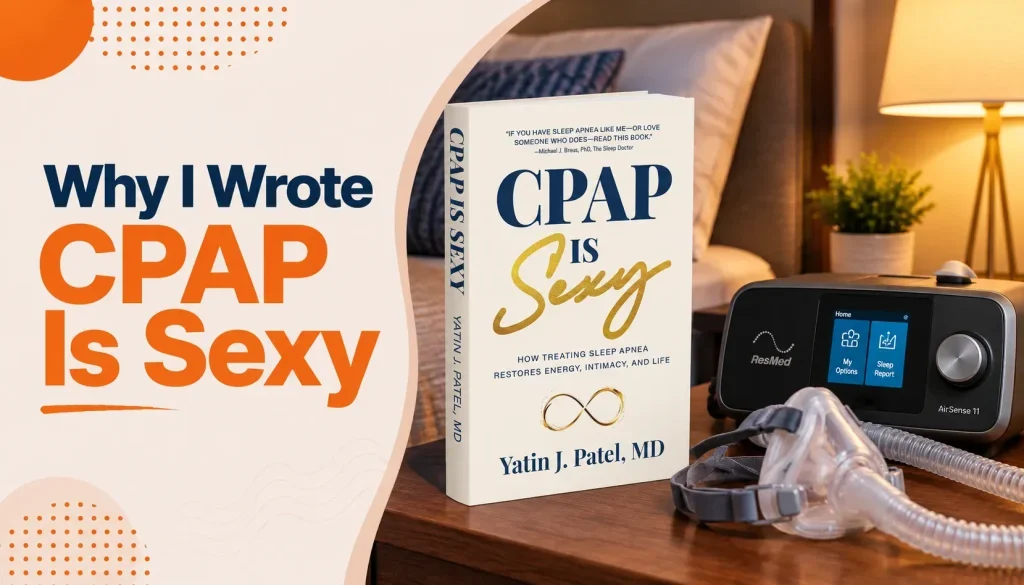
Why I Wrote CPAP Is Sexy
By Yatin J. Patel, MD. Sleep Physician. Creator of the AEI∞ Framework.
He sat across the desk from me, arms folded. His wife had made the appointment. For years, she had watched him stop breathing in his sleep.
I walked him through what untreated sleep apnea is linked to: high blood pressure, heart disease, stroke, drowsy driving. He cut me off.
“I am not wearing that CRAP.”
So I tried something else. I told him studies also show that CPAP can improve intimacy, desire, and sexual function.
His arms unfolded. He leaned forward. “Hmm,” he said. “Maybe I’ll give it a try.”
Why I Wrote This Book
I wrote CPAP Is Sexy to change how we talk about sleep apnea: less fear, more about what treatment can give back.
That sentence on my desk was no trick. Research has found that CPAP treatment may improve aspects of sexual and intimate health for some people with sleep apnea [1]. Results are not the same for everyone, but that research pointed to something my patients cared about far more than a risk chart.
For many years, I led with risk. That was how I was trained, and the risks are real. But I learned, slowly, that fear rarely moves people to change. Patients nodded, went home, and too often nothing happened.
So I changed my approach. I started with what was waiting on the other side: energy that lasts through the afternoon, patience with the people they love, desire they assumed was gone, being present at the dinner table instead of fading in the chair. Patients leaned in instead of shutting down.
That is why the subtitle reads How Treating Sleep Apnea Restores Energy, Intimacy, and Life.
It Started in a Borrowed Room
In 1994, I opened a small clinic in Goshen, Indiana, in the heart of Amish country. My first sleep study ran in a borrowed stress-test room. Over the years, that room grew into an accredited four-bed sleep center at Goshen Hospital.
The people who came through the door were factory workers and farmers, truck drivers and teachers, skeptics and believers. I ended up living in Goshen longer than I lived in the village in India where I was born. That community taught me more than medical school did.
One Patient at a Time
In my first week of the MBA program at Notre Dame, the professor went around the room and asked each of us why we were there.
I told him the truth. I was a sleep doctor in a small clinic in the middle of the cornfields, helping one patient at a time. My ambition was to help the millions of people suffering from obstructive sleep apnea.
In the clinic, my rule was simple: if today we can help one person sleep better and live better, we have done a good job. I still believe that. But one exam room will never reach millions.
This book is a step in that direction. It carries the conversation from my desk to the people who will never sit across from me.
What I Saw After Treatment
Many of my patients arrived because someone else made the appointment. A wife. A husband. A grown daughter. They were tired and short-tempered, nodding off in the recliner by evening, and many of them were sure they slept fine.
Then, for many of them, something shifted once treatment took hold. Not for everyone, and rarely overnight. But often enough that it became the part of my work I looked forward to most. Partners would tell me about the energy, the patience, and the presence they thought were gone for good.
The Amish families I cared for have a way of receiving good fortune. When healing comes, they give thanks. Then they ask a second question: What am I to do with this blessing?
After watching sleep come back to thousands of people, that question started asking me. This book is my answer.
The Gap I Couldn’t Stop Thinking About
More than 80 million American adults, about one in three, meet the criteria for sleep apnea, and about half of those cases are mild [2]. Most people with significant sleep apnea have no diagnosis on record [3].
For the people who do get treated, the bar for success is surprisingly low. Insurance coverage has long been tied to using CPAP four hours a night on 70 percent of nights, and only about half of diagnosed patients are counted as meeting it [4]. Major sleep and lung societies have since questioned whether that threshold reflects what patients really need [5]
Four hours is half a night. Very few people feel like themselves on half a night.
In my clinic, we aimed for seven hours, night after night. Patients who reached seven or more hours got a T-shirt that read “I got A+ on my report card.” The plus stood for seven-plus hours on their CPAP download. People wore those shirts with real pride. That pride lives in this book.
Want to see how the book begins? Read Chapter 1 free at dryatinjpatel.com/chapter1.
Where This Book Really Comes From
Two people shaped this book long before I wrote a word.
My mother, Sushila, spent countless sleepless nights tending to my childhood asthma. She taught me tenderness, patience, and the quiet courage of caregiving. Decades later, I became a pulmonary and sleep doctor. I don’t think that is a coincidence.
My late father, Jayanti Patel, wrote novels in rural India when few people around him could read them. He showed me that words take root quietly and reach places the writer may not see.
Then there are the patients who hated CPAP with operatic intensity. Every objection they raised sharpened my answers. In many ways, they wrote this book with me.
What CPAP Is Sexy Is, and What It Isn’t
It is a sleep physician sitting across the desk from you, sharing what three decades in the clinic taught him. It is stories drawn from real patients, with names and identifying details changed to protect their privacy. It is practical help for people starting treatment and for people who tried it and set it aside.
It is not a replacement for your own doctor. Your situation is yours, and the right next step is a conversation with a physician who knows you.
And it is not a book about fear. It is about what may be waiting on the other side.
Frequently Asked Questions
-
What is CPAP Is Sexy about?
CPAP Is Sexy is about how treating sleep apnea can restore energy, intimacy, and quality of life. It draws on thirty years of clinical practice and real, de-identified patient stories.
-
Who is Yatin J. Patel, MD?
-
Are the patient stories in the book real?
-
Is the book a substitute for medical advice?
-
What inspired Dr. Patel to write CPAP Is Sexy?
Start With Chapter 1
If someone in your life has been tired for a long time, or if that someone is you, start with the first chapter. It’s free.
Read Chapter 1 at dryatinjpatel.com/chapter1.
References
- Reishtein J, et al. Outcome of CPAP treatment on intimate and sexual relationships in men with obstructive sleep apnea. Journal of Clinical Sleep Medicine. 2010;6:221-226.
- Yeghiazarians Y, et al. Obstructive sleep apnea and cardiovascular disease: a scientific statement from the American Heart Association. Circulation. 2021;144(3):e56-e67.
- Patil SP, et al. Optimal NIV Medicare Access Promotion: patients with OSA. Chest. 2021;160(5):e409-e417.
- May AM, et al. Moving toward equitable care for sleep apnea in the United States: positive airway pressure adherence thresholds. American Journal of Respiratory and Critical Care Medicine. 2023;207(3):244-254.
This article shares a physician’s perspective for general education. It is not medical advice and does not replace care from your own physician.