How to Actually Get Used to a CPAP Mask (When You Feel Like You Can’t)
Margaret, Middlebury schoolteacher who commanded classrooms for decades, was in her early sixties — silver-haired, sharp, and severely claustrophobic for most of her life. She couldn’t wear a watch on her wrist. Couldn’t put on perfume or spray anything near her face. When her heart doctor told her she was heading for a stroke if she didn’t treat her sleep apnea, she went home with a CPAP machine and couldn’t bring herself to even touch it. For two years it sat unused while she got sicker.
Five weeks later, Margaret woke up to sunlight coming through her bedroom window with the mask still on her face. She’d slept the entire night. Her husband Gerald was already awake — he’d been lying there watching her breathe, quiet and even, no gasping, no choking. He had tears in his eyes.
“We did it,” she told the woman who’d coached her. “I just showed up.”
If the mask is sitting in a drawer at your house right now, I want you to hear two things. You’re not failing. And Margaret wasn’t braver than you — she didn’t overpower the fear. She outgrew it, one small step at a time. Here’s exactly how.
You can’t overpower it. You can outgrow it.
Here’s the mistake almost everyone makes: they try to force it. Strap it on, push through the panic, white-knuckle it until morning. And it backfires every single time — because every time you push through panic, you teach the part of your brain that sounds the alarm that the mask really is dangerous. You’re training the fear deeper. A problem you could have solved in three weeks turns into a three-month battle.
The fix is an approach called graded exposure — the same principle psychologists use to help people overcome phobias. It was first documented for CPAP in 1993, when a sleep psychologist and a physician at Duke took a man who could not tolerate CPAP at all and walked him up to full-night use in small, comfortable steps. At his six-and-a-half-year check-in, he was still using his machine. The technique is now used in behavioral sleep medicine programs across the country.
The principle is simple: you move slowly enough that your nervous system never hits the alarm, until it quietly concludes the mask isn’t a threat. Some people get through it in two weeks. Some take five — Margaret did. Both are normal. The only wrong move is skipping ahead before a step feels easy.
The approach, step by step
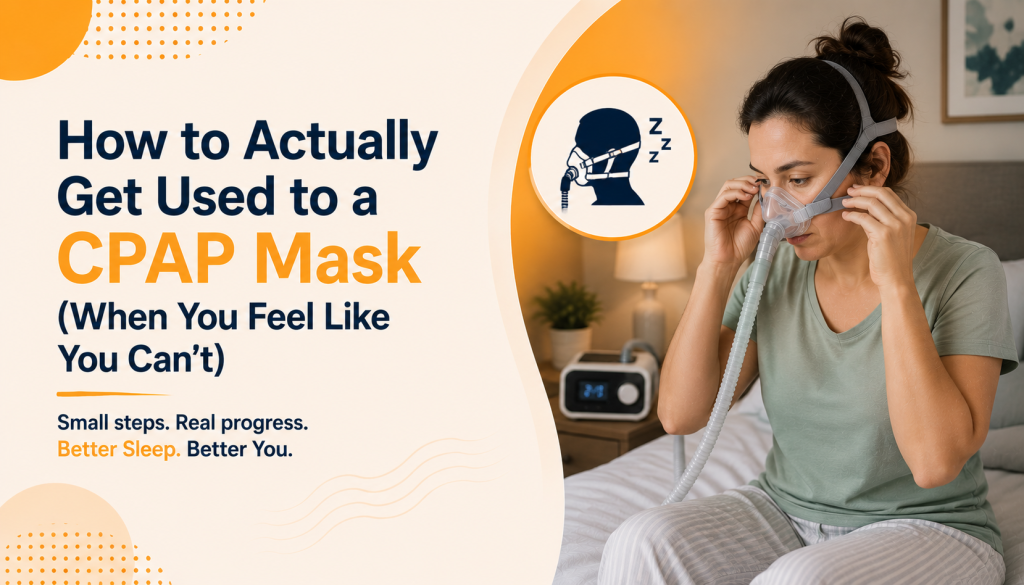
- Hold the mask to your face — no straps, no air. Sit on the couch, watch TV, just hold it there. The goal is twenty boring minutes. Bored is the win; it means the alarm has switched off. (Margaret started by doing crossword puzzles with hers in her lap until it felt as ordinary as a TV remote.)
- Add the straps. Machine still off. Wear it snug, keep doing something relaxing, until thirty minutes feels like nothing.
- Turn the machine on and press the ramp button. The ramp keeps the pressure very low — around 4 cm of water — while you’re awake, and only builds later, once you’re asleep and your airway actually needs it. The first ninety seconds are the hardest part of the whole thing. Don’t fight the air. It isn’t shoving you; it’s just there. Breathe out slowly and gently, and let the machine settle in with you. Your nervous system needs about a minute and a half to figure that out.
- Take a daytime nap with it on. This is the bridge between wearing the mask and sleeping with it. Low stakes — if it doesn’t work, you’ve lost an hour. Margaret’s first nap was forty-five minutes, and she woke with it still on. That was the turn.
- Sleep with it at night. Start with a goal of the first four hours — those are the hours richest in deep sleep — and build toward all night. Most people who stick with this are using it all night within two to four weeks.
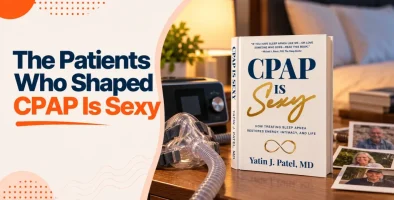
The full day-by-day version — with the breathing exercise, the timing, and the complete troubleshooting guide — is in Chapter 8 of CPAP Is Sexy. Read the opening chapter free at dryatinjpatel.com/chapter1.
Three things nobody tells you
Waking up at 3 a.m. with the mask on the floor is normal. One of my patients knocked his off four nights in a row when he started. By the second week he slept straight through with it on. Your sleeping brain takes a couple of weeks to accept the mask. When it ends up on the floor, just put it back on — no frustration, no verdict on yourself. And even partial use is real progress: the more nights and the more hours you log, the bigger the gains in blood pressure and daytime alertness tend to be.
Do not tighten the straps. It’s the most common mistake there is. A tighter mask doesn’t seal better — it seals worse, because it distorts the cushion and creates leaks. The seal comes from position, not pressure. Loosen it until it just rests against your face. If you’re still getting leaks, the mask style may not be right for your face — ask your sleep clinic about trying a different type.
The machine has comfort settings built for this. If breathing out against the pressure bothers you, there’s a feature — your clinic may call it EPR or C-Flex — that drops the pressure a little every time you exhale, so it feels more like natural breathing. Ask them to turn it on. It makes a bigger difference than most people expect.
Get a coach. It matters more than the gear.
Margaret didn’t do it alone. She saw the same coach every week, face to face, and she had Gerald at home. The patients who succeed almost never go it alone. Recruit your partner, even just to sit with you for step one. If you’re on your own, most sleep clinics now offer phone or video coaching — ours does.
This isn’t a soft suggestion. When researchers pooled more than forty trials covering over nine thousand CPAP patients, adding cognitive behavioral therapy and structured behavioral programs raised nightly use by an average of about 1.3 hours. For CPAP, how you’re supported matters at least as much as which machine you’re handed.
So don’t push through. Don’t skip steps. Find one person to walk it with you, and trust that two to four weeks of patient practice will do what years of frustration couldn’t.
The mask on your nightstand isn’t proof something’s wrong with you. It’s about to be the reason you wake up — like Margaret did — to sunlight, a full night’s sleep behind you, and someone watching you breathe easy.
Read Chapter 1 of CPAP Is Sexy free — and get the full mask protocol when the book launches: dryatinjpatel.com/chapter1.