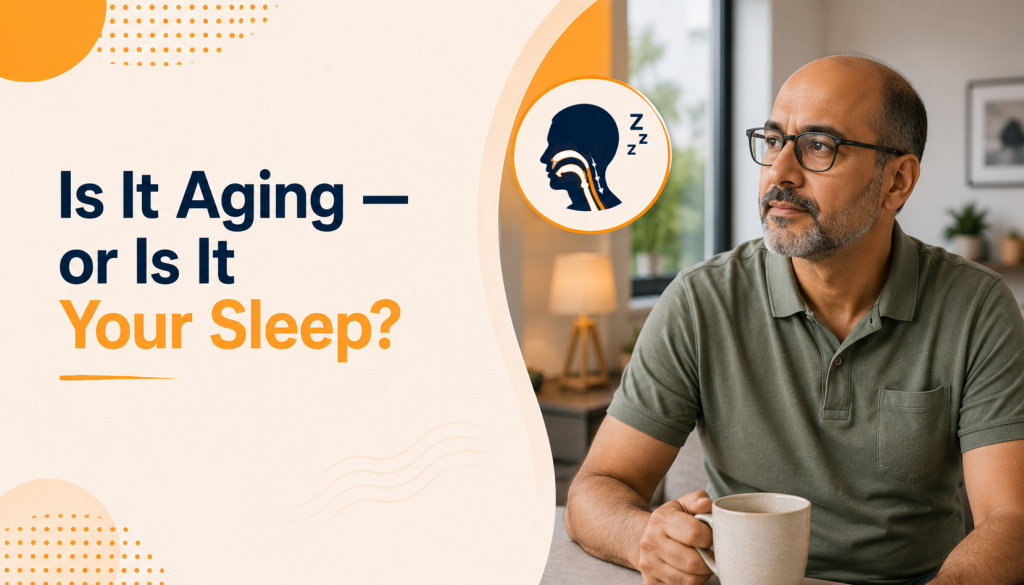
Is It Aging — or Is It Your Sleep?
David was a mechanic in New Paris, a small farming town just south of Goshen. When he was younger, people expected big things from him — sharp, athletic, disciplined, the kind of man who could fix anything. He married his high school sweetheart, built a steady trade, and made a life he was proud of.
Then, over years — so slowly no one could name the day it started — it came apart. The weight crept on. The snoring got worse. His energy flickered out. His memory dulled. His temper got short. He lost work, then lost his marriage, and a gray fog settled over him that everyone, David included, chalked up to stress, to middle age, to just how life goes.
For twenty-seven years, not one doctor thought to check his sleep.
When a neighbor finally sent him to my clinic, his sleep study showed severe obstructive sleep apnea — his oxygen crashing more than once a minute, all night, for decades. A month after he started CPAP, he walked in with a look in his eyes I hadn’t seen before. “Doc,” he said, “I feel awake inside my life again.” He wasn’t talking about feeling young. He was talking about feeling alive.
Three months later, his daughter sent me a video from his retirement party. There was David, holding his CPAP machine over his head like a trophy in front of two hundred people. “Twenty-seven years I lost,” he told them. “But I’ve got twenty-seven more coming, and I’m going to be AWAKE for every single one of them.”
The things we blame on getting older
Here’s what I hear in my exam room, almost word for word, every week:
- “I’m not as sharp as I used to be. I’m just getting older.”
- “I get up to pee three times a night. That’s just age.”
- “I’m tired because I work hard.”
- “I’m irritable because of stress.”
- “I need coffee to function. Doesn’t everyone?”
Every one of these is plausible. And every one of them lets you avoid the honest answer. Yes, age affects your body. But not like this. Not this fast, and not this much. When the sharpness, the energy, the patience, and the spark all fade together over a few years, that’s not a birthday catching up with you. That’s something stealing from you while you sleep.
Want the full story? Read Chapter 1 of CPAP Is Sexy free at dryatinjpatel.com/chapter1.
Why sleep apnea looks exactly like aging
Here’s the part most people never hear. The problem isn’t the years. It’s the nights.
Every time your airway collapses, your brain has to jolt itself awake just enough to reopen it — dozens, sometimes a hundred times an hour. You don’t remember any of it. But each one yanks you out of the deep, slow-wave sleep that repairs your body and files away your memories. You spend eight hours in bed and almost none of it in the sleep that actually restores you.
So you wake up with exactly the symptoms we’ve all been taught to call “getting old”: foggy, flat, forgetful, short-fused, running on coffee, no spark. The machinery isn’t worn out. It’s just never getting the maintenance window it needs.
You’re not getting older. You’re not getting deep sleep.
How fast it comes back
If these symptoms were really just age, they wouldn’t reverse. Here’s the tell: they do.
Researchers at Beth Israel Deaconess and Harvard tested patients the morning after their very first night on CPAP — one night — and found immediate gains in attention and reaction time. The deeper repairs, like memory, took longer to rebuild. But the lights came back on fast. One night was enough for the brain to start recovering.
David needed about a month to feel awake inside his life again. Six months in, he was driving to work singing Springsteen with the windows down — something he told me he hadn’t done in twenty-seven years, because for most of that time music had just sounded like noise.
That’s the difference between aging and apnea. Aging doesn’t hand you back the parts of yourself you thought were gone. Treating the real problem does.
So ask the question
If you’ve quietly been writing yourself off as “just getting older” — or you’ve watched someone you love go flat and called it age — it’s worth asking the one question a sleep study can actually answer.
The version of you that went quiet may not be gone. It may just not be sleeping.
Start with the opening chapter of CPAP Is Sexy, free: dryatinjpatel.com/chapter1. Meet the patients, and see what’s waiting on the other side of a real night’s sleep.