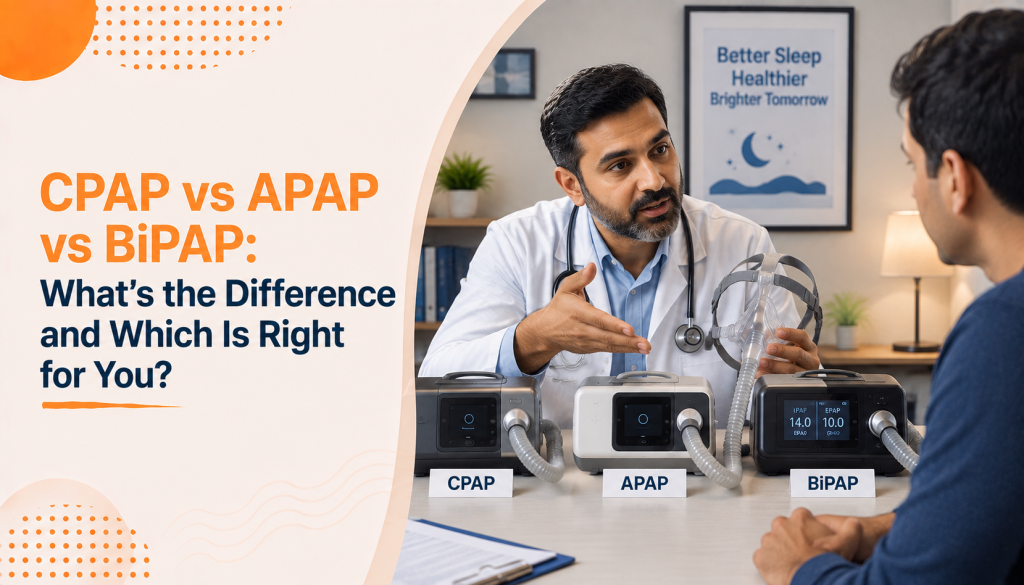
CPAP vs APAP vs BiPAP: What’s the Difference and Which Is Right for You?
Yatin J. Patel, MD, MBA. Board-certified pulmonary and sleep physician.
100K+ PATIENTS · 50K+ SLEEP STUDIES · 30 YEARS
Patients often ask me, usually with the prescription still in their hand, “Doc, did I get the right machine?”
Here is the short answer. CPAP, APAP, and BiPAP are three ways of doing the same job: sending gentle, pressurized room air through a mask to hold your airway open while you sleep. For most adults with routine obstructive sleep apnea, CPAP or APAP is the first choice, and the two work about equally well. BiPAP is a tool for specific situations.
Here is the longer answer, the one I give after thirty years in the clinic. For many adults with uncomplicated obstructive sleep apnea, the specific PAP mode may matter less than whether the treatment effectively controls the condition and can be used consistently. What matters is using it every time you sleep, keeping it clean, following up with your clinic regularly, and replacing your supplies on schedule. I call these the Four Keeps, and we will come back to them.
| CPAP | APAP | BiPAP | |
|---|---|---|---|
| Stands for | Continuous positive airway pressure | Automatic positive airway pressure (auto-CPAP) | Bilevel positive airway pressure |
| Pressure delivery | One fixed pressure all night | Adjusts within a range your doctor prescribes | Two pressures: higher breathing in, lower breathing out |
| How it works | A fan set to one steady speed | Cruise control that responds to what your airway needs | A two-step rhythm that eases off on every exhale |
| Common use | First-line therapy for obstructive sleep apnea | First-line therapy for obstructive sleep apnea | High pressure needs, pressure intolerance, or conditions beyond simple obstruction |
| Key difference | Consistent and predictable | Many patients can start at home without a separate titration study | Separate inhale and exhale pressures |
What Is CPAP and How Does It Work?
What Does CPAP Stand For?
CPAP stands for continuous positive airway pressure. The machine delivers one steady pressure through the night, whether you are breathing in or out. The machine normally uses the air around you and delivers it through the mask under positive pressure. Supplemental oxygen, when needed, is a separate therapy.
How Does CPAP Keep the Airway Open?
When you fall asleep, the muscles in your throat relax. In obstructive sleep apnea, the soft tissue narrows or closes the airway. Breathing pauses, and your brain nudges you partway awake to open it again. Over and over, all night, and most people never remember a moment of it.
CPAP works as a gentle air splint. When it was first described in 1981, low pressure delivered through a nose mask kept the airway open and gave five patients with severe sleep apnea an entire night of uninterrupted sleep [1]. Today your pressure is set either by an overnight titration study in a sleep lab or from the data an auto-adjusting machine gathers at home.
Who Is CPAP Commonly Used For?
CPAP has been the backbone of obstructive sleep apnea treatment for more than four decades. The American Academy of Sleep Medicine (AASM) gives a strong recommendation for either CPAP or APAP as ongoing treatment of obstructive sleep apnea in adults [2]. It is nightly therapy. It works while you wear it.
For the full picture, read our CPAP Therapy guide.
What Is APAP and How Does It Work?
What Does APAP Stand For?
APAP stands for automatic positive airway pressure, also called auto-CPAP. Instead of one fixed pressure, your doctor prescribes a minimum and a maximum, and the machine works inside that range.
How Does APAP Adjust Pressure?
Think of smart cruise control. The machine reads your airflow and breathing pattern and raises the pressure when your airway starts to narrow, then backs off when things settle. That lets it follow changes in the pressure you need through the night and from one night to the next [3]. In my patients, those changes often come with REM sleep, rolling onto your back, a stuffy nose, or a late glass of wine.
When Might APAP Be Considered?
This is what many sleep physicians prescribe today. The AASM gives a strong recommendation that PAP therapy can be started either with APAP at home or with an in-laboratory titration study in adults with obstructive sleep apnea and no significant comorbidities [2]. A machine started at home can keep running in auto-adjusting mode, or its data can be used to set a single fixed CPAP pressure [3]. For many people, that means starting treatment sooner, in their own bed.
Is APAP Appropriate for Everyone with Sleep Apnea?
No. Home APAP is designed for adults whose sleep apnea is not complicated by other significant conditions. Home APAP is not appropriate for every patient. Certain patients with significant comorbidities or other forms of sleep-disordered breathing may require a more individualized PAP strategy and clinical evaluation[3].
If any of those apply, you get a more tailored plan, often starting in the sleep lab.
What Is BiPAP and How Does It Work?
What Does BiPAP Stand For?
BiPAP stands for bilevel positive airway pressure. Medical journals write it as BPAP. BiPAP started as a brand name and became the word everyone uses.
How Is BiPAP Different from CPAP and APAP?
BiPAP uses two pressures: a higher one as you breathe in and a lower one as you breathe out. CPAP holds one pressure all night. APAP moves that one pressure up and down, but breathing in and breathing out still get the same pressure at any given moment.
At higher settings, exhaling against a constant flow can start to feel like work. By dropping the pressure on the exhale, BiPAP makes breathing out feel more natural. AASM titration guidelines allow a switch to BiPAP when a patient is uncomfortable or intolerant of high CPAP pressure, or when breathing events continue at 15 centimeters of water on CPAP [4].
When Might BiPAP Be Considered?
If you have been prescribed BiPAP, you may be quietly wondering whether something is more wrong with you than you thought. It isn’t. BiPAP is matched to your physiology, the way a tailor matches a suit to a body.
According to the AASM, BiPAP is appropriate for patients who need therapeutic pressures higher than CPAP or APAP can comfortably deliver, or when lowering the exhale pressure may improve comfort and nightly use [2]. In my practice, bilevel PAP may be considered when patients have difficulty tolerating higher CPAP pressures or when their underlying breathing disorder requires a different form of PAP support. Depending on the diagnosis, this may include certain patients with hypoventilation, neuromuscular weakness, or other conditions affecting ventilation. Central sleep apnea is different: treatment depends on its type and underlying cause, and bilevel PAP is not automatically the appropriate choice.
Even with hypoventilation, where breathing runs too shallow overnight, BiPAP is not automatic. For stable patients with obesity hypoventilation syndrome who also have severe obstructive sleep apnea, the American Thoracic Society suggests CPAP as the first treatment [5].
If you are holding a new prescription and a head full of questions, the first chapter of my book was written for exactly this moment. Download Chapter 1 of CPAP Is Sexy free at dryatinjpatel.com/chapter1/.
CPAP vs APAP: What’s the Difference?
Fixed pressure versus moving pressure.
CPAP gives you one consistent pressure your physician set from your data. APAP gives you a range and chooses the pressure moment to moment. The AASM gives both a strong recommendation for ongoing treatment [2].
A meta-analysis of 24 randomized trials found the two produced similar improvements in breathing events and quality of life. APAP users wore their machines about 11 minutes longer a night and felt slightly less sleepy, differences whose clinical importance is unclear. The authors concluded the choice can come down to patient preference, the specific reason someone struggles, and cost [6]. Where preference was measured, more people chose auto-adjusting pressure [7].
APAP has trade-offs. In a Korean study of 108 adults on their first night of treatment in the sleep lab, both machines controlled breathing equally well, but people on APAP spent more time awake, partly tied to larger pressure swings [8]. That was one night, looked at retrospectively, but it matches what I see: some people notice the pressure rising at first. A 2025 review also notes that APAP algorithms differ between manufacturers, and factors such as mask leaks can affect how the device responds. Researchers continue to study whether these differences have meaningful effects on longer-term outcomes [9].
Is APAP Better Than CPAP?
Patients often ask me this one. For most adults with uncomplicated obstructive sleep apnea, neither is better. The AASM treats them as equal first-line options [2]. The better machine is the one you will wear.
In my clinic, I have a team I call my CPAP Geniuses. Think of the Genius Bar at an Apple Store, but for CPAP. They know every mask, every machine, every quirk of the equipment. My CPAP Geniuses answer this question the same way every time: they skip the debate about the machine and go straight to your mask, your fit, and how last night went. That is where most of the answers live.
CPAP vs BiPAP: What’s the Difference?
CPAP holds one continuous pressure. BiPAP uses two. For routine obstructive sleep apnea, the AASM recommends CPAP or APAP over BiPAP, with conditions [2]. In a Cochrane review of randomized trials, people used bilevel machines no more than CPAP [7]. Bilevel machines also generally cost more.
Is BiPAP Better Than CPAP?
Patients often ask me this, too. For routine sleep apnea, no. For the right patient, it can make all the difference.
One small French study switched 40 patients who were using CPAP well but still bothered by its pressure to an auto-adjusting bilevel machine. A year later, dry mouth, the choking sensation, and swallowed air had improved, and nine in ten preferred bilevel [10].
It was small, had no comparison group, and several authors worked for the device manufacturer. It shows the switch can help the right person, not that BiPAP is better for everyone.
APAP vs BiPAP: What’s the Difference?
APAP asks how much pressure your airway needs right now. BiPAP asks whether you need a different pressure breathing out than breathing in. APAP is a first-line option for routine obstructive sleep apnea; BiPAP serves specific needs like high pressures, exhale discomfort, or breathing conditions beyond simple obstruction. Some bilevel machines also adjust automatically, which is why the categories can blur.
Which Is Better: CPAP, APAP or BiPAP?
There is no single best PAP therapy for everyone. When I choose, I weigh:
- Your diagnosis, including whether the apnea is obstructive, central, or accompanied by hypoventilation
- Your sleep study findings and the pressure you need
- How well you tolerate that pressure
- How you respond, both in your machine’s data and in how you feel during the day
- Your other medical conditions, insurance coverage, and equipment access
Then I tell you the part that matters more than any of it.
What Matters More Than the Machine: The Four Keeps
Keep It On
Use it every time you sleep. Every night, the whole night, naps too.
For years, when patients hit seven hours a night on their compliance download, they earned an A+ on their report card in my clinic. Some went home with the T-shirt to prove it. A few told me it was the first A+ they had ever received. They were not on fancier machines. They were on machines they wore.
The research lines up with the T-shirt. In a multicenter study of patients with severe sleep apnea, the more hours a night people used CPAP, the more of them returned to normal levels of daytime sleepiness and daily functioning, and the gains in daily functioning kept building up to about seven hours [11].
Keep It Clean
Clean your mask, tubing, and humidifier chamber the way your equipment instructions describe. A clean cushion seals better, feels better on your face, and is a mask you are glad to put on.
Keep Your Appointments
One of my patients came to me with memory so foggy he could not recall his earlier visits. Years into treatment, he still comes in for his annual follow-up, walks up to the front desk, grins, and announces, “Hi, I’m here for my first visit again!” My front desk laughs every time.
Follow-up is part of the treatment. The AASM considers adequate follow-up, including troubleshooting and monitoring your machine’s usage and efficacy data, necessary for effective PAP care, and recommends education when you start [2]. Support pays off. In pooled trials of people new to CPAP, behavioral coaching added about an hour of use a night compared with usual care, and supportive follow-up likely helps too [12].
Keep Your Supplies Fresh
Cushions soften and stretch. Headgear loosens. Filters clog. Replace your supplies on the schedule your equipment supplier and insurance plan set. A worn cushion can create a leak that feels like a pressure problem, and a fresh one can solve it.
Can You Switch from CPAP to APAP or BiPAP?
Yes, with your sleep physician guiding the change.
Moving between CPAP and APAP is usually straightforward, since the AASM recommends both for ongoing treatment [2]. Moving from CPAP to BiPAP is an established path when high pressure is uncomfortable or breathing events persist [4], and it can help patients who keep struggling despite good effort [10].
Do not change your pressure settings or switch PAP modes on your own based only on an app, device reading, or information you find online. Bring your symptoms and treatment data to your sleep team. Adjusting them on your own can leave breathing events untreated or make the machine harder to wear. Bring your physician what you are noticing.
What If Your PAP Therapy Isn’t Working?
Call your clinic if you notice any of these:
- You are still tired after several weeks of consistent use
- Your mask leaks, whistles, or wakes you
- The pressure feels like too much or too little
- You wake up bloated from swallowed air
- Your residual AHI, the breathing events still happening on treatment, is climbing on your report or app
- You find yourself pulling the mask off in the night
Most of these are fixable, and very often the fix is at the mask, not the machine. Mask style matters. In pooled studies, full-face masks were linked to higher pressure needs, more leftover breathing events, and less nightly use than nasal masks [13]. The right mask is still an individual choice, which is exactly what my CPAP Geniuses sort out.
Frequently Asked Questions
-
What is the main difference between CPAP, APAP and BiPAP?
CPAP delivers one fixed pressure. APAP adjusts one pressure within a prescribed range. BiPAP delivers two pressures, higher breathing in and lower breathing out.
-
Is APAP better than CPAP?
-
Is BiPAP better than CPAP?
-
Who needs BiPAP instead of CPAP?
-
Can you switch from CPAP to APAP?
-
Can you switch from CPAP to BiPAP?
-
Which PAP machine is best for sleep apnea?
Medical Disclaimer:This article is for educational purposes only and does not replace individualized diagnosis or treatment. Talk with your sleep physician before starting, stopping, or changing PAP therapy or your pressure settings.
References
- Sullivan CE, Issa FG, Berthon-Jones M, Eves L. Reversal of obstructive sleep apnoea by continuous positive airway pressure applied through the nares. Lancet. 1981;1(8225):862-865. doi:10.1016/s0140-6736(81)92140-1
- Patil SP, Ayappa IA, Caples SM, Kimoff RJ, Patel SR, Harrod CG. Treatment of adult obstructive sleep apnea with positive airway pressure: an American Academy of Sleep Medicine clinical practice guideline. J Clin Sleep Med. 2019;15(2):335-343. doi:10.5664/jcsm.7640
- Morgenthaler TI, Aurora RN, Brown T, et al. Practice parameters for the use of autotitrating continuous positive airway pressure devices for titrating pressures and treating adult patients with obstructive sleep apnea syndrome: an update for 2007. An American Academy of Sleep Medicine report. Sleep. 2008;31(1):141-147. doi:10.1093/sleep/31.1.141
- Kushida CA, Chediak A, Berry RB, et al. Clinical guidelines for the manual titration of positive airway pressure in patients with obstructive sleep apnea. J Clin Sleep Med. 2008;4(2):157-171. PMC2335396
- Mokhlesi B, Masa JF, Brozek JL, et al. Evaluation and management of obesity hypoventilation syndrome: an official American Thoracic Society clinical practice guideline. Am J Respir Crit Care Med. 2019;200(3):e6-e24. doi:10.1164/rccm.201905-1071ST
- Ip S, D’Ambrosio C, Patel K, et al. Auto-titrating versus fixed continuous positive airway pressure for the treatment of obstructive sleep apnea: a systematic review with meta-analyses. Syst Rev. 2012;1:20. doi:10.1186/2046-4053-1-20
- Smith I, Lasserson TJ. Pressure modification for improving usage of continuous positive airway pressure machines in adults with obstructive sleep apnoea. Cochrane Database Syst Rev. 2009;(4):CD003531. doi:10.1002/14651858.CD003531.pub3
- Ahn SH, Jeong EY, Lee H, Kim HJ. Differential effects of auto-adjusting vs. fixed continuous positive airway pressure on sleep continuity during the first night of PAP in obstructive sleep apnea. Sleep Breath. 2026;30(2):114. doi:10.1007/s11325-026-03654-7
- Messineo L, White DP, Hete B, Knepper M, Berry R, Noah WH. Auto-adjusting positive airway pressure: the fine line between engineering and medicine. Sleep Breath. 2025;29(4):253. doi:10.1007/s11325-025-03409-w
- Palot A, Nguyên XL, Launois S, et al. Effect of switching from continuous to bilevel positive airway pressure on sleep quality in patients with obstructive sleep apnea: the prospective POP IN VAuto study. J Thorac Dis. 2023;15(2):918-927. doi:10.21037/jtd-22-825
- Weaver TE, Maislin G, Dinges DF, et al. Relationship between hours of CPAP use and achieving normal levels of sleepiness and daily functioning. Sleep. 2007;30(6):711-719. doi:10.1093/sleep/30.6.711
- Askland K, Wright L, Wozniak DR, Emmanuel T, Caston J, Smith I. Educational, supportive and behavioural interventions to improve usage of continuous positive airway pressure machines in adults with obstructive sleep apnoea. Cochrane Database Syst Rev. 2020;4(4):CD007736. doi:10.1002/14651858.CD007736.pub3
- Andrade RGS, Viana FM, Nascimento JA, et al. Nasal vs oronasal CPAP for OSA treatment: a meta-analysis. Chest. 2018;153(3):665-674. doi:10.1016/j.chest.2017.10.044