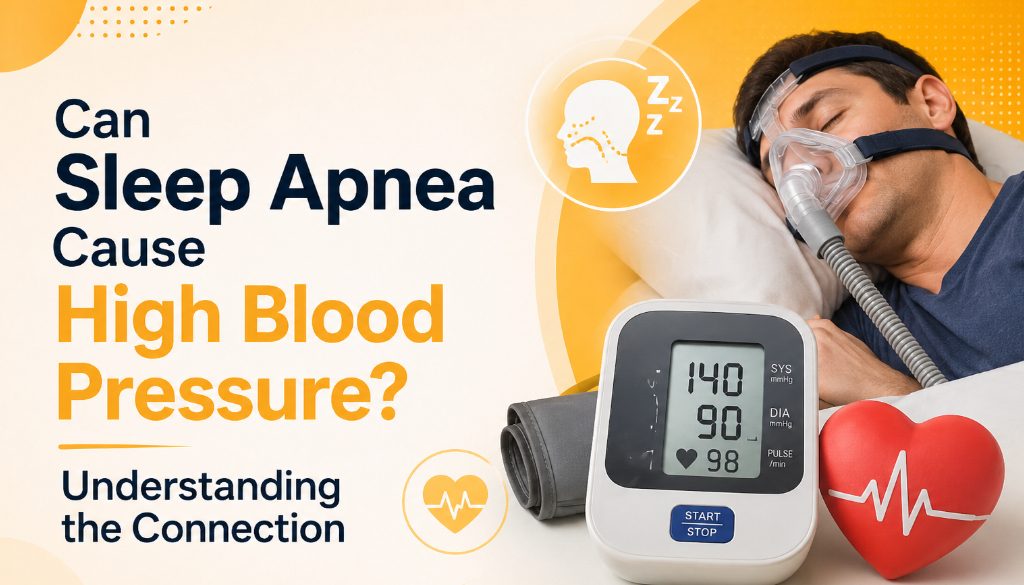
Can Sleep Apnea Cause High Blood Pressure? Understanding the Connection
“When I use my CPAP, my blood pressure is normal the next day.” A sleep physician on why that patient is not imagining it, and what the research actually says.
Paul was a plumbing contractor in his fifties. He did not come to see me because he was tired. He insisted he felt great. He came because his morning blood pressure was dangerously high and would not come down, even on multiple medications.
His home sleep test showed moderate obstructive sleep apnea.
We started CPAP. A month later, his blood pressure read 102/76. Normal is generally around 120/80. His cardiologist began reducing his medications.
For years his doctors had been fighting a battle they could not win, because the real problem was happening at night, while everyone was asleep and no one was watching.
I want to be honest with you up front: Paul’s result was better than most. That is not what happens to everyone, and I will show you the real numbers below. But his story explains something important. If your blood pressure will not behave despite doing everything right, there may be a reason nobody has checked yet.
Can Sleep Apnea Cause High Blood Pressure?
The short answer is yes, sleep apnea contributes to high blood pressure, and the evidence is strong enough that major cardiology guidelines now treat it as an independent risk factor.
The careful answer matters more.
High blood pressure rarely has one single cause. Weight, genetics, salt, alcohol, kidney function, stress, and age all pull on the same rope. Obstructive sleep apnea is one more hand on that rope, and in many people it is the one nobody has identified.
Here is what the research shows:
- Roughly half of people with obstructive sleep apnea also have high blood pressure.
- Roughly three in ten people with high blood pressure have undiagnosed sleep apnea.
- People with untreated obstructive sleep apnea are about twice as likely to develop new high blood pressure over time, independent of other risk factors.
- Among people with resistant hypertension, meaning blood pressure that stays high on three or more medications, the reported prevalence of sleep apnea runs from 60 to 90 percent.
That last number is the one that changes how a doctor thinks. If your pressure will not come down on three drugs, sleep apnea is not a long shot. It is one of the first things worth ruling out.
The 2025 AHA/ACC hypertension guideline now recommends screening for obstructive sleep apnea in patients with resistant or poorly controlled high blood pressure – a critical pathway outlined step-by-step in our comprehensive sleep apnea symptoms, causes, and treatment guide.
How Sleep Apnea Affects Blood Pressure
Picture what is actually happening in your throat at two in the morning.
The muscles that hold your airway open relax. The airway narrows, then closes. You keep trying to breathe. Your chest works harder against a closed door. No air moves.
Your oxygen level starts to fall. Carbon dioxide starts to rise. Your body reads this the way it reads drowning, because physiologically it is not very different. Adrenaline and cortisol surge. Your heart rate jumps. Your blood pressure spikes. Your brain, sensing danger, pulls you up out of deep sleep just long enough for your throat muscles to regain their tone.
You gasp. You start breathing again. You do not remember any of it.
Then it happens again. And again. In severe apnea, it can happen fifty or a hundred times an hour.
Sleep is supposed to be the part of the day when your cardiovascular system rests. Blood pressure normally dips ten to twenty percent overnight. That nightly dip is protective. In untreated sleep apnea, the dip disappears. Doctors call this a non-dipping pattern, and it is associated with worse cardiovascular outcomes on its own.
So the night stops being recovery and becomes a shift your heart has to work.
Why Obstructive Sleep Apnea Is Linked to Hypertension
Four mechanisms do most of the work, and they reinforce each other.
Sympathetic nervous system overdrive. Every apnea event triggers a fight-or-flight surge. Repeat that hundreds of times a night for years and the nervous system stops standing down. The baseline resets higher, including during the day.
Hormonal signaling. Repeated low oxygen activates the renin-angiotensin-aldosterone system, the hormone loop that governs fluid balance and vessel tone. This is the same system most blood pressure medications target, which is part of why sleep apnea can make those medications less effective.
Oxidative stress and inflammation. Oxygen dropping and rebounding all night generates the kind of cellular stress that inflames the inner lining of blood vessels.
Endothelial dysfunction. That inner lining is what allows arteries to relax on demand. When it is damaged, vessels stay stiffer, and pressure runs higher.
None of this is mysterious. It is a mechanical problem in the throat producing a chemical problem in the bloodstream that becomes a pressure problem in the arteries.
I wrote a book about what is on the other side of this diagnosis, and it is not the fear. It is the life. You can read the first chapter free at dryatinjpatel.com/chapter1.
What Are the Signs of Sleep Apnea and High Blood Pressure?
High blood pressure usually announces nothing. Sleep apnea announces itself mostly to whoever sleeps next to you.
Signs worth paying attention to:
- Loud, habitual snoring, especially with pauses (to understand the physical differences between these nighttime events, read our guide on the difference between sleep apnea and snoring
- Someone has witnessed you stop breathing
- Waking with a headache, most often in the first hour of the day
- Waking with a dry mouth or sore throat
- Getting up two or more times a night to urinate
- Daytime sleepiness, especially in the car, in meetings, or in front of the TV
- Trouble concentrating, short fuse, low mood
- Blood pressure that reads highest in the morning
- Blood pressure that will not come down despite medication
That last pair is the combination I want you to notice. Morning readings that run high and pressure that resists treatment are the fingerprints of a problem that happens overnight.
One more thing. The textbook picture of sleep apnea is a heavyset man who snores like a freight train. Plenty of people, and women in particular, do not look like that at all. Their version often shows up as fatigue, insomnia, anxiety, and morning headache rather than thunderous snoring. If that is you and you have been told your tiredness is stress or hormones, a sleep study is still a fair question to ask.
Sleep Apnea and Cardiovascular Health Risks
Blood pressure is the visible part. It sits upstream of the things people actually fear.
Untreated obstructive sleep apnea is linked to roughly double the risk of stroke. In men with the severe form, the Sleep Heart Health Study found nearly four times the risk compared with men without it.
It is also associated with higher rates of atrial fibrillation, heart failure, and coronary disease – underscoring the dangerous, circular risk loop between sleep apnea and heart disease – and, in severe untreated disease, higher all-cause mortality.
I am not telling you this to frighten you. I am telling you because these are the reasons your cardiologist cares, and because every one of these risks traces back to the same nightly event. Fix the breathing, and you address the thing that is driving all of it.
Can Treating Sleep Apnea Help Lower Blood Pressure?
Yes, and here is where I need to be precise with you, because this is where most articles overpromise.
Across the general population of people with sleep apnea, CPAP lowers blood pressure modestly. Meta-analyses of randomized trials put the average around 2 to 5 mm Hg. That is real, but it is not dramatic, and it is not a replacement for blood pressure medication. Guidelines are explicit that medication remains the primary treatment for hypertension in adults with sleep apnea.
But averages hide the people who benefit most. The effect is dose-dependent. Three things predict a bigger drop:
- How severe your apnea is
- How high your starting blood pressure is
- How many hours a night you actually use the machine
In people with resistant hypertension, the picture changes meaningfully. Across randomized trials, systolic reductions of roughly 5 to 7 points and diastolic reductions of roughly 3 to 5 points have been reported. In the HIPARCO-2 study, patients with resistant hypertension who used CPAP at least four hours a night saw nighttime systolic pressure fall about 5.5 points and diastolic about 4.9 points, sustained over roughly five years.
Nighttime pressure is exactly where you want the improvement, because that is the reading that carries the most prognostic weight.
“When I use CPAP, my blood pressure is normal the next day”
A patient said that to me almost word for word. He also said, “My sleep apnea is causing my high blood pressure.” He had worked it out himself, with a home cuff and a few skipped nights.
Patients tell me this often enough that it deserves an explanation, because it seems to contradict the modest averages above.
It does not. The two are measuring different things.
Those 2 to 5 mm Hg figures are averages pooled across everyone with sleep apnea. That includes mild cases, people whose pressure was already normal, and people wearing the machine for three hours before pulling it off. Average all of them together and the number comes out small. It was never meant to predict what happens to one person with moderate or severe apnea, a high starting pressure, and full-night use. Those are the three things that predict a larger drop, and someone who has all three is not the average patient in the study.
There is also a timing difference. A trial reports your office reading or your 24-hour average over months. Your home cuff reports this morning, which is the reading most directly shaped by what your airway did between two and five a.m. Use the machine and the overnight surges stop, the normal nighttime dip returns, and you wake up on the other side of a night your cardiovascular system actually got to rest. Skip it, and the surges come back the same night.
So when a patient tells me his pressure is normal the mornings after he wears it and high the mornings after he does not, I believe him. That is his own body running a controlled experiment, and it is consistent with the mechanism.
One caution, because I have watched people get this wrong. That responsiveness is a reason to use CPAP every single night, not a reason to use it only when a reading runs high. The benefit is not stored. It is earned nightly.
| Approach | What it does | Typical systolic effect |
|---|---|---|
| CPAP alone, general sleep apnea | Opens the airway, ends the nightly surges | About 2 to 5 mm Hg |
| CPAP alone, resistant hypertension | Same, in the group with the most to gain | About 5 to 7 mm Hg |
| CPAP plus meaningful weight loss | Addresses airway and metabolic drivers together | Up to about 8 mm Hg |
| Blood pressure medication | Remains the primary treatment | Varies by agent and dose |
Two honest caveats.
First, current guidelines do not recommend CPAP solely to prevent heart attacks, strokes, or death. The trials have not shown that. CPAP is recommended for sleep apnea itself, for symptoms, and as part of blood pressure management. The cardiovascular benefit signal is strongest in people who genuinely use it, and that is an important distinction rather than a promise.
Second, weight loss matters. Newer medications approved for sleep apnea in adults with obesity produce meaningful blood pressure reductions, and the guidelines now describe weight management alongside CPAP as the combination most likely to move the needle. That is a conversation for you and your physician, not a replacement for treating the airway.
Here is the part I find most encouraging. You do not have to wait years. Researchers at the University of Wisconsin followed forty-seven adults, average age forty-one, through CPAP treatment. Blood pressure and arterial stiffness improved within four weeks. When patients stopped using CPAP for a single week, the gains faded, and their numbers drifted back toward baseline.
Your blood vessels are paying attention every night. Both directions.
How Sleep Apnea Is Diagnosed
Diagnosis is far easier than most people expect, and it no longer requires a night in a lab for most patients.
Screening. Your doctor may use a short questionnaire such as STOP-BANG, which asks about snoring, tiredness, observed apneas, blood pressure, body mass index, age, neck size, and sex.
Home sleep apnea test. For most adults with a high likelihood of moderate-to-severe obstructive sleep apnea and no major heart or lung disease, this is the first step. You sleep in your own bed wearing a small device that records airflow, effort, oxygen, and pulse.
In-lab polysomnography. Recommended when the picture is complicated: heart failure, significant lung disease, neuromuscular conditions, suspected central sleep apnea, or a home test that came back negative in someone with strong symptoms.
The result. You get an apnea-hypopnea index, or AHI, meaning the average number of breathing events per hour. Five to fifteen is mild, fifteen to thirty is moderate, above thirty is severe. Paul was in the moderate range and still had blood pressure his cardiologist could not control.
When Should You See a Doctor?
Bring this up at your next visit if any of the following are true:
- Your blood pressure remains above goal on two or more medications
- Your readings are highest in the morning
- You snore loudly, or someone has seen you stop breathing
- You wake unrefreshed no matter how long you were in bed
- You have atrial fibrillation, heart failure, type 2 diabetes, or a history of stroke
- You are sleepy behind the wheel
The specific sentence to say is simple: “Could my blood pressure be related to my sleep? Should I be tested for sleep apnea?”
Most physicians will take that question seriously. Very few will bring it up first, because a fifteen-minute visit rarely gets to the part of your life that happens at three in the morning.
Frequently Asked Questions
-
Does sleep apnea cause hypertension, or do they just occur together?
Both are true. They share risk factors such as excess weight and age, which is why they travel together. But long-term studies show that people with untreated obstructive sleep apnea go on to develop new high blood pressure at roughly twice the rate, even after accounting for those shared factors. That is why guidelines treat it as an independent contributor rather than a coincidence.
-
Does CPAP lower blood pressure?
-
Can I stop my blood pressure medication if I start CPAP?
-
How fast does it work?
-
How many hours a night do I need to use it?
-
Will losing weight fix it instead?
-
My blood pressure is fine. Should I still get tested?
Conclusion
Sleep apnea is a nightly, mechanical event with cardiovascular consequences that show up on your blood pressure cuff in the morning. It is common, it is frequently missed, and it is highly treatable.
If your pressure will not come down despite doing everything your doctor asked, you may not be failing at treatment. You may be treating the wrong hour of the day.
Paul thought he felt great. What he got back was not just a better number. It was a body that finally got to rest at night, and a cardiologist who started taking pills away instead of adding them.
That is what is on the other side of this. Not a machine on your nightstand. A day that works, because the night finally did.
Read the first chapter of CPAP Is Sexy free at dryatinjpatel.com/chapter1.