Sleep Apnea and Weight Gain: What’s the Connection?
For thirty years, I ran a sleep clinic. Here’s something that still tells the whole story in one line: the number one source of patient referrals to my clinic was the cardiovascular center. Number two was the bariatric center -the weight-loss surgeons – while number one was the cardiovascular center, showing how intimately weight management is bound up with sleep apnea and heart disease.
Think about what that means. Before anyone opened a textbook, the doctors treating the heart and the doctors treating weight were the ones who kept running into the same hidden problem and sending it my way. Sleep apnea sits right in the middle of both.
So if you’ve been fighting your weight and feeling like you’re losing – eating carefully, walking more, and watching the scale barely budge – there may be a reason that has nothing to do with willpower. Some of it is happening while you sleep, in the hours you don’t remember.
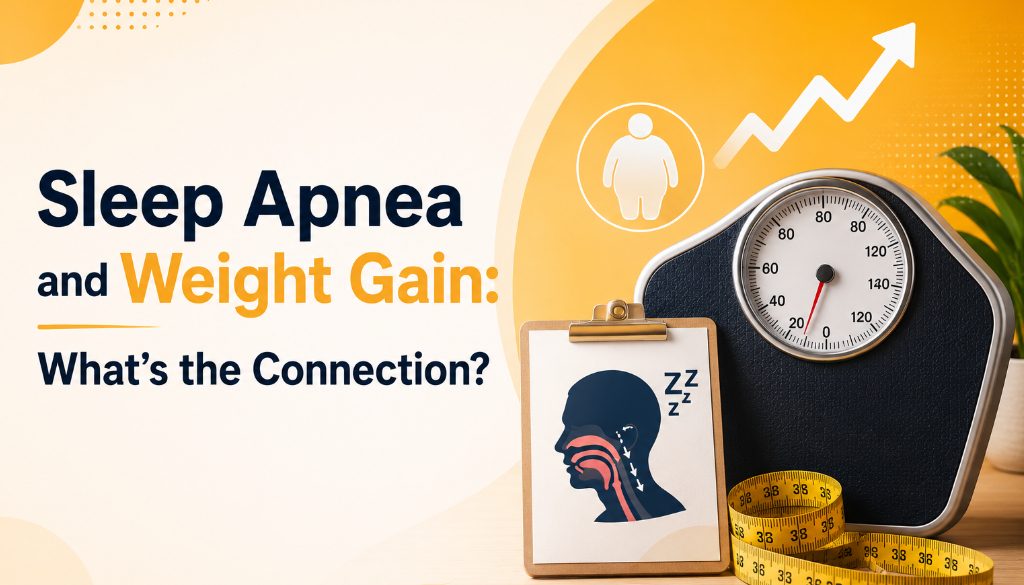
Sleep apnea and weight gain feed each other. Obstructive sleep apnea is a condition in which the airway repeatedly collapses during sleep, disrupting your rest without fully waking you – and you can find a comprehensive breakdown of this cycle in our sleep apnea symptoms, causes, and treatment guide. Extra weight is the single biggest changeable risk factor for it. And once you have it, sleep apnea makes losing weight harder – and can quietly push it in the wrong direction. It runs in both directions, which is exactly why so many people feel stuck.
Understanding that loop is the first step to breaking it. Let me walk you through it the way I would across the desk.
How Sleep Apnea Affects Metabolism
When your breathing stops and restarts over and over through the night, two things happen: your oxygen dips (doctors call it intermittent hypoxia), and your sleep fragments into hundreds of tiny arousals. You don’t feel them individually. You feel them as a foggy, heavy morning. But underneath, your metabolism is taking the hit.
Here’s what that low-oxygen, broken sleep is linked to:
- Insulin resistance. The dips in oxygen and the fragmented sleep make it harder for your body to use insulin, which pushes blood sugar up and raises the risk of type 2 diabetes.
- Low-grade inflammation. Untreated apnea is associated with chronic inflammation that interferes with normal metabolism
- A shift in how you burn and store fuel. The nightly stress of untreated apnea appears to change the way the body handles calories, which makes weight harder to manage.
- Fatty liver changes. The repeated oxygen drops are linked to non-alcoholic fatty liver disease, another drag on metabolism.
These changes can show up even in people who aren’t heavy, though they tend to be stronger when obesity is in the picture. The point I want you to take from this: your metabolism isn’t broken because you’re lazy. It may be working against a headwind you can’t see.
Can Weight Gain Worsen Sleep Apnea?
Yes – and the effect is bigger than most people expect, changing simple nighttime noise into a dangerous airway collapse (which is the primary difference between sleep apnea and snoring). Fat inside the tongue and throat narrows the opening. Fat around the middle presses on the lungs and changes the mechanics of every breath.
The numbers are striking. In a long-running study that followed the same people over the years, a 10% weight gain predicted roughly a 32% increase in the apnea-hypopnea index – the count of times your breathing stops or slows each hour. That same 10% gain raised the odds of developing moderate-to-severe apnea about sixfold.
A few markers worth knowing:
One important caveat, because I don’t want anyone to walk away with the wrong picture: sleep apnea is not only a condition of larger bodies. Plenty of people with a normal BMI have it, driven by jaw structure, large tonsils, or a chronically stuffed nose. Weight is the most common lever. It isn’t the only one.
The Sleep and Hormone Connection
This is the part that surprises people. Sleep apnea disrupts the hormones that govern hunger, fullness, and stress – and it does it in a direction that favors weight gain.
- Leptin tells you you’re full. In sleep apnea, leptin often runs high, but the body stops responding to it, so the “I’ve had enough” signal doesn’t land.
- Ghrelin tells you you’re hungry. Poor sleep and apnea are associated with higher ghrelin levels, which means greater appetite and a stronger pull toward high-calorie foods, usually late.
- Cortisol, the stress hormone, tends to run high when your oxygen drops all night. Elevated cortisol favors fat storage around the middle.
- Every apnea event triggers a small adrenaline surge. Night after night, that chronic stress response is linked to higher blood pressure and more insulin resistance
Put those together, and you get the loop I mentioned at the top: the apnea disrupts the hormones that control appetite and metabolism, which makes weight climb, and the added weight makes the apnea worse. It’s a cycle. But a cycle has a place where you can break in.
Before we get to that – if this is starting to sound like your last few years, I wrote the first chapter of my book CPAP Is Sexy to walk you through what sound sleep gives back: the energy, the presence, and the person you remember being. You can read it free at dryatinjpatel.com/chapter1.
Can Weight Loss Improve Sleep Apnea?
Absolutely – and here’s the encouraging part. There’s no minimum amount of weight you have to lose before you see any benefit. Even modest loss helps, and more loss tends to help more.
What the research shows:
- In the same long-term study, a 10% weight loss predicted about a 26% drop in the apnea-hypopnea index. The airway rewards you for going the other direction.
- In a large randomized trial, a lifestyle program that produced around 11 kilograms (roughly 24 pounds) of weight loss cut breathing events by nearly 10 per hour – and the people who lost 10 kilograms or more saw the biggest improvement. More than three times as many of them reached full remission of their apnea compared with the group that didn’t lose the weight.
- In milder apnea, sustained weight loss resolves the problem entirely for a meaningful share of people.
Two honest qualifiers. For moderate-to-severe apnea, weight loss improves things but often doesn’t erase them, so treatment like CPAP may still be needed. And exercise appears to help on its own – studies show regular aerobic activity can lower apnea severity even without much change on the scale. Movement is worth it whether or not the weight moves.
Sleep apnea is highly treatable. That’s the through-line here.
Treatment Options
Effective treatment usually combines a few of these, matched to you.
One honest note on CPAP, because patients ask. CPAP treats breathing issues beautifully, but it is not a weight-loss device – a few studies have found a small weight change of about a kilogram on CPAP, likely a gain in lean mass rather than fat. That’s not a reason to skip it. It’s a reason to pair it with movement and good eating, so both sides of the loop get addressed at once.
Lifestyle Tips
Alongside medical treatment, these help both the sleep and the weight:
- Treat the breathing first. Poor sleep drives weight gain through those same hormones, so getting your apnea handled is the foundation on which everything else stands.
- Protect 7 to 9 hours. Not just time in bed – real, restored sleep.
- Move most days – brisk walking, swimming, or cycling. Even one to two hours of vigorous activity per week is associated with a lower risk.
- Eat mostly whole foods, and keep large meals away from bedtime.
- Drink earlier, not later. Alcohol relaxes the airway that already collapses, so an evening nightcap worsens apnea that night. If you drink, drink early.
- Skip sedatives that further relax the airway. Talk to your doctor about anything that makes you drowsy at night.
- Track it. If you’re on CPAP, consistency is everything – the more nights you use it, the more you get back. Review your numbers with your clinician over time.
Frequently Asked Questions
-
Does sleep apnea directly cause weight gain?
It’s more accurate to say it creates the conditions for it – more hunger, less energy to move, and a metabolism working against you. It may not add pounds in every person, but it reliably makes losing them harder.
-
Will losing weight cure my sleep apnea?
-
Can I stop using CPAP if I lose weight?
-
Are there medications that treat both obesity and sleep apnea?
-
Does CPAP help with weight loss?
Conclusion
Sleep apnea and weight gain pull on each other in a loop that can feel impossible from the inside. Extra weight narrows the airway; the apnea then disrupts the hormones and metabolism that govern your weight. But a loop has an entry point. Treat the breathing, take the weight down even modestly, and the whole cycle starts turning the other way – better energy, steadier metabolism, and the strength to keep going.
If you suspect you have sleep apnea, or you’re doing everything right and the weight still won’t move, talk to your doctor and get evaluated. Addressing both together gives you the best shot at lasting change.
And if any of this sounds like you, start with the first chapter – it’s free. Download it at dryatinjpatel.com/chapter1, and see what’s waiting on the other side of a good night’s sleep.
References:
- Peppard PE, Young T, Palta M, Dempsey J, Skatrud J. Longitudinal study of moderate weight change and sleep-disordered breathing. JAMA. 2000;284(23):3015-3021.
- Veasey SC, Rosen IM. Obstructive sleep apnea in adults. N Engl J Med. 2019;380(15):1442-1449
- Shechter A. Obstructive sleep apnea and energy balance regulation: a systematic review. Sleep Med Rev. 2017;34:59-69.
- Gottlieb DJ, Punjabi NM. Diagnosis and management of obstructive sleep apnea: a review. JAMA. 2020;323(14):1389-1400.
- Malhotra A, Grunstein RR, Fietze I, et al. Tirzepatide for the treatment of obstructive sleep apnea and obesity. N Engl J Med. 2024;391(13):1193-1205.
- Tasali E, Pamidi S, Covassin N, Somers VK. Obstructive sleep apnea and cardiometabolic disease: obesity, hypertension, and diabetes. Circ Res. 2025;137(5):764-787
- Hoyos CM, Murugan SM, Melehan KL, et al. Dose-dependent effects of CPAP for sleep apnea on weight or metabolic function: individual patient-level meta-analysis. J Sleep Res. 2019;28(5):e12788